Hemden, Bocholt (Germany)
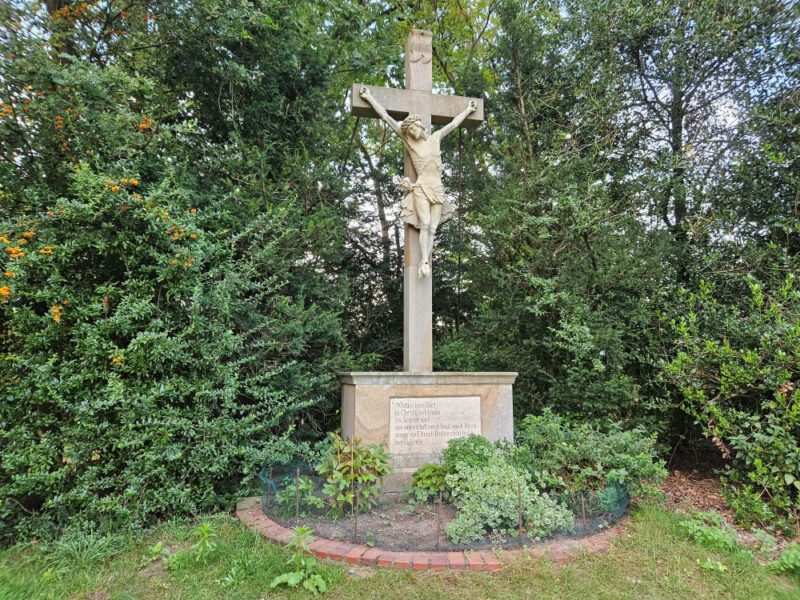
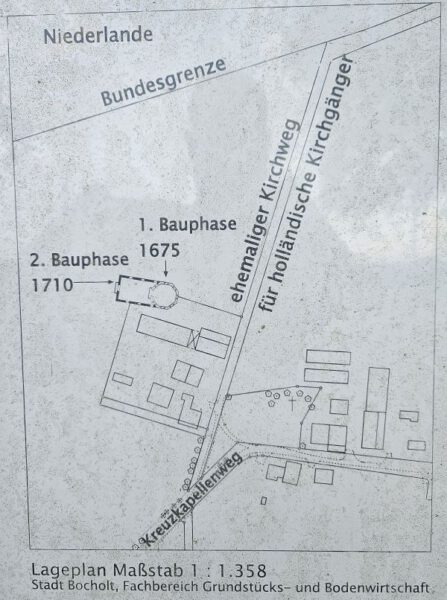
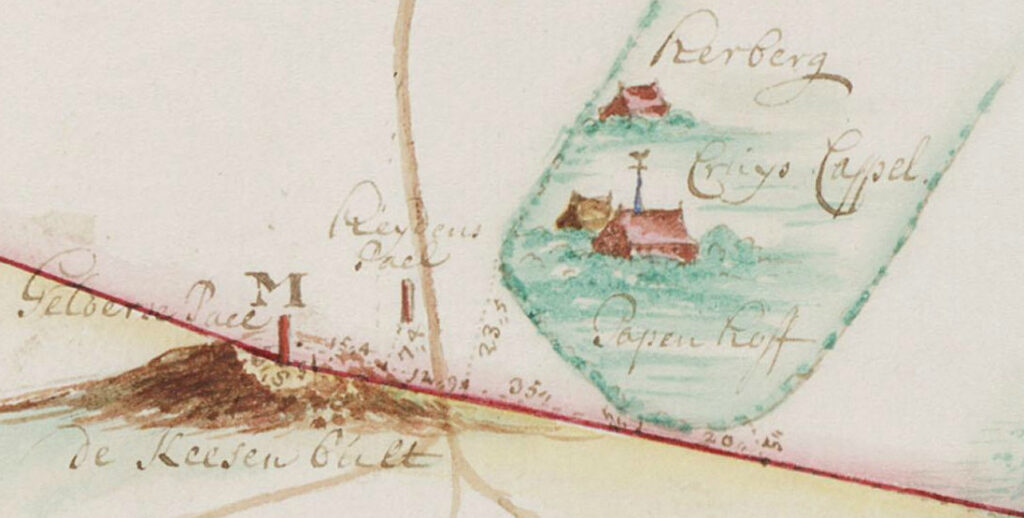
The ‘Kruiskapel’ (Cross Chapel, or German: ‘Kreuzkapelle’) in Hemden was a ‘refuge chapel’ for the Catholics of Aalten and Bredevoort. During the height of Calvinism (1675–1821), they were forbidden from practising their faith in their home region. The chapel stood in the German village of Hemden, two hundred metres beyond the current ‘green’ border near the Kesenbult, at the end of the Kiefteweg.
Missionary Outpost
From 1672 to 1674, Christoph Bernhard von Galen, the Prince-Bishop of Münster (1650–1678), waged war against the Dutch Republic, supported by King Louis XIV of France. Von Galen, nicknamed ‘Bommen Berend’ (‘Bombing Bernard’), was forced to withdraw from Dutch territories following the Peace of Cologne in April 1674. However, the Catholics remaining in the area were still prohibited from owning their own churches or holding religious services. To provide the Catholics of Aalten and Bredevoort with the opportunity to practise their faith, Von Galen ordered the construction of nine missionary outposts along the border, one of which was the Cross Chapel in Hemden.
Construction of the Cross Chapel
Initially, Catholic services in Hemden were held in a barn on the Leicking estate, which had been converted into a house of prayer. In 1675, by order of Von Galen, the Cross Chapel was built on the Reyerding estate. The chapel, dedicated to the Holy Cross, was constructed under the leadership of Jesuit Father Ernst Ignatius Busch, who served as the parish priest for the Aalten and Bredevoort congregations from 1672 to 1674.
The chapel was an octagonal, largely wooden structure and became the religious centre for the exiled Catholics of Aalten and Bredevoort. Between 1710 and 1714, the chapel was restored and enlarged into a rectangular shape.
The ‘Kruisberg’ (Cross Hill)
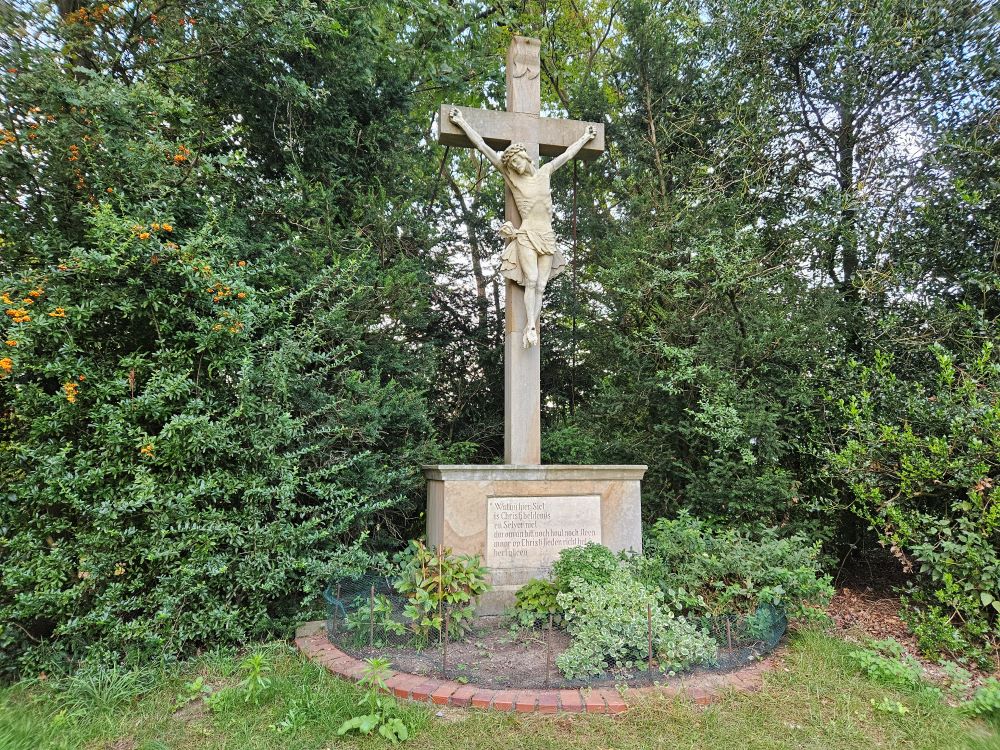
Around the same time, the ‘Kruisberg’—a small hill—was created near the chapel, upon which a cross was placed. This cross faced the chapel and stood on a pedestal bearing the following inscription (translated from the Middle Dutch):
What you see here is an image of Christ and not He Himself,
therefore, worship neither wood nor stone,
but direct your heart only to Christ.
This inscription was intended to refute the Protestant accusations of the Reformation era that Catholics were worshipping idols through their figurative representations of Christ and the saints.
Church Life
By 1751, the parish of the Cross Chapel numbered approximately 27 German and 451 Dutch Catholics. Every Sunday, on Catholic feast days, and for family events such as baptisms and weddings, the Catholics from Aalten and Bredevoort made the journey to the chapel, often via the present-day Bodendijk and Veenhuisweg. According to local tradition, the worshippers travelled in their work clothes and carried their tools with them so as not to draw attention as churchgoers.
Transcriptions of the baptismal and marriage registers of the Cross Chapel are available on the Genealogiedomein website and are valuable sources for genealogical research.
The Restoration of Catholicism in the Netherlands
From 1798, the people of Bredevoort, and from 1799 those of Aalten, were once again granted the right to practise the Catholic faith freely in their own country. They established their own churches in Bredevoort and Aalten, which led to a decline in the number of Dutch visitors to the Cross Chapel. By 1800, only a few German believers remained, mostly attending on Sundays and feast days.
In 1821, Pope Pius VII decreed that the parishes of Aalten, Bredevoort, and other surrounding areas were to be assigned to the ‘Dutch Mission’. As a result, only five German families remained as members of the Hemden parish. The Cross Chapel had thereby lost its original purpose.
The End of the Cross Chapel
On 16 July 1821, Pope Pius VII formally declared the separation of the Dutch Catholics. Two years later, in 1823, the Cross Chapel was demolished. The parish was dissolved and relocated to the nearby Bocholt rural district of Barlo, a few kilometres south-east of Hemden. All that remains today to commemorate the chapel is the Kruisberg, with its Baroque cross and a stone memorial plaque.
In total, seven parish priests served at the Cross Chapel. Although the chapel itself has vanished, the Kruisberg and its cross remain as a reminder of the religious life of the Catholics from Aalten and Bredevoort during a time of oppression and persecution.
Features
| Function | Roman Catholic refuge chapel |
| Year of construction | 1675 |
| Demolition | 1823 |