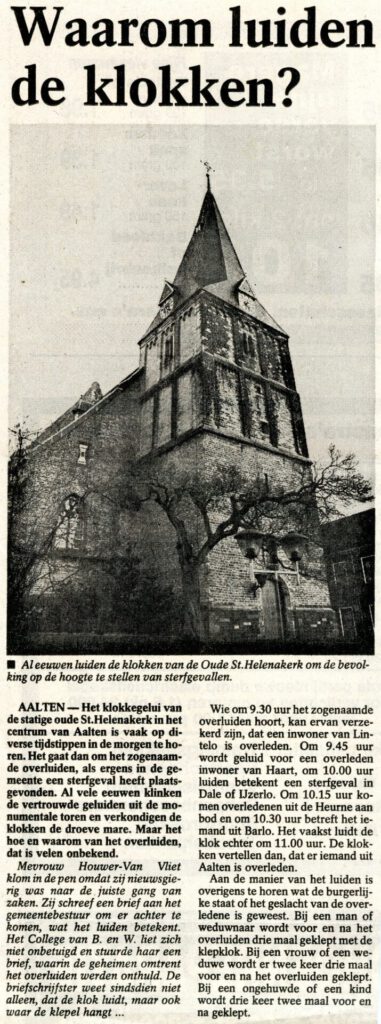
For centuries, the bells of the Oude Sint Helenakerk in Aalten have tolled to inform the population of deaths, the so-called ‘overluiden’.
It frequently occurs that the bells of the Oude Helenakerk are tolled at various times in the morning. In the past, this happened more often than it does today. In former times, almost everyone knew what this signified. Based on the time and the number of strokes, people could deduce in which rural district someone had died, as well as whether it was a child, a woman, or a man, and whether the deceased was married or unmarried.
The custom of tolling the bells when a death has occurred is called ‘overluiden’. For many centuries, the sound of bells has emanated from the monumental tower of the church on weekdays. Many people pause for a moment and think: memento mori.
The bells of the Oude Helenakerk on the Market Square in Aalten are still used for this solemn moment, always in consultation with the next of kin. The ‘overluiden’ can be performed for all deceased persons, not just for members of the Protestant Congregation.
Meaning
If the bells are tolled at 9:30 AM, it concerns a resident of the rural district of Lintelo. If it occurs at 9:45 AM, someone from de Haart has passed away. At 10:00 AM, the bells toll for a death in Dale or IJzerlo, and at 10:15 AM for someone from the Aaltense Heurne. If it concerns someone from Barlo, the time is 10:30 AM. Often the bells toll at 11:00 AM, which signifies the ‘overluiden’ of a deceased person from the village of Aalten.
For a man or widower, the clapper bell is struck three times before and after the tolling. For a woman or widow, the clapper bell is struck twice three times before and after the tolling. For an unmarried person or a child, this occurs three times twice before and after the tolling.