
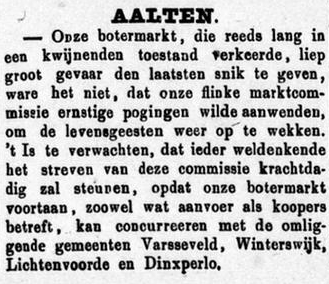
In 1937, G.H. Rots described how life used to be in Aalten in a series of articles. Among other topics, he devoted a section to the traditional farming life of the past.
“The rural districts of Aalten formed an inseparable whole with the village. The villagers needed the farmer, and conversely, the farmers of the rural districts sought contact with the villagers. The roads were far from good, and due to the narrow wheel rims, the sandy paths had much to endure. Water drainage was poorly regulated, and maintenance left much to be desired. And yet those roads had to be used at the cost of much horse and ox flesh. For most farmers formerly kept oxen, which were used as draft animals for the wagons and carts. Progress was made at a slow pace: if I do not arrive today, then tomorrow; slow but steady, for the ox was a strong draft animal. After serving as a draft animal for several years, it was led to the slaughterhouse.”
Primitive
“The entire farming operation was, of course, primitive; there was no chemical fertilizer, resulting in much lower soil yields. Group stables were unknown, and chicken coops did not exist ‘on the farm.’ The chickens spent the nights with the cows in the stable. Some poles had been installed there, and the entire flock of poultry would trot up the ‘chicken rack’ in the evening. And when the days were short, they hardly ever came down. Egg production occurred only in the summer, and even then not in great quantities. The cattle also did not look as flourishing as they do today. One had to feed what one’s own soil produced. Everything was ‘pro rata,’ in proportion, but much less and less productive than nowadays.”
Butter factories did not exist; the milk was soured in cream pots and churned by hand. On some farms, that chore was performed by a dog. The churning dog had to walk in a large wheel, which set it in motion, and via an axle connection, it moved the churning mechanism. The kneaded butter was shaped into ‘welters,’ and then the housewife would take it to the market. In Aalten, the butter market was behind the Town Hall. However, this market did not enjoy a flourishing period, as the shopkeeper was also a willing buyer. With a closed purse, one could then buy groceries, and large suppliers received cash in addition. The eggs also brought in some money, but as mentioned, production was not that large.”
‘Koojonges’
“Many small farmers went to work for daily wages, and some also had a weaving room where a bit was earned. Everything, of course, had to be performed by manual labor; machines were unknown. Every farmer (who was not a day laborer) therefore had at least one head farmhand and a ‘cow boy.’ And those ‘cow boys’ usually came from the village.”
It was the custom that boys from working-class families, before learning a trade or craft, first went to ‘the farmer’ for a few years. Working-class families in the village were usually quite blessed with children, and when a boy was 10 or 11 years old, he had to go to ‘the farmer’ for ‘room and board.’ It was then said: “then he will learn decency immediately.” In any case, the boys learned the first principles of the farming business, which served them well in later life.
For full-fledged farmhands and maidservants, the wages were also not very high. Thirty or fifty guilders per year, but they would occasionally receive clothing as well. A few shirts, a few ‘brunten’ (a type of apron), wooden shoes, and some other necessities. That was the entire wage of the maidservant. In the spring they had a holiday, the so-called ‘spinning week.’ Then they would spend a week at home with their mother. The wages of the farmhands were slightly higher, but still very low by modern standards. And do not count on having much free time or short days. We already mentioned that the threshing flail had to be taken up as early as four o’clock in the morning.”
Nutrition
“For their own nutrition, more was enjoyed from the farm than is the case today. In the first place, everyone grew a quantity of buckwheat. Buckwheat flour was suitable for pancakes. And invariably, pancakes were baked every morning, usually with a ‘slice of bacon’ in them. The cooking oil was also a product of their own cultivation. The rapeseed was taken to the oil miller, and a few large jars of rapeseed oil and a number of rapeseed cakes were collected again a few weeks later. The cakes were excellent cattle feed, a treat for freshly calved cows.”
The food was otherwise as simple as possible, yet nutritious. Home-baked bread, for many farmers had their own baking oven and baked their own bread. The only delicacy was ‘rice porridge with brown sugar,’ usually a meal for Sunday evenings or when visitors came. A large bowl full of ‘rice porridge’ was placed in the middle of the table. Every person sitting at the table received a spoon, and then the eating began. Decency required that one dip the spoon shallowly into the firm porridge, so as not to give the impression that one was after the tastiest top layer with brown sugar. If someone was nevertheless so bold, people would soon think: “He is also mowing the sods.” Eating eggs was done only on Easter Sunday. Then sometimes more were consumed than was good for the stomach.”
Harvest
“When the harvest was in and the potatoes were dug, there was reason for joy; then a domestic party was arranged and they had ‘stubble-end.’ This party was limited to the household members and workers who had assisted with the harvest. That the farming industry had to contend with economic difficulties is evident from the fact that many families sold their farms and sought a new existence in the New World in America. With a few exceptions, none have returned, and they have achieved greater prosperity in their new fatherland.”
Land prices were low here, and especially wild land was not expensive. For a hundred guilders per hectare, one could already buy wild land, for there were plenty of forests and heathlands, and where there are now lush meadows and excellent farmland, there were formerly vast forests, heathlands, and wild land. The rural district of Haart in particular was very heavily forested.”
When chemical fertilizer made its entry into the farming business, a turn for the better occurred. Wild lands were reclaimed, forests were cleared, water drainage was better regulated, and numerous workers found employment in the reclamation and cultivation of wild lands. The livestock population increased, the quality of the cattle improved, agricultural courses gave tips and instructions for effective fertilization, and one new farm after another was built. Old-fashioned stables were changed, and nowadays the building style of a farm is quite different from before.”
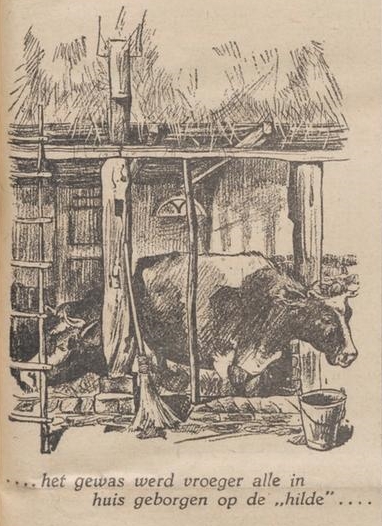
The crops were formerly all stored indoors, ‘on the beams’ and ‘on the loft,’ while now ‘stack heaps’ can be seen everywhere, sheltering the harvest. Among the villagers, too, there was a change in economic and social relations, and agriculture was practiced less. Manure piles had to be cleared away, modern industry arrived, and gradually conditions became more modern.”
Moving house
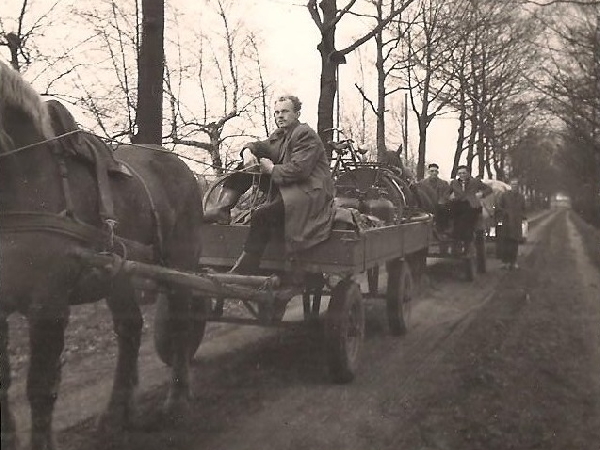
“On the rare occasion that a farmer moved, this took place on ‘Saint Peter’s Day,’ February 22nd. All belongings were loaded onto the neighbors’ wagons, and the entire procession moved from the old house to the new or different farmstead. The neighbor women had already gone ahead to the new home, had cleaned it, and had lit the fire. In the local dialect, this was called ‘vuur beün’ (preparing the fire).”
When the new residents arrived, the coffee was already brewed, and the newcomers could immediately refresh themselves with a nice cup of coffee. The neighbors helped that day; one dropped something here, another there; it was a colossal bustle. As a crowning touch, the ‘moving-in meal’ followed later, which again did not lack for spirited drinks.”
Deaths
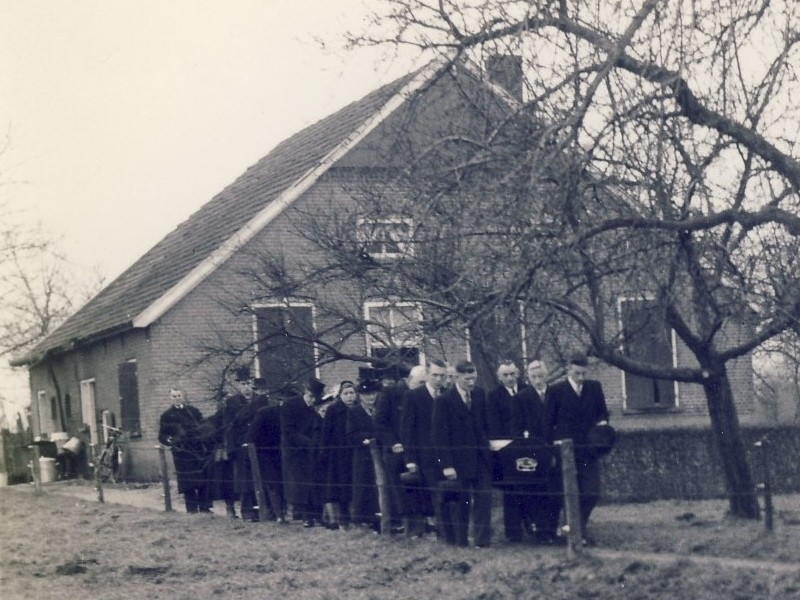
“In the event of a death, the neighbors were immediately notified; the neighbor women laid out the corpse, which was so-called ‘verhaenekleed’ (shrouded). The nearest neighbors then acted as the primary representatives of the residents. The nearest neighbor woman took over the tasks of the housewife, and the neighbor man those of the master of the house. These customs were the same among the villagers, and even now in the rural districts, that old custom is maintained.”
In the past, there was the so-called ‘funeral beer.’ After the funeral, the residents of the rural district went to one or another café in the village. There they rested from the tiring journey and beer was served. Generally, that beer was not of the very best quality in the past, and it was a sort of brown liquid that one was given to drink. In that café, they took leave of one another and everyone went their own way.”
The funeral procession of the local residents consisted of the cart on which the corpse was transported. This was uncovered. Then followed a number of “canvas carts,” high carts with white hoods. If there was a death in the village, one of the neighbors had to go around the ‘rot’ (neighborhood group) in the morning to warn the people that they ‘had to come to load at eleven o’clock.’ It was usually quite busy there at eleven o’clock, for it was the custom that the ‘nearest neighbor’ went around with the ‘bottle.’ The corpse was carried from the house of the deceased to the cemetery by the neighbors, and again gin was involved, for the pallbearers were given a restorative beforehand.”
Visit
“In the month of May, there were many farm visits. Then friends, family, and acquaintances were invited, and the farmsteads swarmed with visitors. The lands were inspected, the livestock criticized; it was more like a small-scale exhibition. These visits were also always held whenever something had been built. The building material had been fetched by the “neighbors” from the brickworks or storage sites, and a party crowned it all. That neighborly help was something traditional and was also indispensable; people supported each other mutually. Together, they performed what one could not manage alone, and especially during family events, neighborly help was indispensable.”
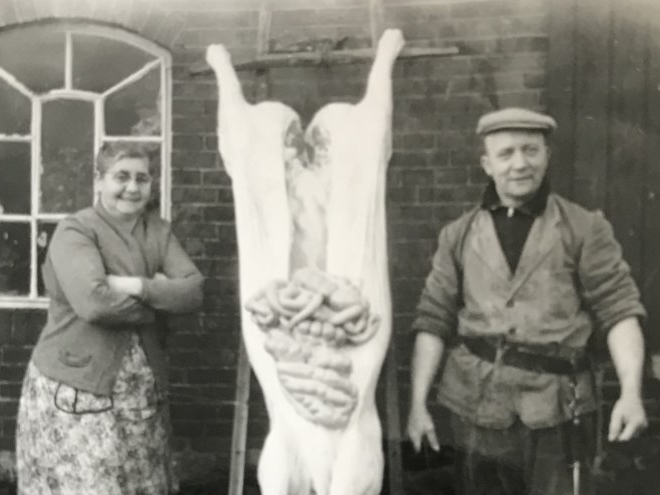
“During the long winter evenings, people often went on neighborhood visits, and the slaughter visits were also a real night out for the residents of the rural districts. The large sod fire (sods were light peats, the top layer of a peat layer) spread a pleasant warmth when one sat close to it, and then the master of the house sat with his chair tilted back before one side of the mantelpiece, and the neighbor before the other. The conversation then concerned the business, the cows, and the pigs. The visitors smoked for free, and when the pipe had to be lit, a glowing coal was taken from the fire with the tongs.”
The depression in the hearth plate, where the actual heart of the fire was located, was called ‘rake’ or ‘vuurrake.’ The ‘blowpipe,’ the tongs, and the fire spoon were the tools that hung beside the fire. Above the fire, a large chimney breast was built out, which served as a smoke catcher. It was also the storage place for everything one wanted to keep dry, including the gunpowder and the powder horn, for every farmer had a gun, a muzzle-loader, which had to be loaded with powder. Poaching was in the farmer’s blood. He would occasionally outsmart a hare or a rabbit.”
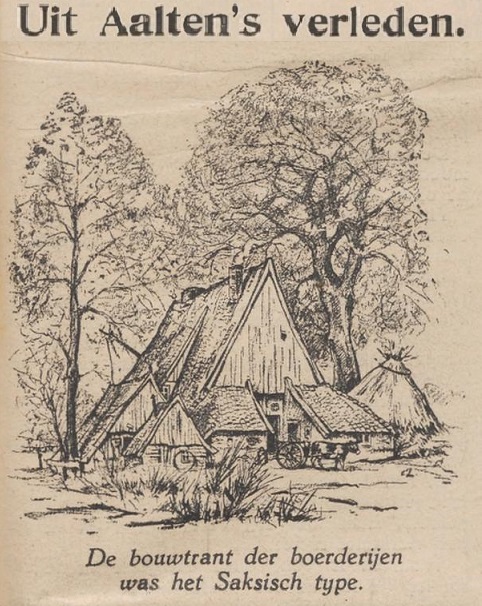
The architectural style of the old farms was the Saxon type. In very old houses, the living space for humans and animals was not separated. In most, there was a partition wall, sometimes of stone, sometimes of so-called ‘wand,’ a wickerwork of wood, plastered with loam on both sides. The box beds were mostly all installed in the kitchen, and one can imagine the situations that arose as a result.”
When clothes had to be mended or made new, the tailor from the village came to the house to perform those tasks, and in the evening he would clatter back to the village with the pressing iron and the pressing board in his hands. When May arrived, the farmer could earn an extra income by peeling wood. Around the fields were wooded banks on which oak coppice was grown. When this wood had reached a thickness of approx. 5 cm, it was cut, and because it was ‘in sap’ in May, it was peeled, i.e., stripped of its bark. The wood was chopped to a length of about 1 meter, and then it was laid over another piece of wood and beaten until the bark or crust came loose. The bark was dried and taken to tanneries, where it was processed into tannin. The wood that remained was called ‘schelhout’ (peeled wood) and was a very popular fuel.”
Another resource to increase income was the burning of charcoal. Some had acquired skill in this, and these charcoal burners had their customers everywhere. In the autumn, the farmers moved with the cattle to the fields. Entire fields were overgrown with spurrey, a crop sown after the rye. The cattle were put on the ‘tether’: a pole was driven into the ground, to which a wooden pole with an iron bracket was attached, and fastened to the cow chain or rope. The cattle could then graze a certain section, and each time the cattle had to be ‘tethered further.’”
Market
“When it was market day, people went to the market; if there was livestock to be sold, it was transported to the market, for cattle trading only happened at the market. The Aalten cattle market was therefore very well attended. People became informed about the prices of oxen and other cattle; they heard all sorts of news at the market, which in turn provided subject matter for conversation in the domestic circle.”
The annual fairs were the major event in the life of the population. First there was the May market, in the autumn the Fair, and on December 6th the Saint Nicholas market. Then it was a bustle of great importance in the village. In the morning, the married couples went from home to the market. The cattle market was overcrowded, and in the inner market, there was no lack of stalls and sellers of all kinds of household items. Well-known figures were the quacks who sold herbs, which were said to cure most diseases. The tooth-pullers also usually had good business.”
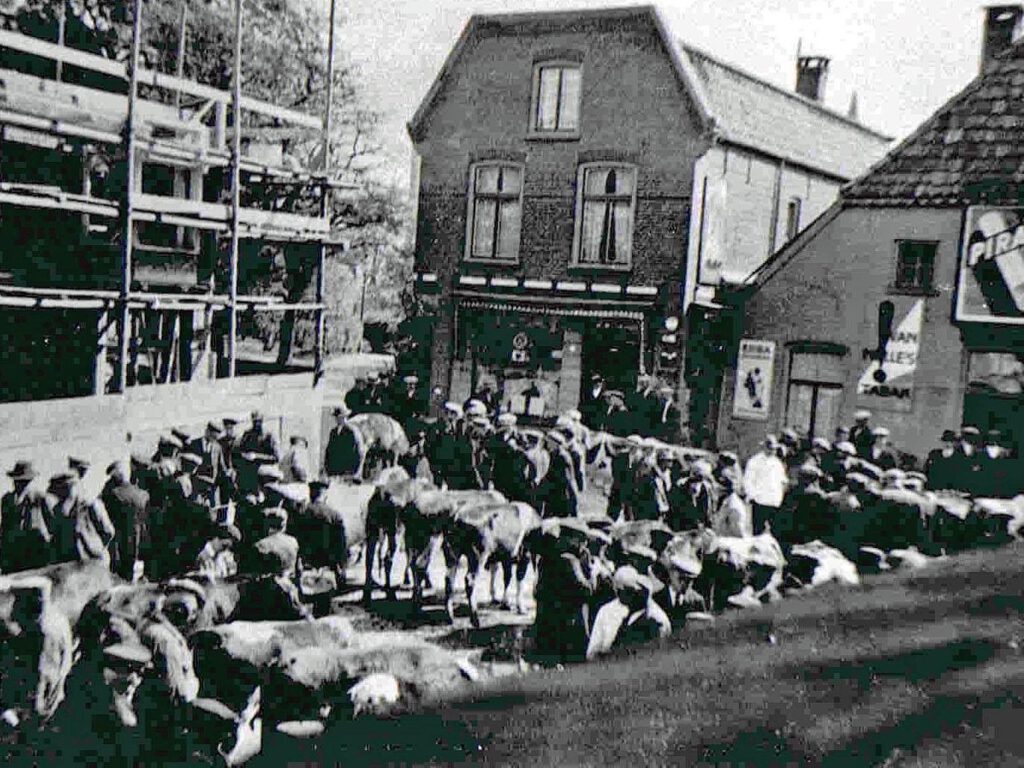
At those annual fairs, there was dance music in most inns. The young people went to the market in the afternoon. The farm girls first strolled past the stalls, bought something to their liking, and finally grouped together. Then the boys appeared, and they tried to find each other to go out this evening. Some had already made appointments beforehand. These ‘had the sods dry already,’ for in the local dialect, if one had someone’s promise to celebrate the annual fair together, it was said: ‘then one had the sods dry.’ When it was nine o’clock in the evening, and there were still girls who received no proposal, then the chance for them was gone and they had to return home alone. Thus the first marriage bonds were often formed, and the first meeting at the annual fair was decisive for their entire lives.”