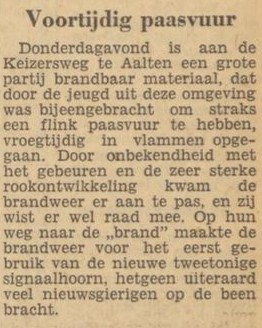
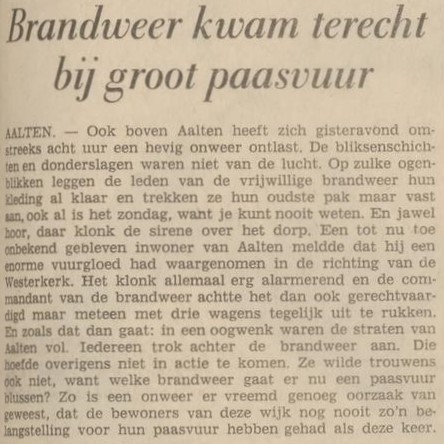
An Easter bonfire is a type of bonfire lit during Easter in parts of Europe. For this purpose, wood is collected and placed in a large pile, which is sometimes dozens of meters high. As darkness falls, the entire stack is set ablaze.
The spectacle often attracts many spectators and is usually a true community event. Originally, it was a Germanic festival dedicated to Ostara, the goddess of spring. After Christianization, the tradition was given a Christian interpretation.
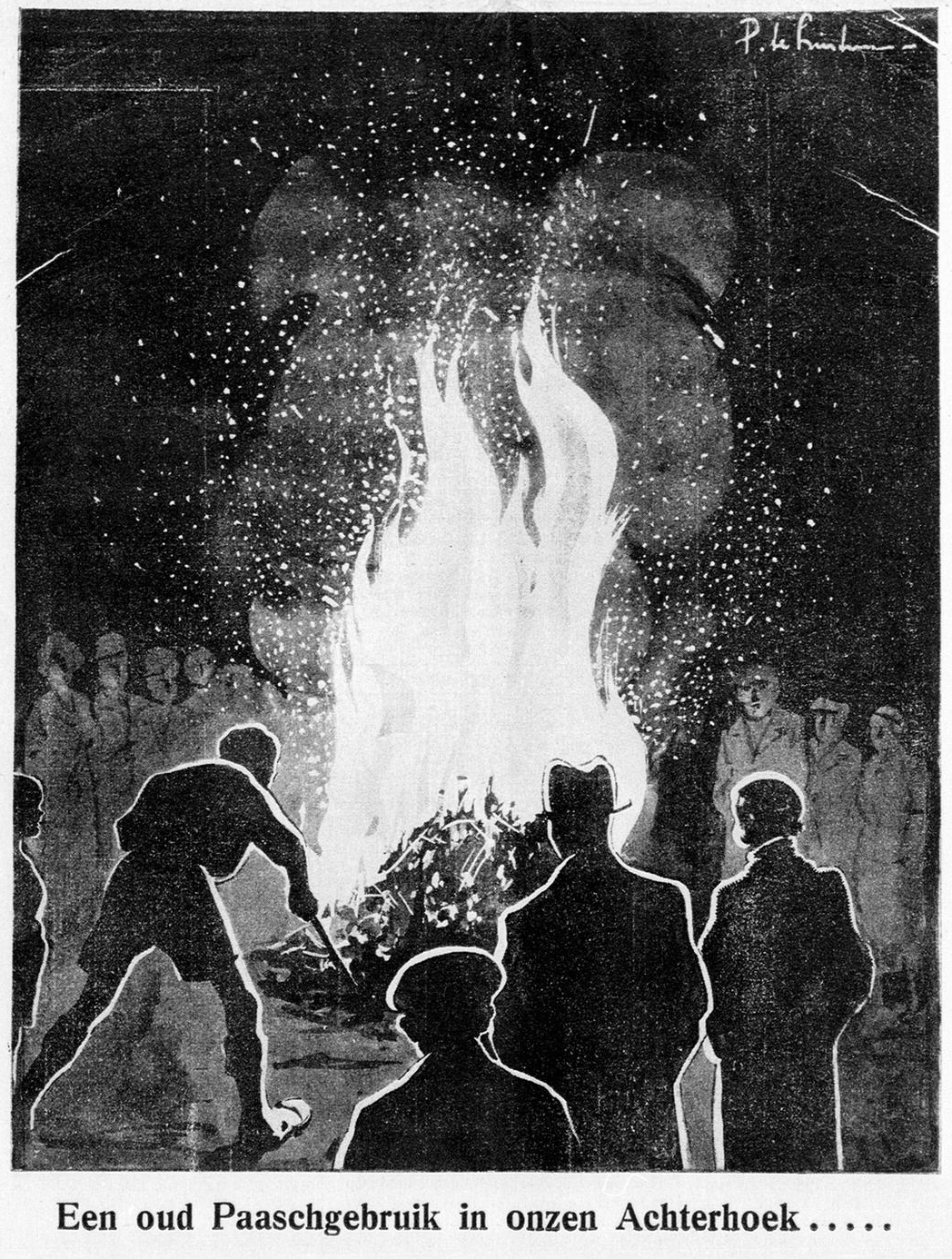
Easter Bonfire in Aalten
G.H. Rots described the Aalten Easter bonfire tradition in 1937 as follows:
“Every spring as Easter approached, the boys from a ‘rot‘ (= district/neighborhood) gathered to discuss plans for the ‘Easter fire.’ They appointed a board, in which the treasurer in particular played a significant role.
They went from house to house to ask if people had anything left for the Easter fire. Those who had no wood usually offered a small contribution in hard cash, forming a ‘fund.’ The treasurer had to manage this fund, which could sometimes amount to thirty cents. It occasionally happened that the treasurer used the fund, or part of it, for his own purposes. Then there was trouble brewing. Sometimes heavy fighting broke out, and mutual quarrels were the order of the day.
But the end of the story was always: there was an Easter fire. Every district had such a fire, and it was all about who had the largest one. It was not uncommon for one group of boys to head out late at night to hijack wood from another group and supplement their own supply with it.
The fire was lit on Easter Sunday. In the middle was a pole, above which a tar barrel was hung, causing the fire to flare up high. And so, one could see several fires burning around Aalten, a spectacle that had numerous onlookers.”
Palm Sunday
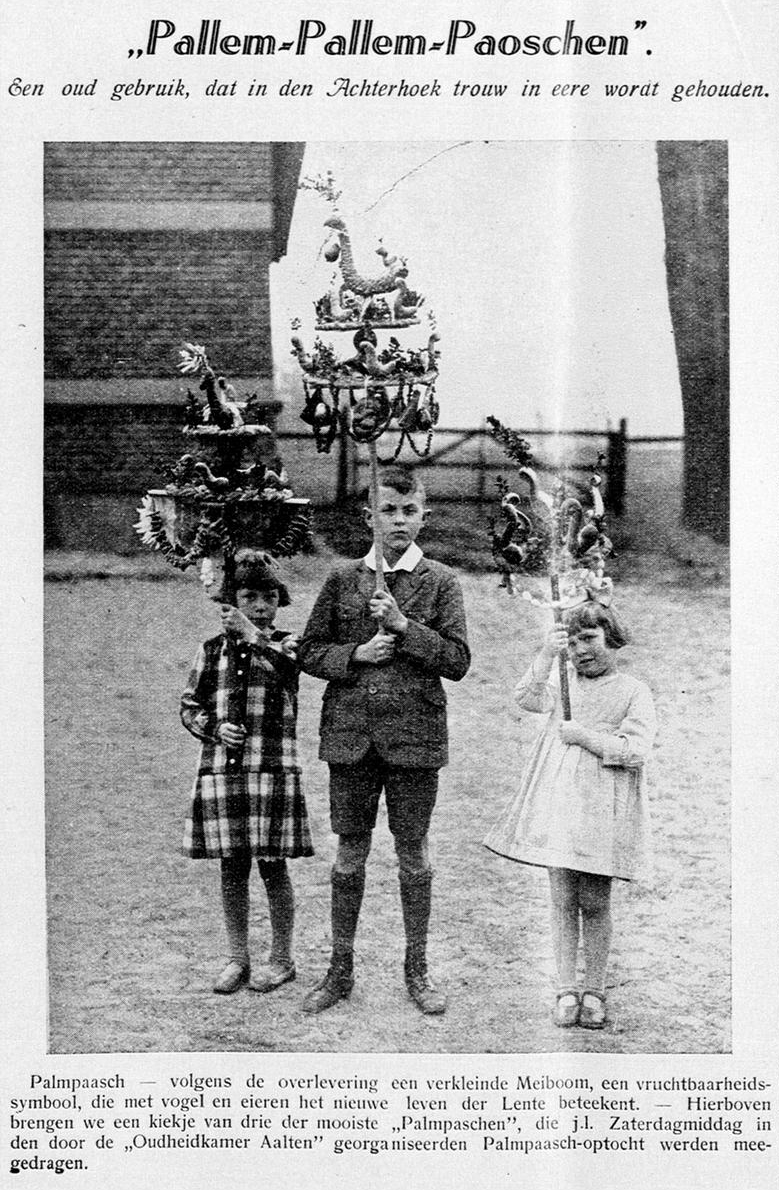
“Egg throwing was still frequently done by small children in the morning. If they wanted them to be a beautiful brown color, they were boiled in chicory porridge. On Palm Sunday, one could see the children walking with beautifully decorated pine branches, so-called ‘palmpaschen,’ while the children sang Palm Sunday songs, including this one:
Eikorij, eikorij,
When it is one more Sunday, we get an Easter egg.
One egg is no egg.
Two eggs is an Easter egg.
These types of songs were sometimes supplemented in other municipalities. These songs are mentioned in folkloric contributions regarding Easter customs.”
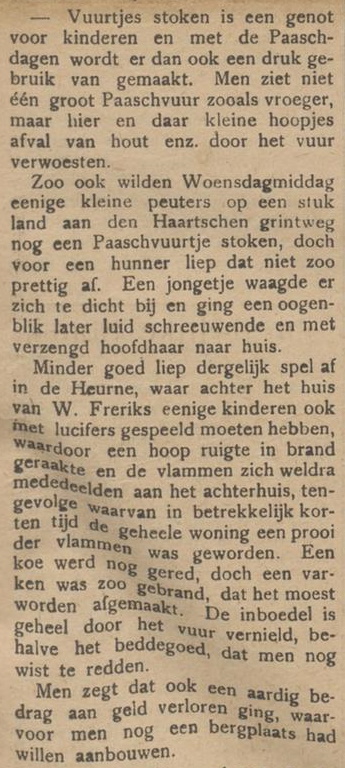
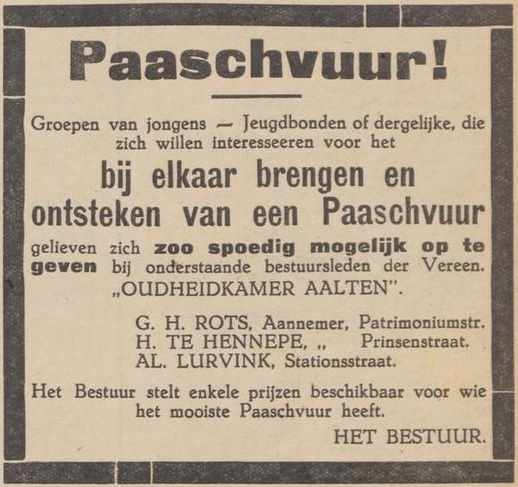
Sources
- Wikipedia
- ‘From Aalten’s Past’, by G.H. Rots, Aaltensche Courant, 19 November 1937 (via Delpher)