Category: Celebrations & Events

  • Smoking Competitions

    Smoking Competitions

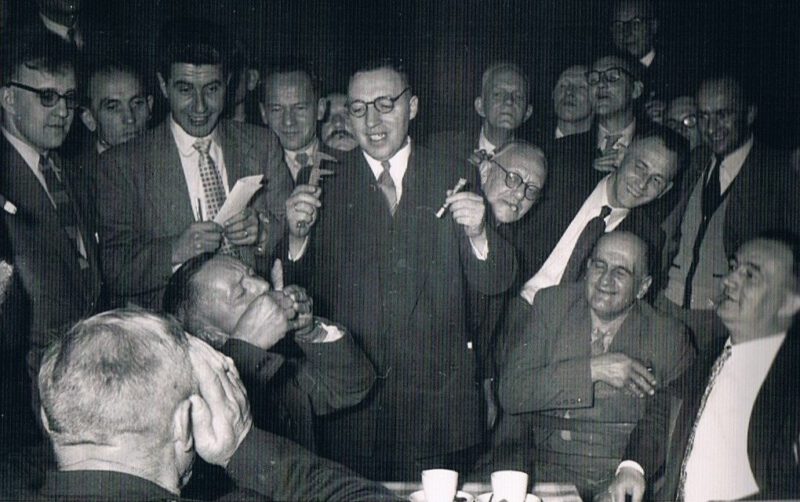
    We can hardly imagine it nowadays, but in the last century, competitions were organised in which participants competed against each other in various disciplines related to the smoking of cigars and cigarettes.

    The Arnhemsche Courant wrote on 6 March 1908:

    In the Catholic circle in Aalten, a smoking competition was held in slow and fast smoking. Mr J. Betting received the first prize for fast smoking, smoking his cigar in 7 minutes, and in slow smoking, the 1st prize was won by H. Weijkamp, who took an hour and 45 minutes over his pipe of tobacco. A useful way to pass the time as well!

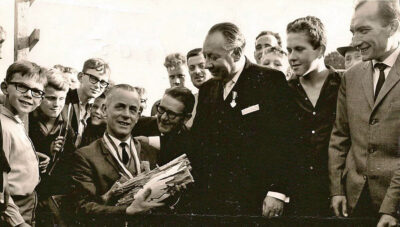
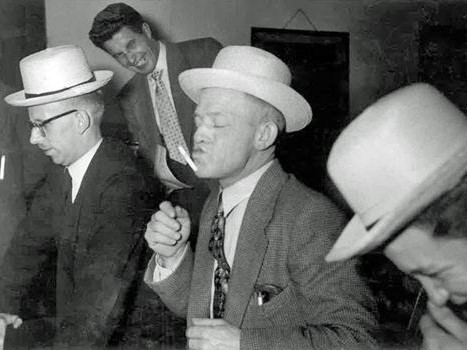
    In the 1960s, Dick Fries organised smoking competitions in Aalten. On the right, you can see a photo of the “Throwing a cigarette butt in the air and catching it in the mouth” event.
    On 21 March 1961, the Dagblad Tubantia wrote:

    Aalten has another smoking champion

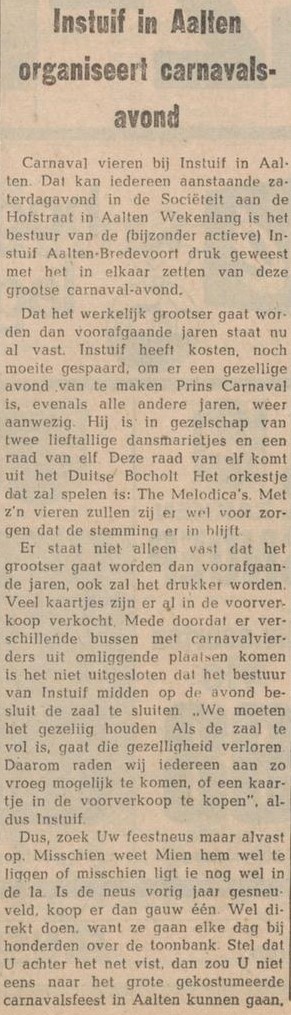
    Mr E. Jentink, Lintelo 67, became the champion cigar smoker of Aalten on Monday evening, for the time being for a year. He won this title during the annual smoking competition held at the Sociëteit on the Hofstraat. As is known, this competition is about the longest cone of ash on a 110 mm cigar. Mr Jentink managed to produce one of no less than 104 mm, however 1 mm shorter than last year’s champion.

    The interest in this smoking festival grows every year and had already grown to over 200 participants yesterday. It went without saying that when the command “fire” was given around half-past eight and the brand was lit in over 200 cigars simultaneously, all were soon shrouded in dense mists.

    It cost the participants effort to see how far his neighbour was progressing with the ash cone. It did not take long, however, before exclamations of “Oh, what a shame, I’ve lost it” rang through the hall.

    After about an hour, there were only a few left who could be eligible for the championship. Very carefully, an attempt was still made to take one last puff in order to stretch for another millimetre. The result, however, was usually a couple of “glowing” fingers and an avalanche of ash over their clothing.

    When the last cone had fallen and the balance could be made, it turned out that Mr Jentink had become champion with 104 mm. Mr A. Pokhuizen occupied second place with a cone of 103 mm. For the third prize, there were two candidates, namely Mr A. Driessen and Mr W. Winkelhorst, each with a cone of 102 mm.

    After this battle, the participants were treated to a somewhat “lighter” programme, namely with a performance by Rudi Carell and Dick Harris.

    Dagblad Tubantia, 19 March 1963:

    Champion smoker produced an ash cone of 100 millimetres

    Geert did not have it easy

    With an ash cone of exactly 100 mm, Mr G. te Lindert, Lankhofstraat 23, became the champion cigar smoker of Aalten last night. It was certainly not an easy task for Geert, because more than 200 hopefuls competed with him for this title. It was the tenth time in succession that this competition was held.

    Great tension and “avalanches”

    Little has changed, however, over the course of the years. This was hardly possible, for since the first time this competition was held, this gathering has been at the centre of attention. Only the occasion with which numerous participants enter the fray has grown larger annually. For many, it is no longer a “gamble,” as they practise busily months in advance, and many let their nails grow longer to be able to hold the “butt” for as long as possible.

    The sociability of the evening and the tension are certainly no less. From the moment the over 200 cigars go “into the fire,” a deathly silence prevails in the hall. “Shrouded in mists,” the jury members move between the tables to use the callipers where necessary.

    “Skew burners” and “curvers” are already plentiful halfway through the competition. Familiar phenomena yesterday were again the avalanches of ash, under which a face, lapel, or jacket were often buried.

    Geert te Lindert, a true lover of the cigar, succeeded in bringing the ash cone to 100 mm before it fell. How tense the battle was is proven by the 99½ mm ash cone that his competitor, and last year’s cup holder, Mr D.A. Driessen managed to produce. With a cone of 99 mm, Mr L.C. Rodenburg, who also won prizes last year, took third place.

    After this exciting battle, a sociable evening was made of it with the cooperation of Lubbert van Gortel and Kees Schilperoort. The NCRV broadcaster recorded the competition for broadcast in the radio newspaper.

    Dagblad Tubantia, 9 March 1965:

    Smoking competition was a success

    With an ash cone of exactly 100 mm, Mr A. Driessen became the winner on Monday evening of the annual and 12th smoking competition, which was held to great interest in the sociëteit. When the starting signal was given at a quarter to eight, the fire was lit in over 200 substantial cigars at once.

    Within a few minutes, the smoke was so thick you could cut it, and the participants could hardly distinguish their neighbour. Of course, that was not necessary, as everyone had enough to do with themselves. Especially when the ash cone increases in length, and then often tends to start pulling askew, no one has any need to interfere with their neighbour’s smoking art.

    It becomes different when, after half an hour, the first “victims” see their ash cone fall into pieces with a face of “Oh, what a shame.” Then the dropouts gather in large numbers around the survivors who, often at the cost of a blister and twisting themselves into all sorts of contortions, try to add a few millimetres to the wobbly cone by taking a few more puffs. It becomes deathly quiet in the hall, and the tension can be read on the faces.

    So too last night, when all attention was focused on the smoking art of Mr Driessen, who finally succeeded in emerging from the smoke screen as the winner. Last year, he also won the 1st prize. If he succeeds in winning the championship again next year, he will become the definitive owner of the challenge cup.

    In second place finished Mr H. Arentsen with a cone of 99½ mm. Mr J. Pluimers came in third place with a cone of 99 mm.

    After the smoke screen had cleared somewhat, the participants were treated to a cheerful programme, provided by a cabaret company from Apeldoorn, under the motto: “Lachen is troef” (Laughter is trump).

    Sources


    • Arnhemsche Courant, 6 March 1908 (Delpher)
    • Dagblad Tubantia, 21 March 1961 (Delpher)
    • Dagblad Tubantia, 19 March 1963 (Delpher)
    • Dagblad Tubantia, 9 March 1965 (Delpher)
    • Facebook page Oud Aalten
  • Volksfeest / Fair

    Volksfeest / Fair

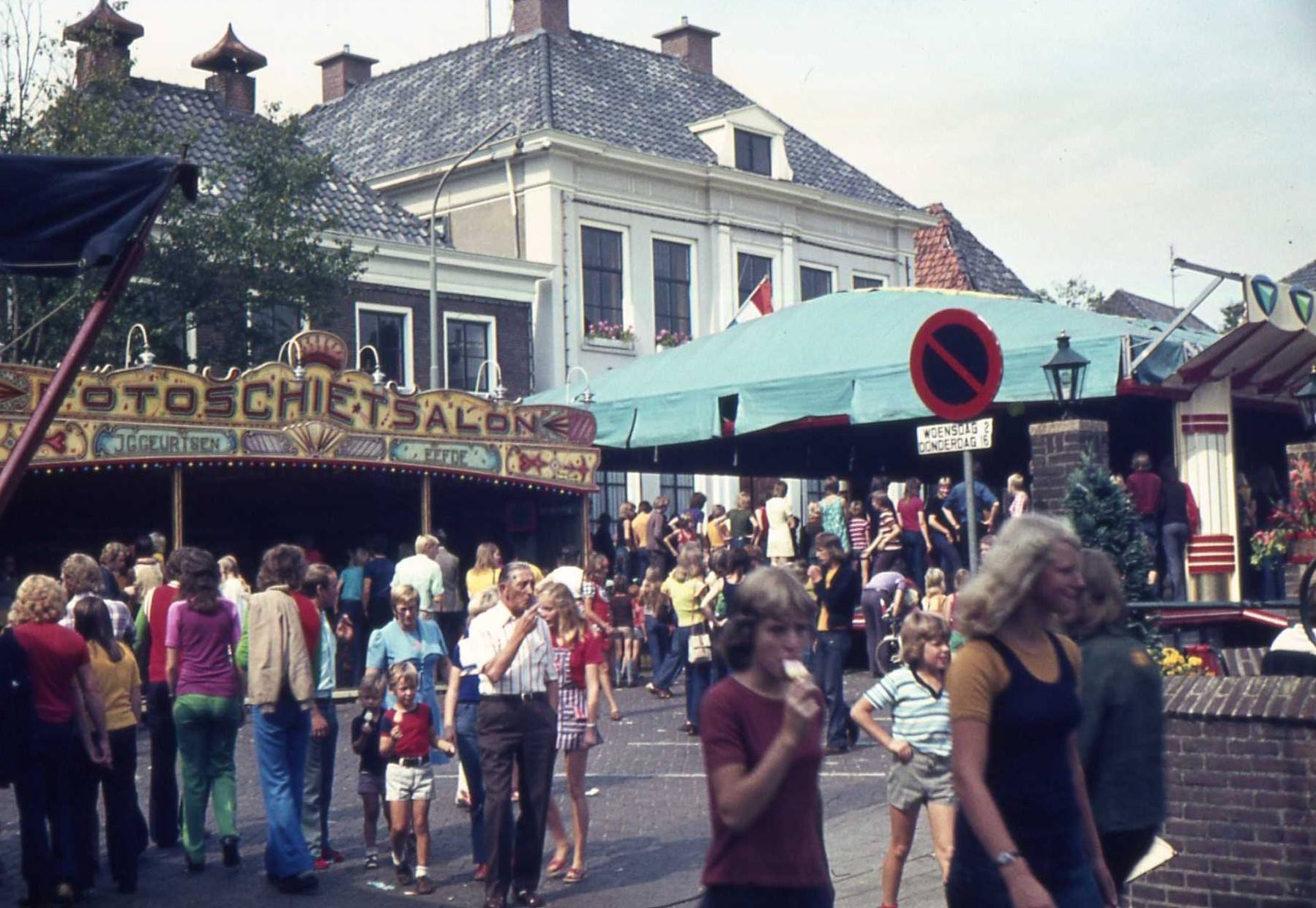
    Markt met kermis, jaren 1970

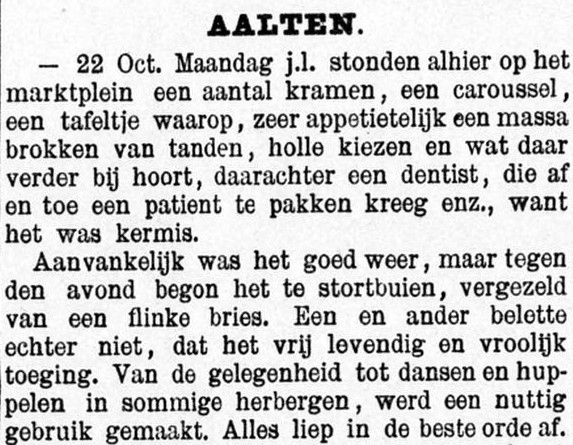
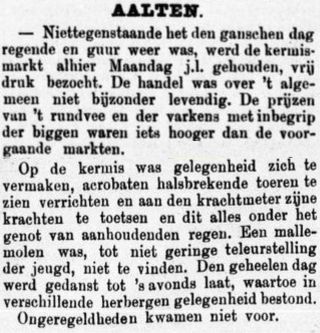
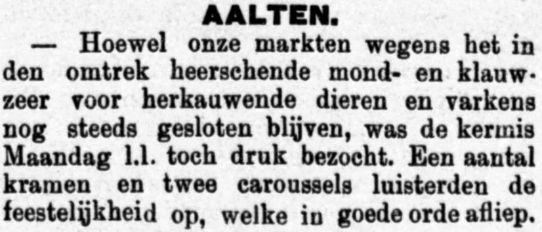
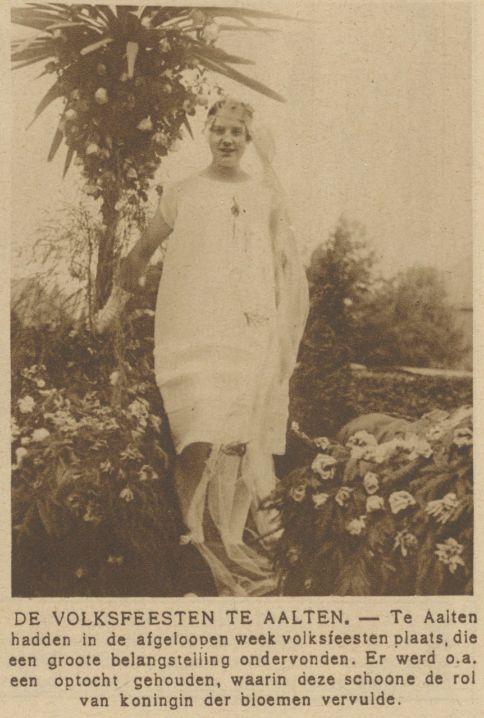
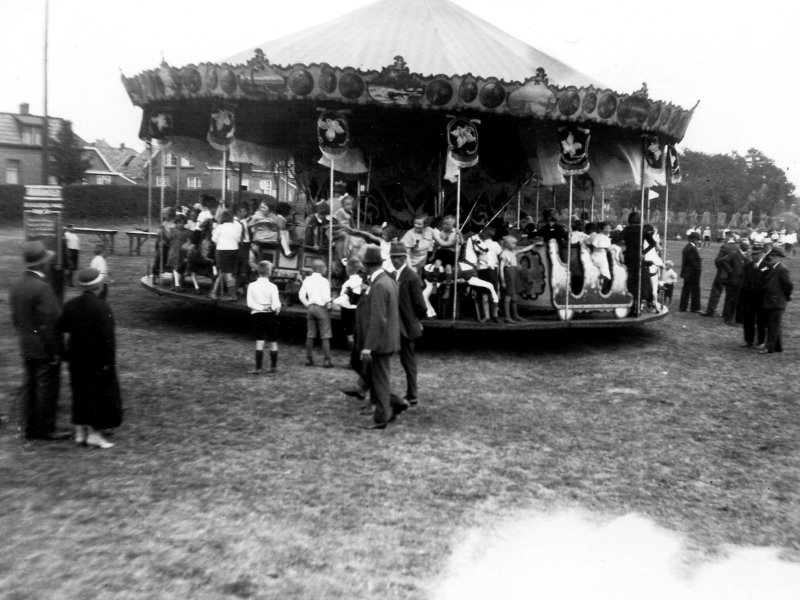
    The Aalten Volksfeest is an event that many residents of Aalten look forward to every year. Nowadays, it is celebrated during the third weekend of September. In earlier years, it was also celebrated on other dates. The folk festival is also often referred to as the ‘kermis’ (fair). However, the actual fair, meaning the attractions, is nowadays called the ‘lunapark’.

    For many decades, the king shooting and the fair were held on the grounds near the ‘Festival Hall’ / ‘De Pol’. Nowadays, however, these activities take place in the center, primarily on the Markt and the Hoge Blik.1

    The oldest mention of the fair in Aalten dates back to 1835. That year, the ‘Geldersche Volks-almanak’ mentioned that the fair in Aalten would take place on October 19. 2

    In the ‘Eleventh report on the state and activities of the Dutch association for the abolition of strong drink’, published in 1855, it is written: “the fair in Aalten is insignificant, mostly children’s joy”.3

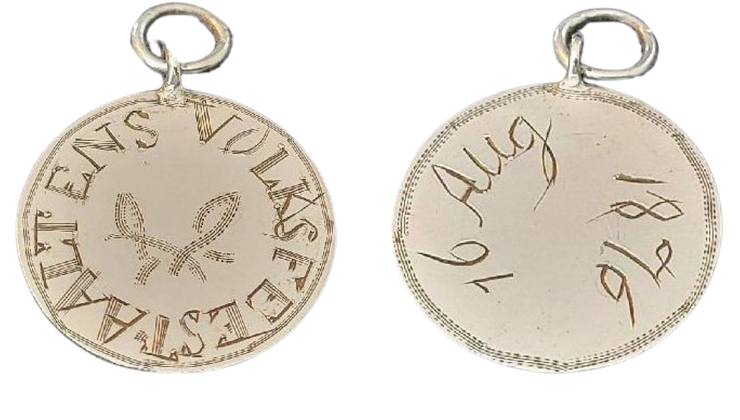
    Volksfeest 1876 – silver medal

    Medals are often a material reminder of an event in the past. This also applies to the small medal depicted here:

    The medal consists of a silver plate with a diameter of 22 mm, to which an eyelet has been soldered. The front is engraved with the text: AALTENS VOLKSFEEST, with a ribbon surrounded by a border of stripes. On the reverse is the date 16 Aug 1876, within a border of small lines and stripes. The edge of the medal is serrated; the plate is presumably a ground-down coin. It is striking that the engraving was carried out quite amateurishly.

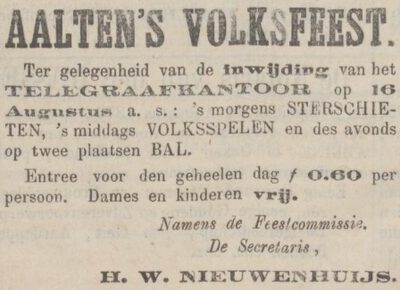
    Regarding the occasion for the folk festival, the Zutphensche Courant of August 12, 1876, reports: the opening of the Telegraph Office in Aalten. The precise reason for the production of the medal is unknown; it may have been awarded as a prize during the star shooting. 4

    Stichting Volksfeest Aalten

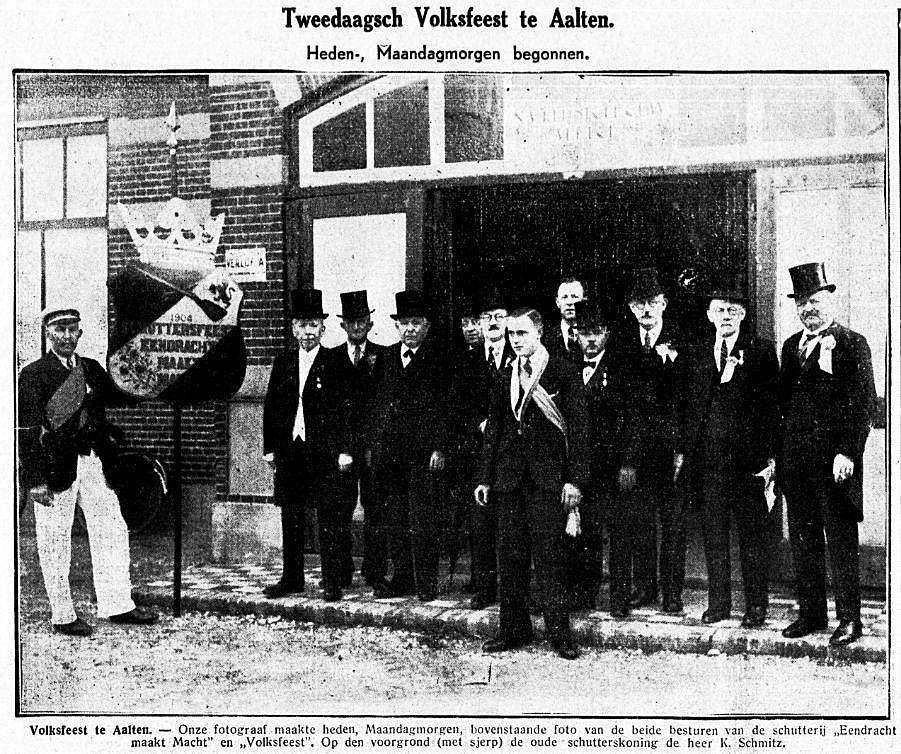
    In September 1973, a ‘Volksfeest Committee’ was established, created by the merger of the ‘Festival Hall’, the Schuttersvereniging (Marksmen’s Association), and the Fair Committee. Later, this became the ‘Stichting Volksfeest Aalten’. Ten years later, Wout Delleman (1927), Jan Willem Bilderbeek (1920), and Johan Diederik Beskers (1918) appeared before notary Obbink for the establishment of Stichting Volksfeest Aalten (SVA).

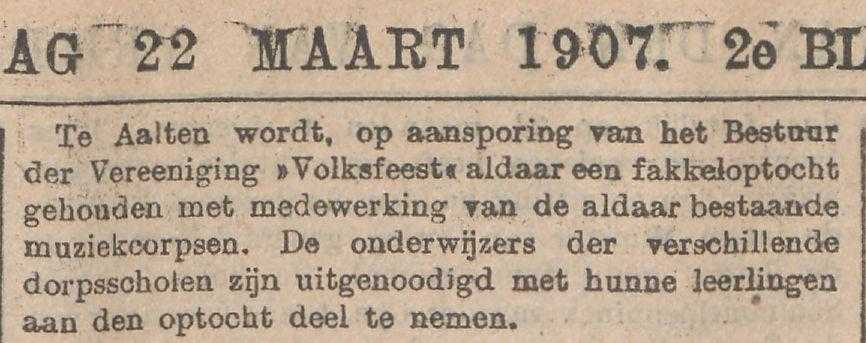
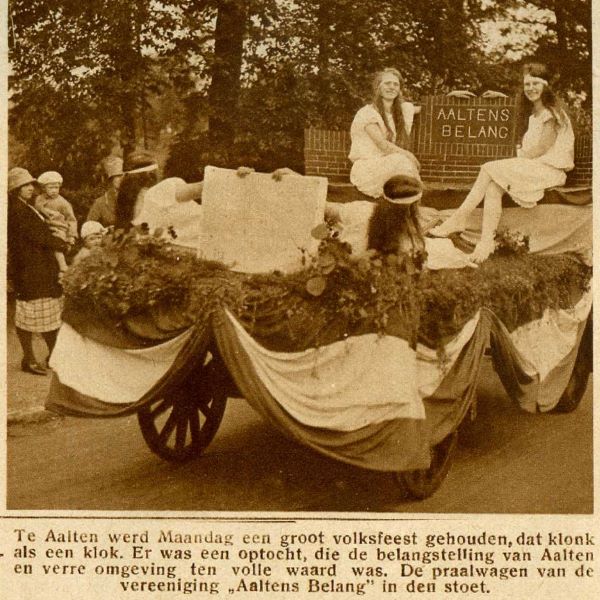
    The core activities of Stichting Volksfeest have hardly changed in 50 years. Long before SVA was established, a festival, then called a fair, was organized every year. Children’s games, a lantern parade, king shooting, and the Allegorical parade are traditionally part of the ‘festival for everyone’. The locations have changed several times, and the Volksfeest has also moved from June to the third weekend of September.

    Previously, the Volksfeest was held from Thursday to Saturday. Since 2014, Sunday has been added to the program with Frühshoppen.

    King Shooting

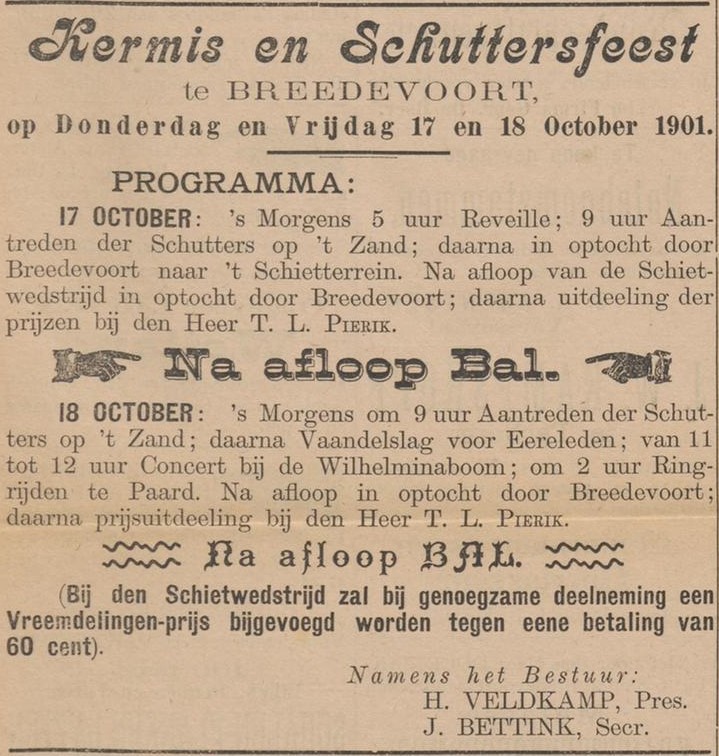
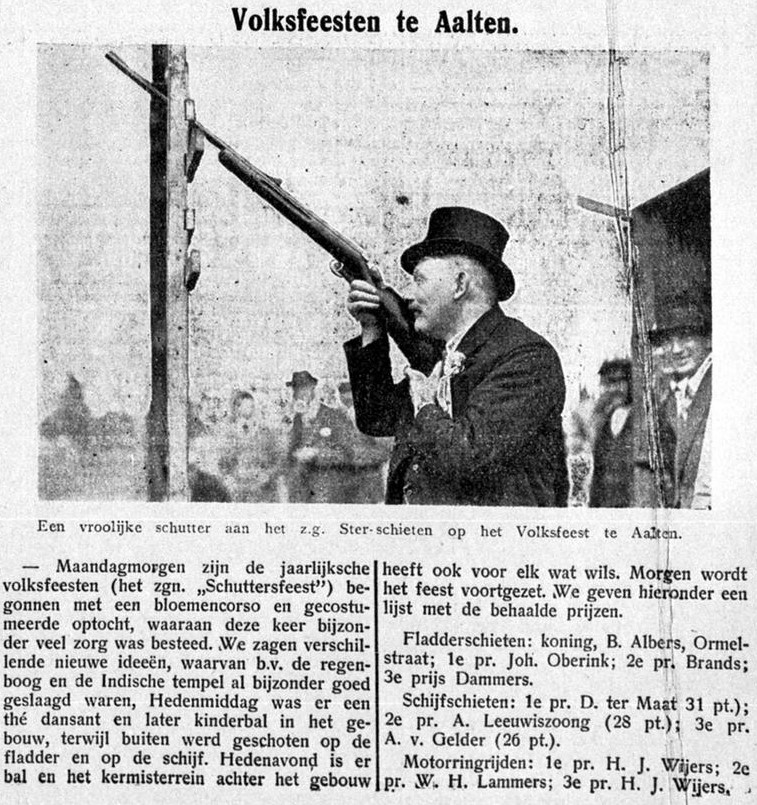
    A traditional part of the folk festival is the king shooting or bird shooting. King shooting is an old custom found in large parts of Europe. King shooting originates from the schuttersfeest, the annual festive folk entertainment of the local marksmen’s guild.

    The tradition of king shooting has been known in Aalten since well into the last century. In addition to king shooting, Aalten also had ‘fladder’ and target shooting, and bird clubbing for ladies. Furthermore, at the beginning of the last century, one could also participate in ring tilting on horseback or bicycle.

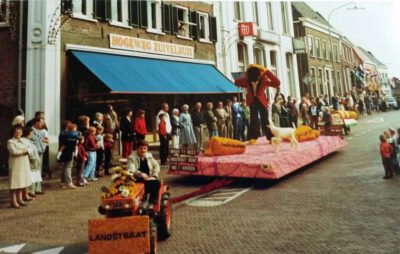
    The winners of the shooting competitions on Friday may call themselves king, queen, and youth king/queen of Aalten for a year. The following day, they are driven around in a carriage or cabriolet during the allegorical parade to greet the public. This is followed by the tribute to the flag by the flag wavers of St. Helena on the Markt.

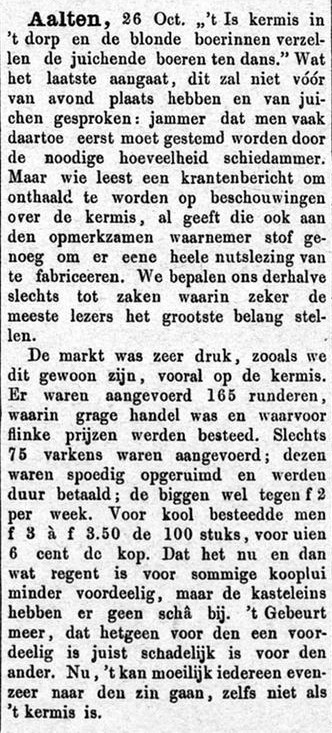
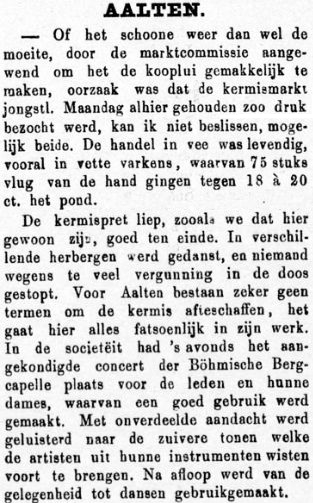
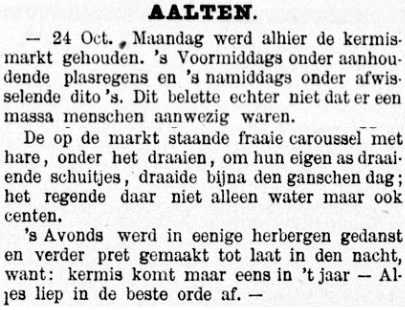
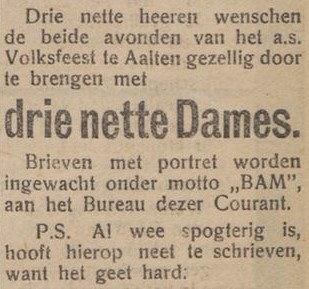
    Newspaper reports

    (click to enlarge) 5

  • Easter Bonfire

    Easter Bonfire

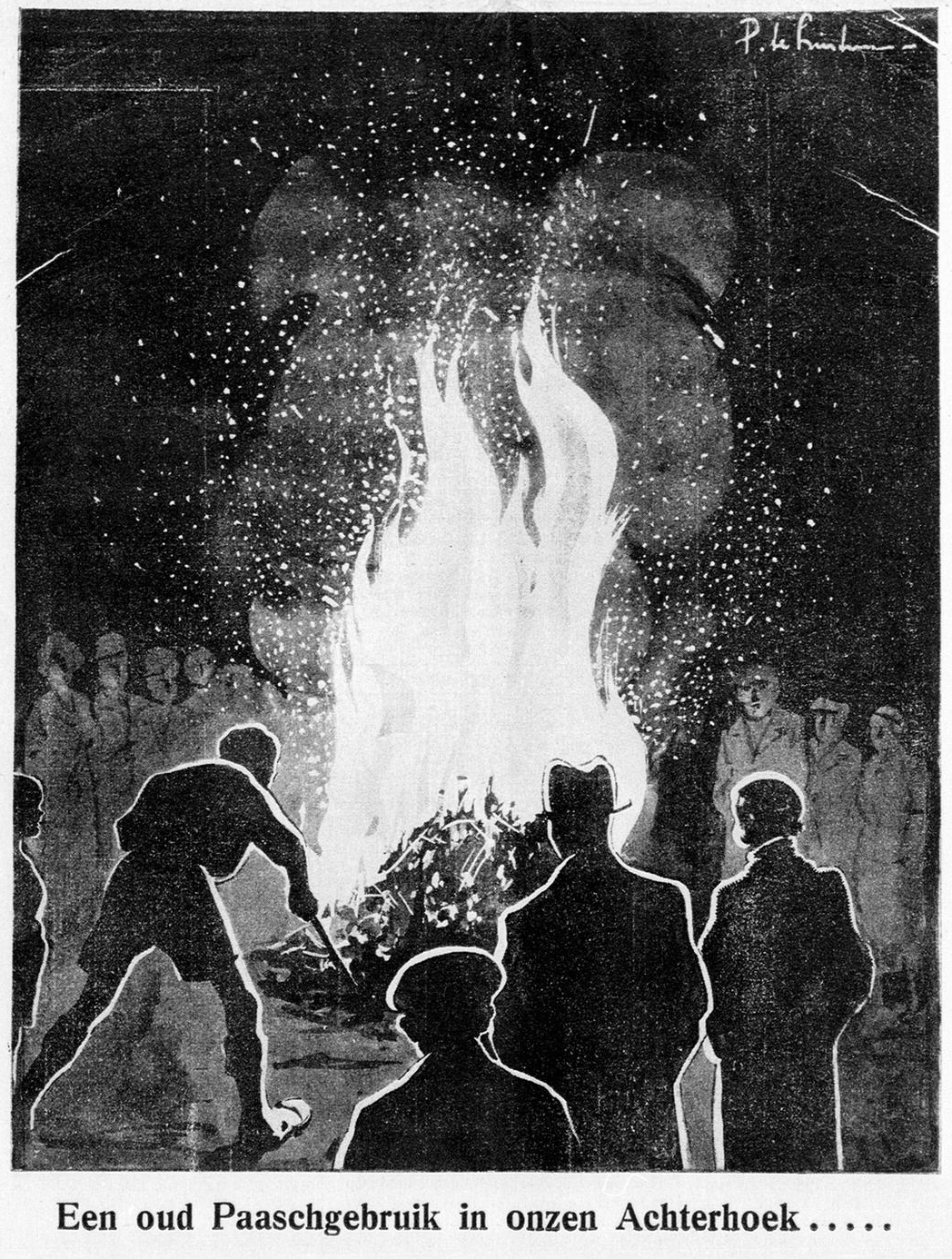
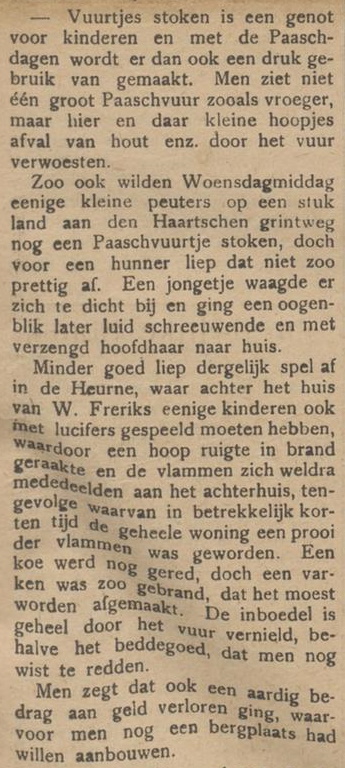
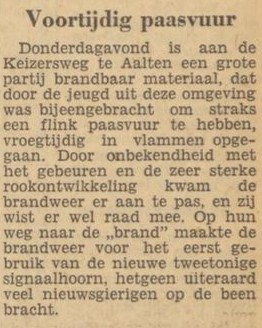
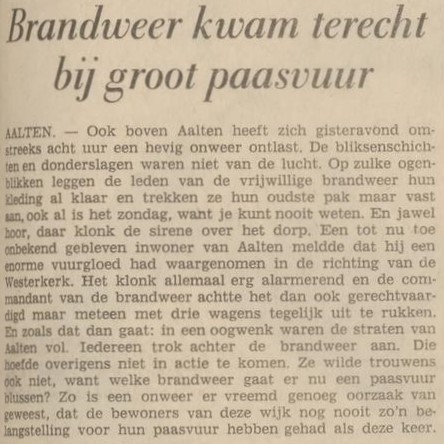
    An Easter bonfire is a type of bonfire lit during Easter in parts of Europe. For this purpose, wood is collected and placed in a large pile, which is sometimes dozens of meters high. As darkness falls, the entire stack is set ablaze.

    The spectacle often attracts many spectators and is usually a true community event. Originally, it was a Germanic festival dedicated to Ostara, the goddess of spring. After Christianization, the tradition was given a Christian interpretation.

    Easter Bonfire in Aalten

    G.H. Rots described the Aalten Easter bonfire tradition in 1937 as follows:

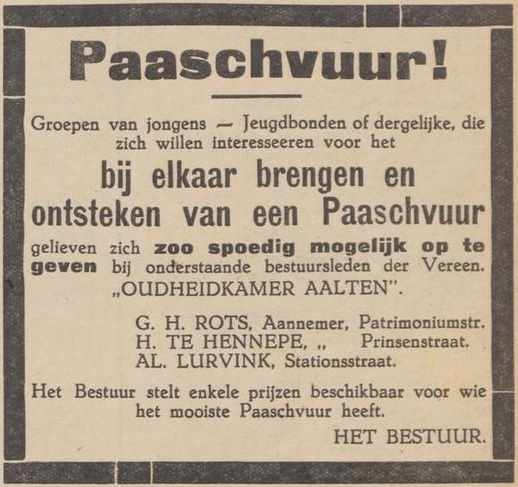
    “Every spring as Easter approached, the boys from a ‘rot‘ (= district/neighborhood) gathered to discuss plans for the ‘Easter fire.’ They appointed a board, in which the treasurer in particular played a significant role.

    They went from house to house to ask if people had anything left for the Easter fire. Those who had no wood usually offered a small contribution in hard cash, forming a ‘fund.’ The treasurer had to manage this fund, which could sometimes amount to thirty cents. It occasionally happened that the treasurer used the fund, or part of it, for his own purposes. Then there was trouble brewing. Sometimes heavy fighting broke out, and mutual quarrels were the order of the day.

    But the end of the story was always: there was an Easter fire. Every district had such a fire, and it was all about who had the largest one. It was not uncommon for one group of boys to head out late at night to hijack wood from another group and supplement their own supply with it.

    The fire was lit on Easter Sunday. In the middle was a pole, above which a tar barrel was hung, causing the fire to flare up high. And so, one could see several fires burning around Aalten, a spectacle that had numerous onlookers.”

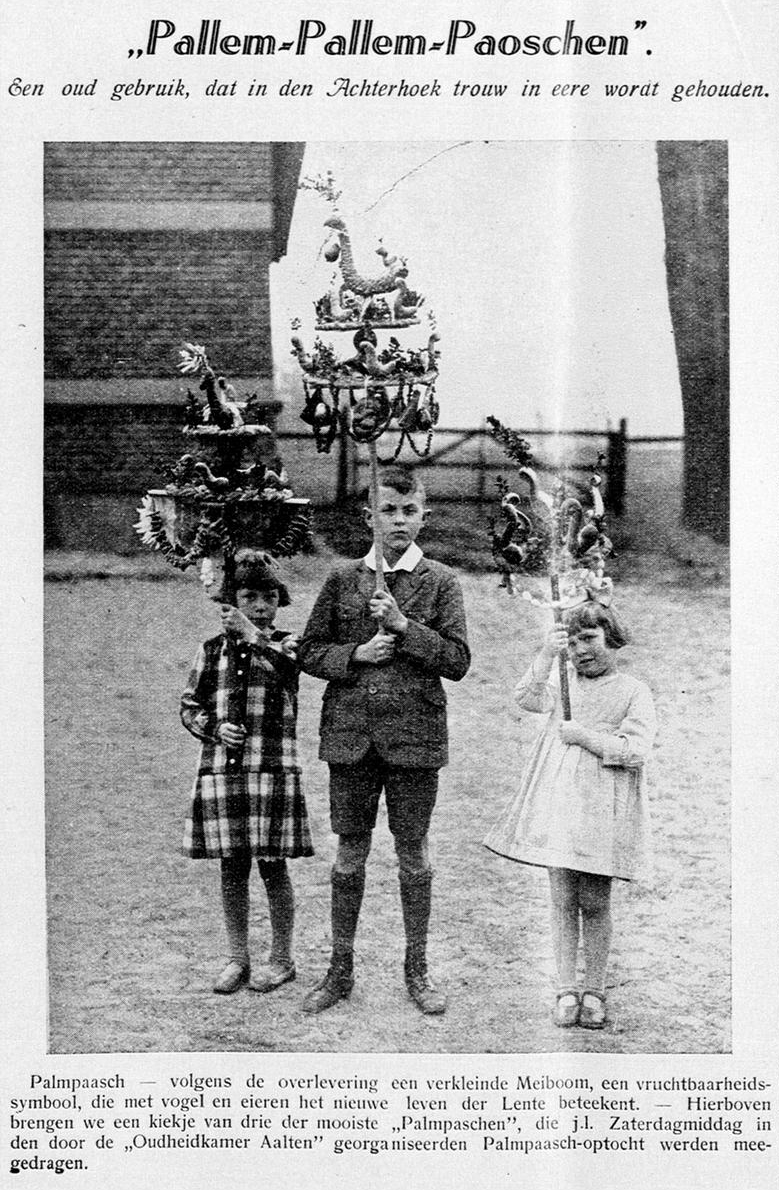
    Palm Sunday

    “Egg throwing was still frequently done by small children in the morning. If they wanted them to be a beautiful brown color, they were boiled in chicory porridge. On Palm Sunday, one could see the children walking with beautifully decorated pine branches, so-called ‘palmpaschen,’ while the children sang Palm Sunday songs, including this one:

    Eikorij, eikorij,
    When it is one more Sunday, we get an Easter egg.
    One egg is no egg.
    Two eggs is an Easter egg.

    These types of songs were sometimes supplemented in other municipalities. These songs are mentioned in folkloric contributions regarding Easter customs.”

    Sources


    • Wikipedia
    • ‘From Aalten’s Past’, by G.H. Rots, Aaltensche Courant, 19 November 1937 (via Delpher)
  • Spuitbal

    Spuitbal

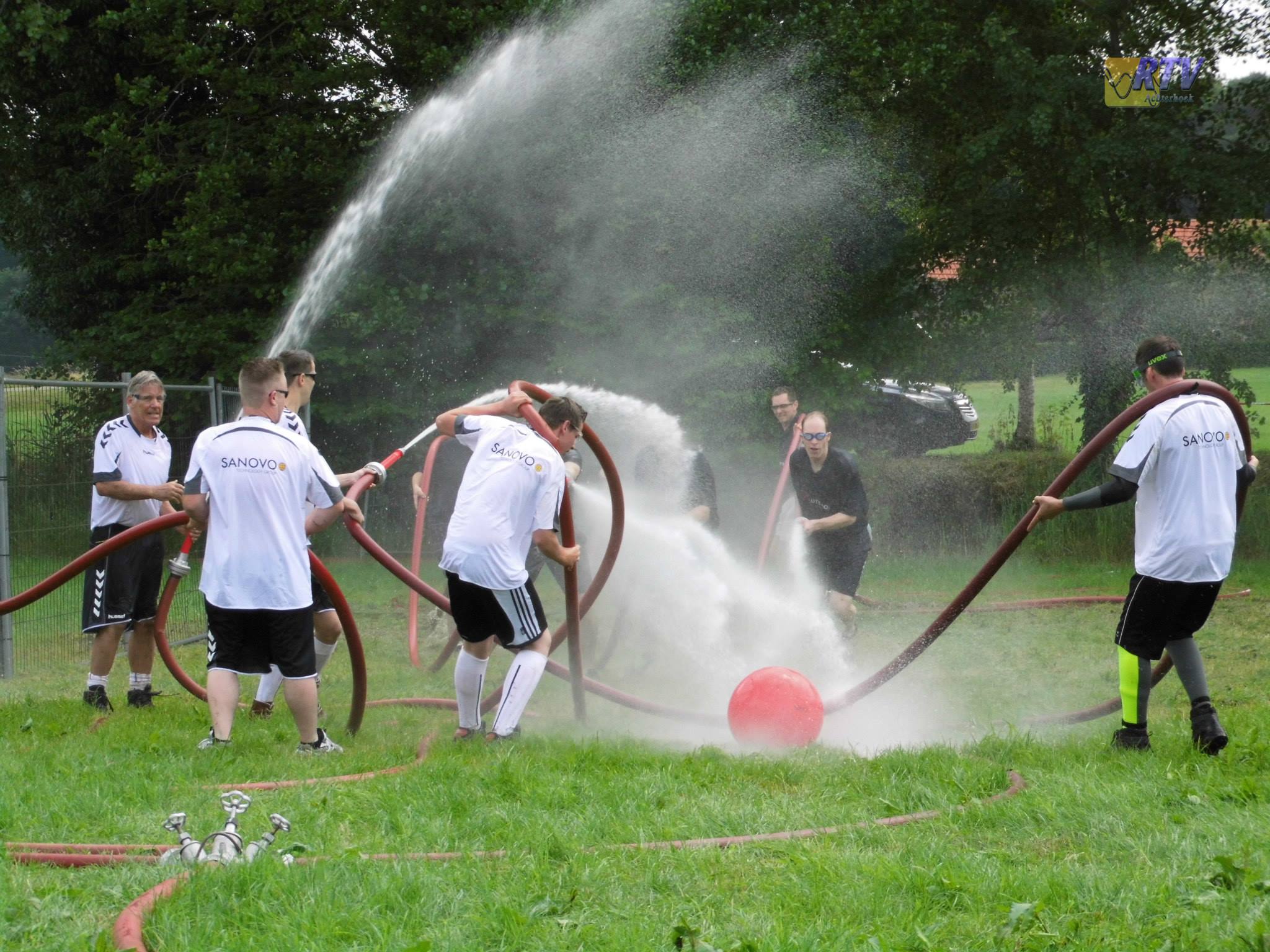
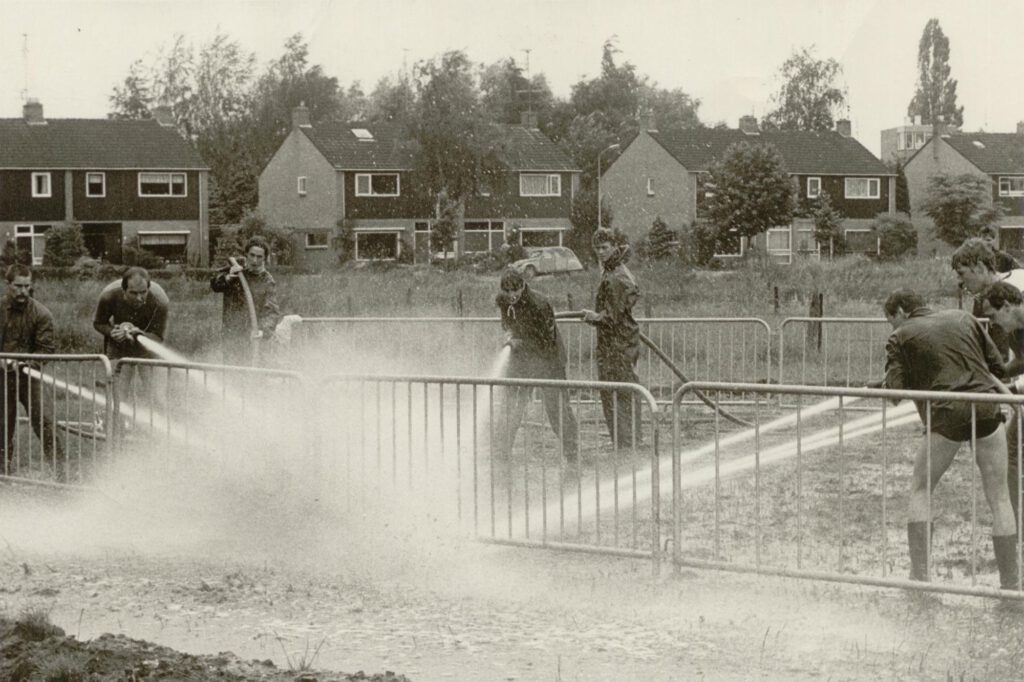
    Spuitbal was an annual recurring event organised by the Aalten Fire Brigade from 1981 to 2016. Each year, this water-filled spectacle attracted many participants and spectators.

    Game Setup

    In Spuitbal, two teams of six people competed against each other. Each team operated three fire hoses and tried to push a large ball into the opponents’ goal using powerful jets of water. Each hose was operated by a pair: the front player aimed the jet at the ball, while the rear player had to ensure there were no kinks in the hose. The team that scored the most goals in six minutes won.

    In the early years, the Spuitbal tournament was organised at various locations, including at De Ahof. In later years, the event took place at Camping Lansbulten on the Eskesweg. The necessary water was pumped from the nearby stream.

    In 2008, no fewer than six women’s teams and thirty men’s teams took part. Many teams returned every year, such as De Flippers, De Pimpels, De Pollekes, Atlantic, Schiller, ’t Noorden, and Jong Gelre.

    The 36th (and, as of yet, final) edition took place in 2016. In 2017, the event was cancelled due to insufficient interest, and it has not returned since.

    Video

    On YouTube, various videos can be found of Spuitbal in Aalten, such as the video below from Jong Gelre from 2012.

    Sources (including)


  • Zeskamp (1968)

    Zeskamp (1968)

    Event

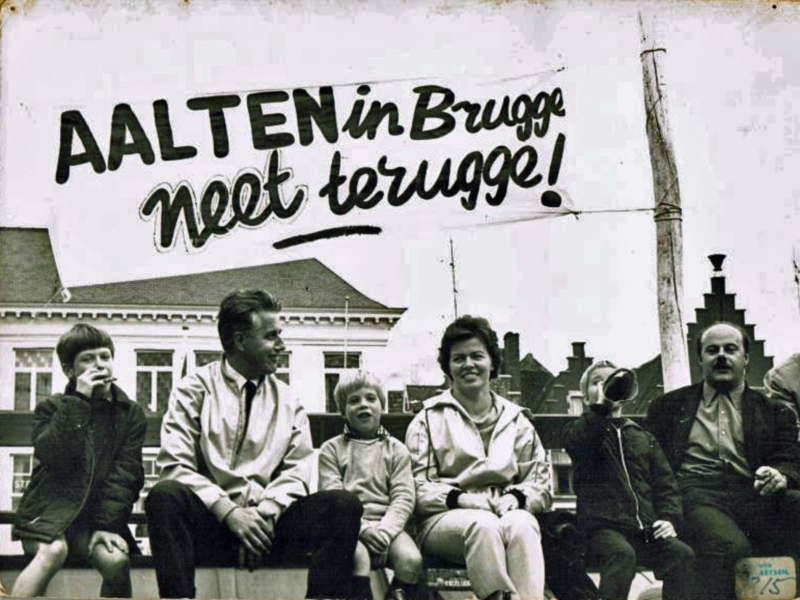
    In 1968, Aalten put itself on the map by participating in the popular TV event ‘Zeskamp’ (Hexathlon). At the time, the municipality had approximately 12,000 inhabitants. The textile industry was in decline, and outside the built-up area, farming remained the primary way of life. During this period, Aalten was a pillarized village. However, Zeskamp appears to have brought about a turning point.

    Zeskamp was a sporting event organized by the NCRV and the Belgian BRT, which they broadcast live on TV. At the time, it attracted millions of viewers, making it one of the most-watched TV programs. There were participants from six different locations: three from the Netherlands and three from Belgium.

    Residents participated en masse and with great enthusiasm. People of various religious and ideological backgrounds worked together. For the first time, they truly met and got to know one another. In this way, imaginary walls were broken down.

    The competitions were held on six Saturday evenings, each time in one of the participating locations. In Aalten, the Market Square served as the arena.

    Ultimately, Aalten advanced to the final in Zutphen and won! The participants were honored with a parade through the village.

    See also:

  • Old Christmas Traditions

    Old Christmas Traditions

    Several excerpts from the Java-bode, December 22, 1956

    Old Christmas traditions – Java-bode, 22 December 1956

    Christmas: A Christian holiday, yet many customs originate from paganism. In modified forms, they have withstood the test of time.

    Already several days before Christmas, a festive mood awakens in people, reaching its peak during the Christmas days. It is no coincidence that the Christmas tree, holly, and mistletoe are popular then, and that Christmas bread, Christmas wreaths, and other Christmas pastries enhance the festive joy. It is seldom considered that such items and customs originate from ancient paganism.

    In the past, our ancestors celebrated the Yule feast around this time, the festival of fertility, in honor of the return of the light. The shortest day had passed, and the days began to lengthen again. Sacrificial meals were held, and sacrificial fires blazed high in the sacred forests. Christmas is a Christian holiday, but all those customs emerged from pagan soil and have, more or less modified, remained and been adopted by modern man.

    It is difficult to link Christmas customs to a specific day, as what occurs here on Christmas Day takes place elsewhere on December 26th or even on Epiphany. Some customs, such as eating certain types of cookies and pastries, are in vogue throughout that entire period between Christmas and Epiphany. In general, it can be said that in the rural Netherlands, Christmas Day is the holy day, a day of reflection and meditation, while Boxing Day is used more as a day for going out or visiting.

    Achterhoek

    Among the elderly in the Achterhoek, the superstition still lives that on Christmas Eve “Derk met de bèèr” rides around, destroying everything left lying outside. In many places, all agricultural tools are still stored in the barn and the yard is cleaned…

    In many families in the Achterhoek, something extra is eaten on Christmas Eve, and this custom is reminiscent of the old name “dikkevretsavond” (gluttony evening). In farming families, pancakes fried with sausage are often served. A mocking rhyme that points to an extra treat goes: “Kasaventjen, Kasaventjen, dan gaat ‘t er bie ons op. Dan slacht mien va ‘nen pekkelhering en ik, ik kriege de kop”.

    In Aalten, people eat “pilleweggeskes” on Christmas Eve, small spherical “weggen” (loaves) on which two dough pills are placed in a cross shape. Children still know an old begging song: “Pilleweggen-aovend, offert geld, Geft de kleine kinder wat, Geft de groten ‘ne schop vör ‘t gat!”

    The aforementioned two dough pills in a cross shape did not originally belong on this Christmas pastry. They were placed there when the common people no longer understood the name “pilleweg.” A “pil” is a godchild or baptized child, and the “pillegift” in the form of a “pillewegge” was a baptismal gift. It was also a reminder of the pagan bread offering made to ward off the demons of the childbed. Anise, caraway, and cinnamon drove the gods away with their strong scent.

    The fact that “pillewegen” are given as gifts on Christmas Eve likely finds its origin in the veneration of Mary as a woman in labor. The custom of eating walnuts on Christmas Eve in the cozy domestic family circle (in Aalten, for example) is still in vogue.

    Source


  • Carnival / Shrovetide

    Carnival / Shrovetide

    In large parts of the country, Carnival is celebrated seven weeks before Easter. In Aalten, this is not so much the case. Carnival is traditionally a Catholic festival, and Aalten has remained predominantly Protestant since the Reformation. Nevertheless, Carnival was also celebrated in Aalten in the past.


    Carnival is originally a Christianized pagan folk festival traditionally celebrated only by Catholics. In parts of Gelderland, Carnival is celebrated exuberantly every year, while in many other parts it is not celebrated at all. These regional cultural differences often date back to the Reformation and the Eighty Years’ War (1568-1648). During this conflict, regions emerged that quickly aligned with the Protestant rebels. Other regions held on to the Catholic faith of the legitimate sovereign and Duke of Guelders for a long time.

    For instance, the Lordship of Bredevoort was conquered in 1597 by the Calvinist Maurice of Nassau. He subsequently made the entire region from Aalten to Winterswijk Protestant. His half-brother Frederick Henry did not definitively conquer Groenlo from the Catholic sovereign until 1627. In the preceding years, the Catholic faith was able to take deeper root in the society of Groenlo and its surroundings thanks to the Counter-Reformation.
    Carnival in Aalten
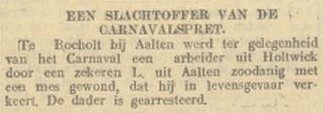
    Nevertheless, Carnival was also celebrated in Aalten in the past. In 1937, G.H. Rots described in a series of articles how things were done in Aalten in earlier times. For example, he dedicated a section to ‘vastenoavond’, or Carnival:
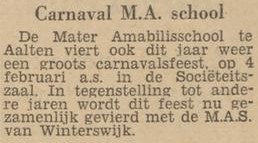
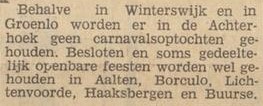
    “If we look at the cheerful things again, the first thing people in the village concerned themselves with was ‘vastenoavond’. However, compared to the Carnival festivities in southern parts of the country, it was very modest here. There was music in a few cafés, and a few people also appeared on the streets in jester costumes. Characteristic, however, was the custom of the youth walking around with a so-called ‘foekepot’. This was a tin canister over which a dried piece of pig’s bladder was stretched. In the middle was a small hole, into which a small wooden stick fitted. By pushing this stick up and down, a humming sound was produced, and so on Shrove Tuesday one could hear the dull sound of foeke-foeke-foeke. They sang the following song with it:
    Foekepotterij, foekepotterij, give me a penny, then I’ll pass by. I have no money to buy bread, I’ve walked with the foekepot for so long. Foekepotterij, foekepotterij, give me a penny, then I’ll pass by.

    The penny was usually given, and the ‘Shrove Tuesday fools’ did good business.”

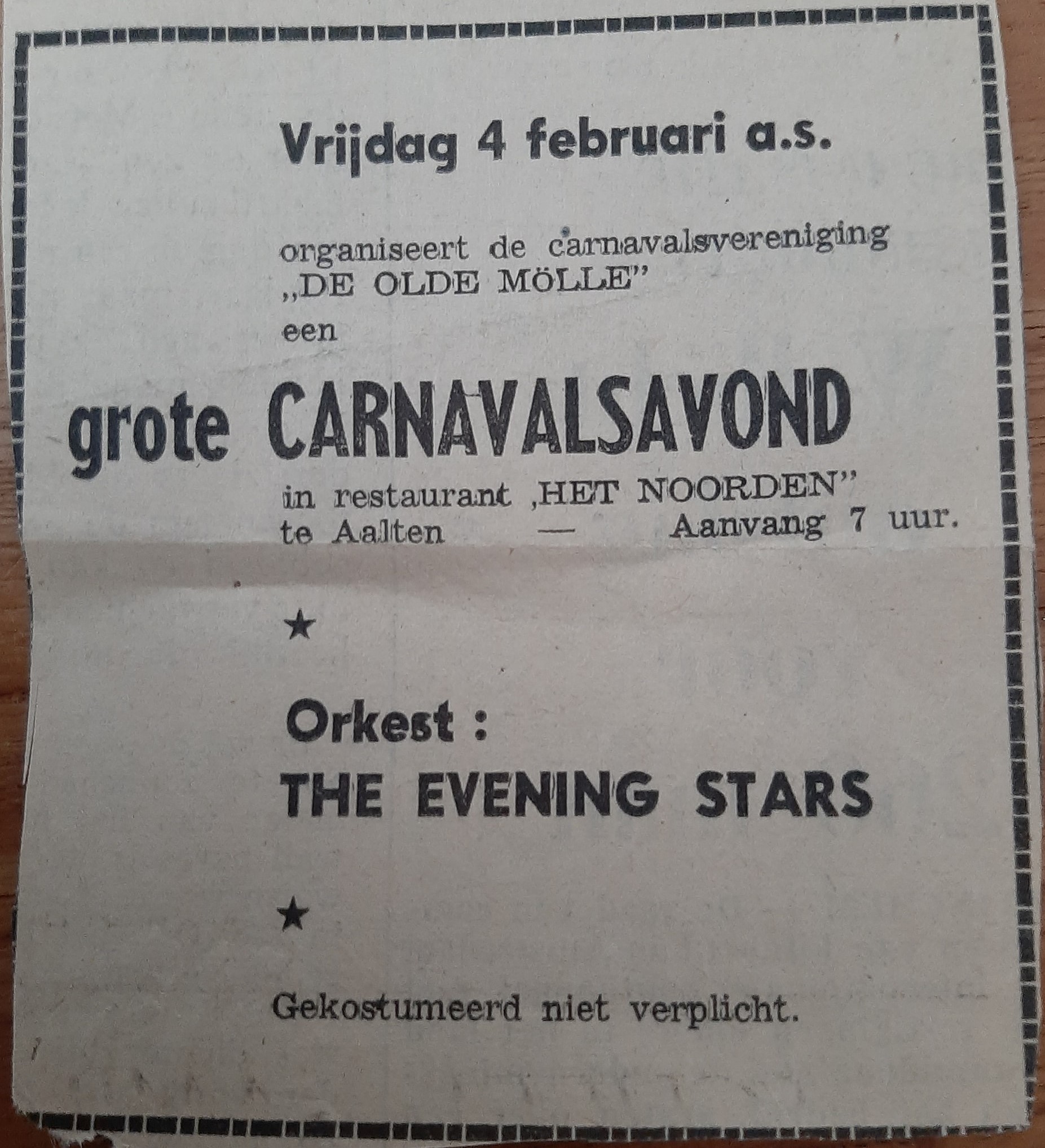
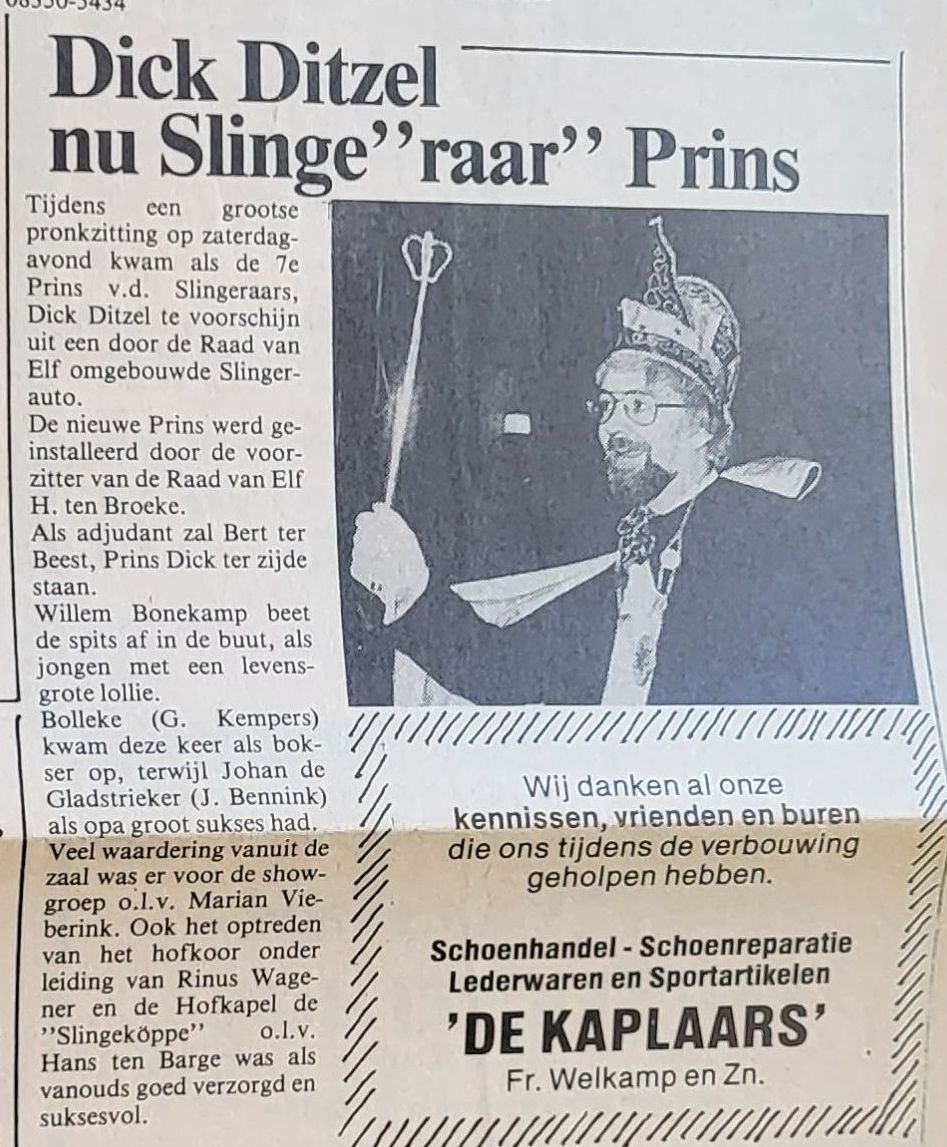
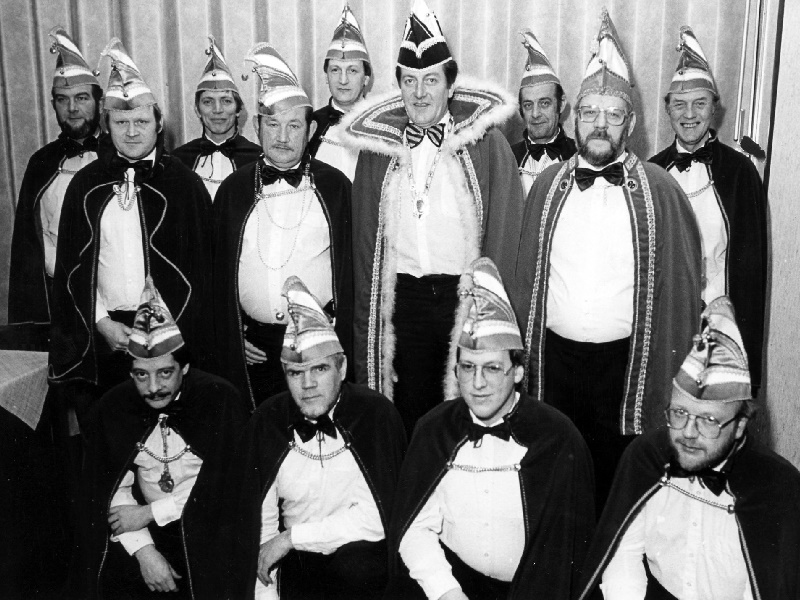
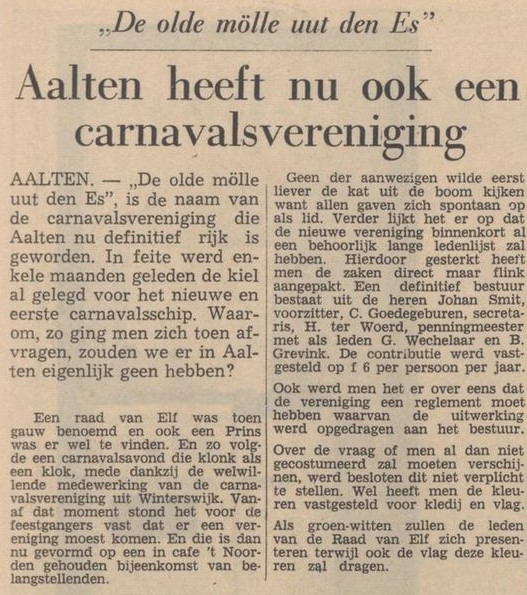
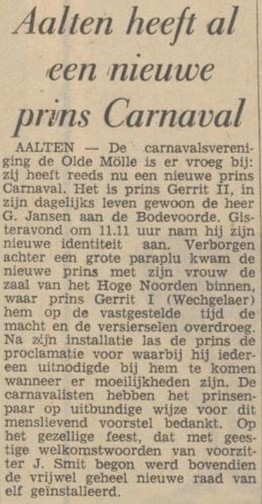
    Aalten even had three Carnival associations: De Slinge-raars, Spuit Elf, and De Olde Mölle.

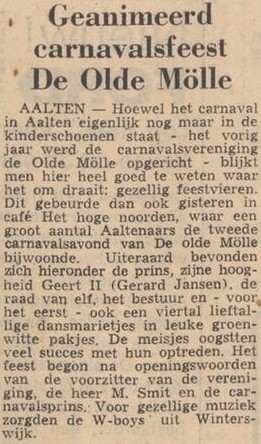
    De Olde Mölle was founded in 1965 at café ‘t Noorden.

    Carnival society 'De Olde Mölle' (The Old Mill), Aalten
    Carnival society ‘De Olde Mölle’ (The Old Mill), Aalten – Carnival prince Jan, his adjutant and the Council of Eleven.

    Nowadays, Carnival in Aalten is only celebrated by the children of the St. Jozefschool, the only remaining Catholic primary school in the village. Other residents of Aalten who wish to celebrate Carnival are forced to go to places such as Groenlo (Grolle), ‘s-Heerenberg (Waskuupstad), or Doetinchem (Leutekum).

    Newspaper reports

    Carnival society 'De Olde Mölle' (The Old Mill), Aalten – Dagblad Tubantia, 18 February 1966
    Dagblad Tubantia, 18 February 1966
  • 100 Years of Independence

    100 Years of Independence

    Aaltensche Courant, 30 July 1913

    We frequently read or hear about “Plan 1913”. What is meant by that? It is the plan or intention to festively commemorate the joyous event of 100 years ago. Is there reason for this? Those who still ask this provide proof that they have forgotten what they learned at school regarding the history of our fatherland. The only thing that can be offered as an excuse is that for many, their school years lie far behind them and oral tradition is no longer heard.

    It was in 1863, when the fiftieth anniversary of the Netherlands’ Independence was celebrated in Aalten, that things were quite different. Back then, there was hardly a family where one did not hear from the lips of grandparents about the sad times our ancestors lived through as long as the French were in charge here. Incidents that had personally affected a family were recounted, but now, 50 years later, much of that is covered by the veil of oblivion.

    In general, therefore, we wish to recall a few facts that history has recorded. The 17th century (1600–1700) is called the “Golden Age” of our history; the 18th century (1700–1800), the “century of decay”.

    What was the cause of that decay? People began to rest on the laurels achieved by their ancestors. A spirit of enterprise was no longer to be found. In idleness, people began to enjoy the accumulated wealth and were afraid to give up anything that might contribute to the promotion of the country’s prosperity. No funds were made available for the army and navy, and the prestige of the once-mighty Republic of the United Netherlands dwindled from year to year.

    In the eyes of other European states, we no longer counted. Furthermore, dissatisfaction with the administration arose, fuelled by the revolutionary spirit that manifested itself in France—so much so that the revolutionaries, called Patriots, acted hostily towards Stadtholder William V and his supporters, called Orangists.

    The French Period

    When the great Revolution had taken place in France, and the revolutionaries had put the King and Queen to death, the Patriots called in the help of the French to drive out the Stadtholder here as well. In 1795, they marched into our country with a large army and were received with cheers by the revolutionaries.

    The government was unable to stop them because the army was not properly equipped and the fortifications were dilapidated. The money needed for their maintenance had been cut, but now they could give the French 100 million guilders, which they demanded for the help and assistance they had provided. William V fled to England, and his opponents took the place of the former government officials.

    Now, the French could have left again, but they did not think of it. Time and again, when the French soldiers here were well-fed and clothed, they were exchanged for a ragged, starving bunch, to recover their strength here at the expense of the citizenry. Their influence on the course of affairs in this country meanwhile increased more and more, until they took the entire administration into their own hands.

    In France, there was great confusion until it finally succeeded for a lawyer’s son from Corsica, named Napoleon Bonaparte, to create some order. He was a brave general and a capable warrior, who defeated the armies of the states that had declared war on France and prescribed humiliating peace terms to his enemies. In 1804, he had himself proclaimed Emperor, and two years later he sent his brother, Louis Napoleon, here to rule over our country as King.

    Heavy Sacrifices

    The alliance with France cost us heavy sacrifices. The English, who were at war with the French, now became our enemies as well and took possession of almost all our colonies and robbed our merchant ships, which meant our trade was as good as gone. One already had to pay a quarter of one’s income in taxes, and yet Napoleon demanded more.

    Napoleon had had his brother Louis proclaimed king here in the expectation that he would submit entirely to his will. However, he was disappointed in this. Louis came here with the intention of promoting the prosperity of his kingdom as much as possible and protecting the people from further oppression. He showed this, among other things, by refusing to introduce conscription and by tacitly allowing smuggling with England.

    To hit England, Napoleon had strictly forbidden all trade with that country. Now that Louis did not support him enough in this, he forced him to abdicate (1810), and Holland was annexed by France. Our country now became a French province and thus ceased to be an independent kingdom. The government was now organised on a French footing. The Dutch language had to gradually disappear. French had to be learned in schools, and newspapers also had to appear in French.

    An army of customs officers occupied the coast and ensured that when a ship with English goods arrived, the cargo was burned. Indische goods, such as coffee, tea, tobacco, and rice, rose astonishingly in price as a result. The impoverished citizenry managed with a decoction of toasted rye bread instead of using coffee, and instead of tobacco, people smoked walnut leaves. To replace sugar, people set themselves to making sugar from the sweet sap of beets.

    Many wealthy citizens became poor, and those who had to live off their interest, as well as numerous orphanages and charitable institutions, suffered want when Napoleon had the interest on the national debt “tiered”—that is, he only acknowledged one-third of it. Those who, for example, were entitled to 300 guilders in interest only received 100 guilders. No more was earned, but more had to be paid, causing poverty to pinch; hundreds of houses were sold for demolition, magnificent country estates were disposed of for a trifle, horses and carriages were abolished, and servants dismissed. In Amsterdam, grass grew on the streets.

    Fighting for Napoleon

    But the Frenchman did not just take goods; he also demanded blood. Napoleon needed soldiers to fight for him in all corners of Europe and now forced our boys to serve in his armies. He introduced conscription, which for us was something unheard of. In our previous wars, there were always enough volunteers to defend the fatherland, but now it was determined by lot who had to take up arms. Thus, numerous families saw their beloved relatives head off to foreign lands, never to see them again.

    Yet no one dared to complain, or they would make the acquaintance of prison. Secret spies crept around everywhere to pick up every suspicious word, and the police often forced their way into homes and opened letters to hear someone’s opinion of the Emperor. Books and newspapers were not allowed to appear before they had been approved.

    Yet this oppression also had its good side. The people now forgot their old party squabbles and felt united again and yearned for salvation. Napoleon’s power had reached its peak. Only England and Russia still defied him; otherwise, he ruled over all of Europe. Russia, too, would now feel his blows. With an army of more than half a million, he marched thither, but for every twenty soldiers, nineteen died miserably in Russia’s snowfields. The approximately fifteen thousand Dutchmen also never returned to their fatherland.

    “Oranje boven” (Orange up/Long live Orange)

    After this outcome, the Counts of Hogendorp, Van Limburg Styrum, and Van der Duijn van Maasdam secretly hatched plans to shake off the French yoke. After the Battle of Leipzig, in which Napoleon was defeated, the signal for the uprising was given by adorning oneself with the orange colour, which was previously punishable by death. The French soldiers watched, bewildered, and did not have the courage to resist.

    Prussia and the Cossacks offered help, and on 15 November 1813, the cry “Oranje boven” already rang through Amsterdam’s streets, and two days later in The Hague. On 21 November, Van Hogendorp and Van der Duijn van Maasdam accepted the provisional government, and on 30 November, the Prince of Orange, son of the expelled Stadtholder William V, set foot on land at Scheveningen, where he was cheered by the crowd with unprecedented enthusiasm. Two days later, he was proclaimed Sovereign Prince in Amsterdam.

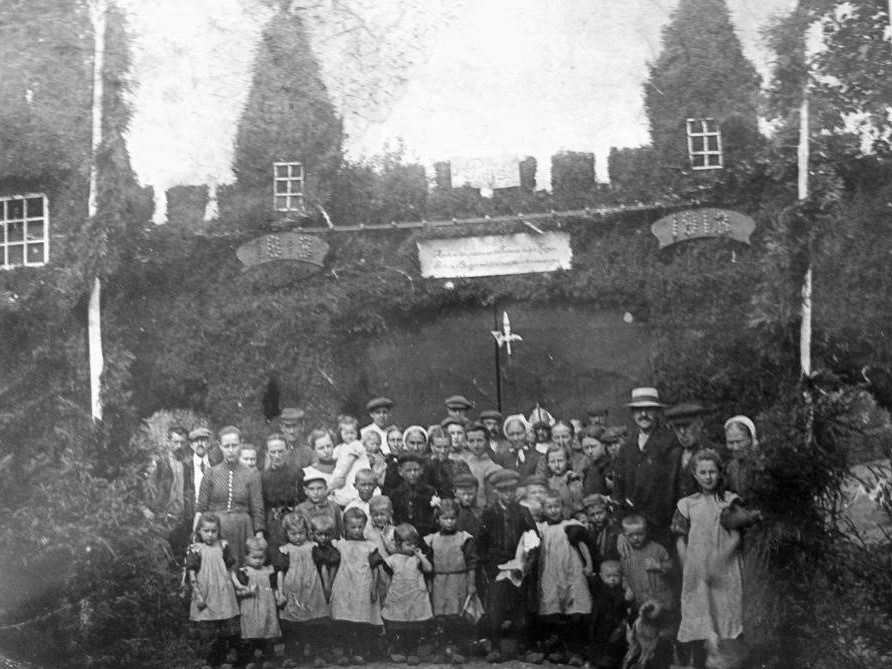
    The French slunk away, and the Netherlands was free. That is one hundred years ago now, and all that time we have been spared from enemies crossing our borders. There is, therefore, reason to festively commemorate the Netherlands’ deliverance with thanks to God. Let us value our freedom, for no greater disaster can befall a people than when they are dominated by strangers. At the centenary of our independence to be celebrated within the municipality of Aalten on 28 August next, let our age-old motto therefore ring out loudly: “Oranje boven”.

    Source