
‘t Zand, Bredevoort (destroyed)
Bredevoort Castle was a fortress in the heart of the eponymous town and former Lordship of Bredevoort in the County of Zutphen within the Duchy of Guelders. It was one of the most significant castles in Gelderland. During the 13th and 14th centuries, Bredevoort Castle played a major role in the struggle between Guelders and Münsterland.
The castle was first mentioned in 1188 on a list of properties belonging to the Diocese of Cologne as “Castrum Breidervort“. At that time, the castle was a site of contention. Consequently, it had multiple owners, leading to a centuries-long struggle for control. In 1238, the castle came into the hands of Ludolf van Steinfurt and Herman van Lohn as a shared inheritance. The castle was to be fortified, with both parties sharing the costs. In 1278, the fortress was destroyed by Count Everhard I von der Mark during an act of revenge. Following this, the castle remained a ruin for 23 years. A deed of sale from 1284 refers to the “area castri Bredevort”.
After years of conflict over Bredevoort between Münster and Guelders, the castle eventually returned to the hands of Count Herman van Lohn II in 1301. In that year, the bishops of Münster and Cologne pledged to assist Herman van Lohn with the restoration of the fortress. In the turbulent times that followed, the fortress frequently changed hands between Münster and Guelders through combat or sale. The bishops of Münster and Cologne were required to jointly fund the reconstruction of Bredevoort Castle.
After centuries of fighting over the castle, the Bishop of Münster abandoned the struggle and sought peace negotiations. Following years of negotiation, peace was finally signed on June 28, 1326, with the Treaty of Wesel. This significant treaty was also signed by the cities of Zutphen, Groenlo, Emmerich, and Arnhem. As a result, Reinoud II of Guelders acquired the pledge of the jurisdictions in Winterswijk, Aalten, and Dinxperlo, as well as the County of Bredevoort. This move definitively incorporated the area into Gelderland.
Floor plan
In 1562, the lord of the manor of Bredevoort, Diederik van Bronckhorst-Batenburg, Lord of Anholt, commissioned a floor plan of the castle at Bredevoort. This plan also described the functions and structural condition of the various components. Measurements were recorded in Rhineland feet. A Rhineland foot is over 31 cm long. The castle was a rectangle measuring 42 m long and 36 m wide. The walls were approximately 65 cm thick. An earthen rampart surrounded the castle, with roundels at the corners. The rampart was approximately 2 m wide.
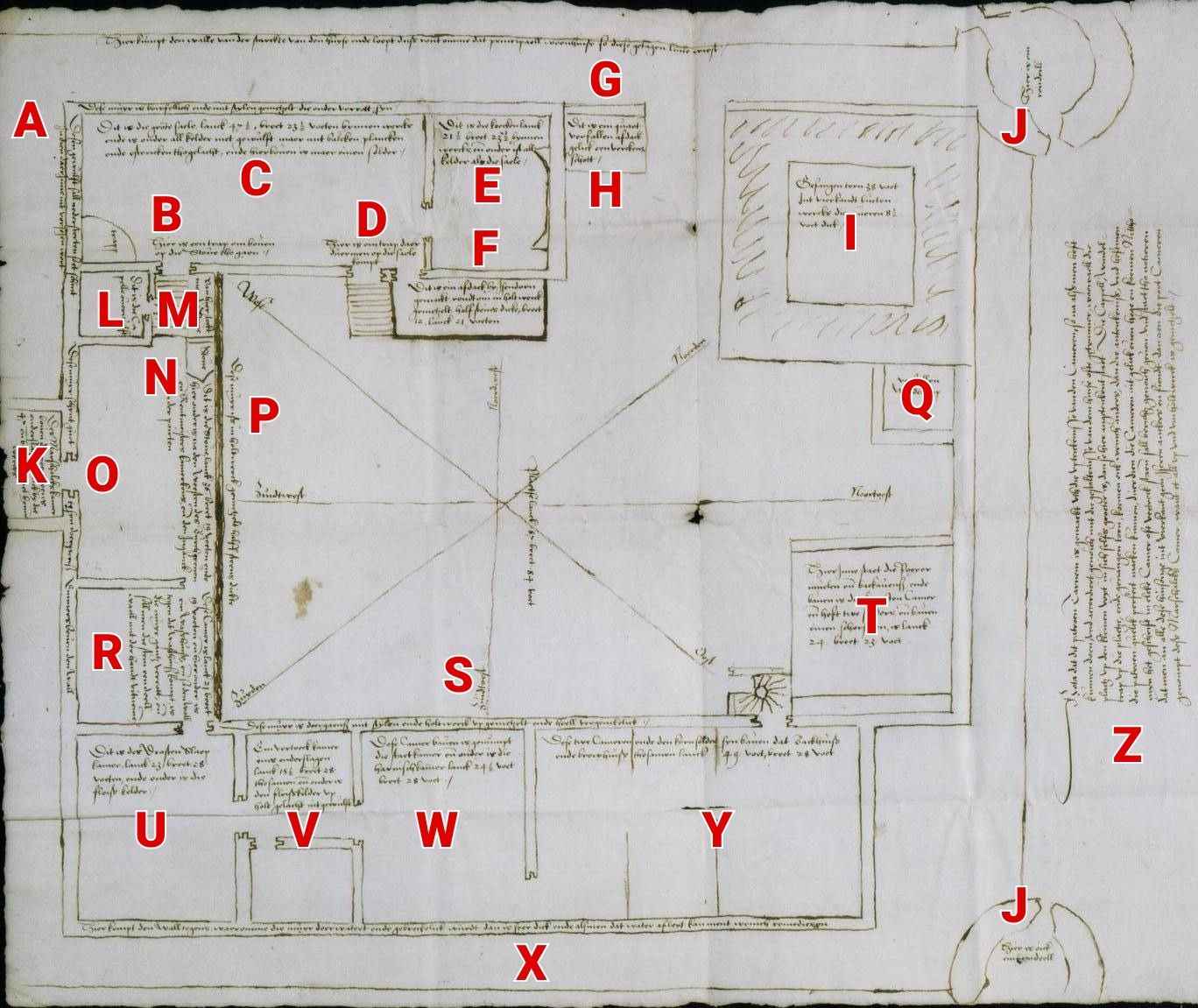
Explanations of the descriptions on the floor plan (translated from old script):
- This vault will collapse if it is not repaired soon.
- Here is the staircase leading to the knights’ hall.
- This wall is dilapidated. The vertical beams are rotted at the bottom. This is a large hall: 47 feet long and 23 feet wide, measured from the inside. Beneath it is a cellar. The floor consists of beams and planks and is finished with floor tiles. There is only one attic above the hall.
- This is a staircase to enter the large hall.
- This is the kitchen, 21 feet long and 23 feet wide. Beneath it is a cellar of the same size as the cellar under the large hall.
- This shed was built by Drost Isendoorn. The walls are masonry set between beams.
- This is the rampart that runs around the castle.
- This is a very dilapidated shed, much like a pigsty.
- The prison tower. It is 38 feet square (measured from the outside). The walls are 8½ feet thick. [This tower was likely used later as a powder tower, Ed.]
- Here are two roundels.
- The Drost’s chamber (Maarschalcksekamer) above the gate. [The name ‘Maarschalckse kamer’ dates from the period 1534-1555 when Marshal Maarten van Rossum was Drost of Bredevoort, Ed.]
- This is the chapel.
- From here, the hearth of the knights’ hall is stoked.
- This is the knights’ hall. The room is 36 feet long and 19 feet wide. Below this are the rooms of the burgrave (castle warden) and the steward. The gate entrance is also located below here.
- This wall is in good condition, as far as it can be seen above the rampart.
- This wall is built between wooden beams and has a thickness of half a brick. [The bricks used were ‘kloostermoppen’ of approximately 14 cm in width, Ed.]
- A dilapidated spiral staircase.
- Another room. Below this is a laundry room. Because the rampart rests against the laundry room, the wall is rotted. The stones are loose.
- This wall is largely built between wooden beams and is very dilapidated.
- This contains the grain mill and the baking ovens. Above is the servant’s room, with two attics and a chimney.
- This is where the Drost sleeps. The room is 28 feet long and 23 feet wide. Beneath it is a meat cellar.
- This room is divided in two. The floor is made of wood. The meat cellar also lies beneath this area.
- This upper room is called the salon (state room, armory). Below it is the armor room.
- Here the rampart touches the wall, causing the wall to let in moisture and show defects. The wall is very thick, and if the water could be kept out, it would likely provide some improvement.
- These two rooms, as well as the granary, are located above the bakehouse and brewhouse.
- This drawing was made in Arnhem after everything was measured as accurately as possible. The drawing is fairly accurate. However, in reality, some parts are slightly larger than depicted here, such as the chapel, the spiral staircase in the courtyard, and the prison tower.
External Appearance
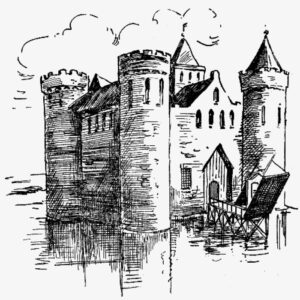
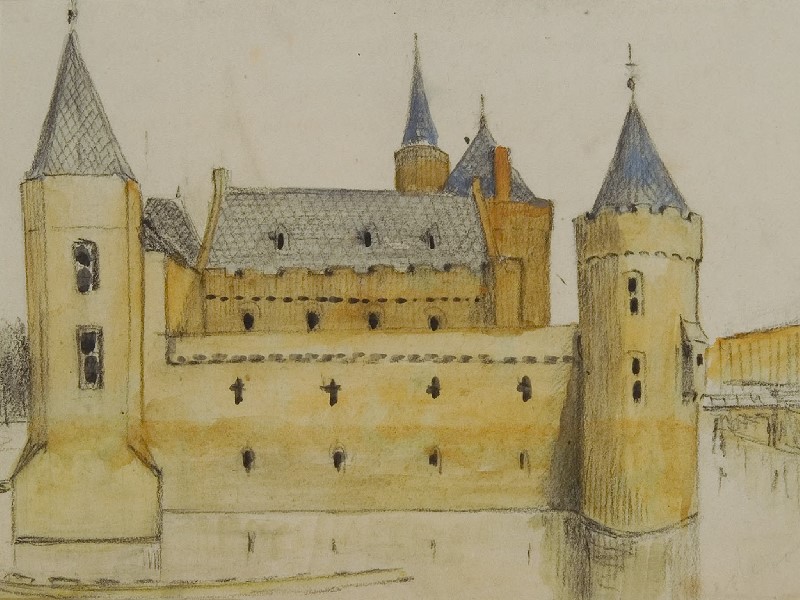
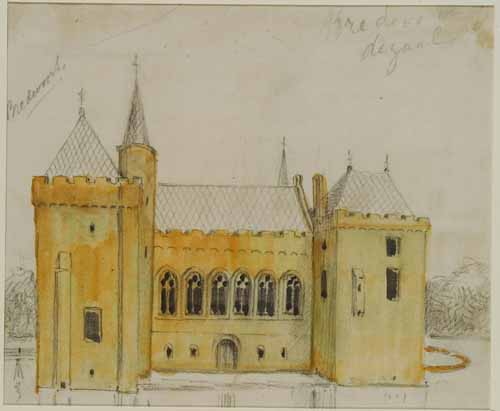
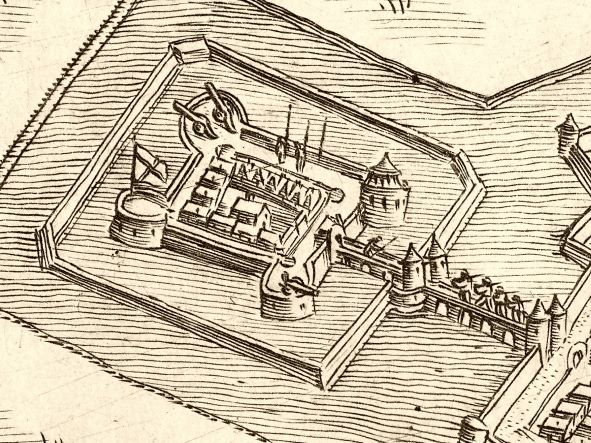
Not much is known about exactly how Bredevoort Castle looked. While drawings of the castle exist, they are partly based on assumptions and imagination.
The castle was built on a sandy ridge of approximately 42 x 26 meters, making it one of the larger castles in the Netherlands. Old maps show the main fortress to be a typical concentric castle, featuring double moats and a thick curtain wall. It included an outer bailey with heavy corner towers and a rectangular castle wall equipped with four corner towers, three of which were later lowered to become roundels.
The castle and the town were separated by a double moat. Access to the castle from the town was via a bridge. One had to pass through two gates, the second of which was equipped with a barbican, and finally a gatehouse in the curtain wall before reaching the inner courtyard. Within the fortress, various buildings stood around a spacious inner court. These depictions changed over time, and the appearance and stature of the castle would have been altered frequently throughout the centuries due to conflict, war, city fires, and other causes.
Destroyed
The castle was heavily damaged by the Gunpowder Tower Disaster in 1646. Following this, the castle dominated the cityscape as a ruin for over 150 years until around the end of the 18th century. The last known mention of a visible ruin dates to 1791, recorded in the Bredevoort church council minutes when William V viewed the remains during his visit to Bredevoort. The main building (excluding the outer bailey, roundels, and curtain wall) had dimensions of approximately 42 x 36 meters. This made it one of the larger castles in the Netherlands.
Remains
Today, the remains of the castle—in the form of foundations, vaults, tunnels, and rubble—lie beneath and around the ‘t Zand square and the Hozenstraat in the heart of the town. In the spring of 2009, during archaeological research around the former school on ‘t Zand, part of the foundations was uncovered. Wall remains between 2.5 and 4 meters thick were found. On ‘t Zand square, foundations of the barbican were discovered. The contours of this gatehouse have been made visible in the paving with brass-colored bands.
Sources
- bredevoort.nu
- Werkgroep Hebasa-ADW (1998), Stad en Land, uitgeverij Fagus
- Wikipedia
- Youtube-kanaal ‘bredevoort2008’