
Legionnaire from Aalten in the French Foreign Legion
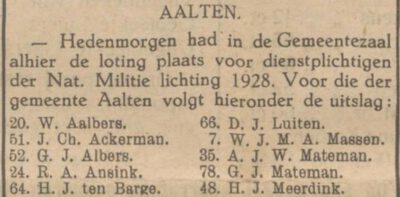
Willem Johan Marinus Anton Massen, known as Willem, was born on 2 March 1908 at Köstersbulte in Aalten, the son of Marinus Massen and Johanna Heinen. Before Willem’s first birthday, the family moved to Prinsenstraat 25.
He had a difficult childhood; his parents had been stripped of their parental rights. Willem’s father passed away on 4 March 1926. In August 1927, Willem was selected by ballot to carry out his military service in the Dutch army (the National Militia) in 1928.
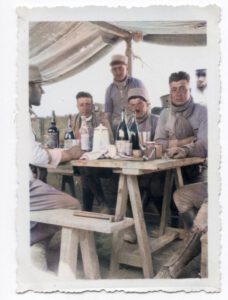
French Foreign Legion
Willem Massen evidently had adventurous blood, and he allowed an acquaintance to persuade him to sign up for the French Foreign Legion—an elite branch of the French Army consisting of military mercenaries from all over the world. At that time, when a Dutchman enlisted in the Foreign Legion, he lost his Dutch nationality and became stateless.
Willem served in the Legion from 1930 to 1935, a period during which the unit was primarily deployed for ‘pacification’ and border patrols in the French colonies of North Africa, specifically Morocco and Algeria. The Legion was a melting pot of international volunteers, often seeking to escape their pasts, who led a harsh, disciplined existence under new identities in the rugged desert and mountain landscapes.
Return to the Netherlands
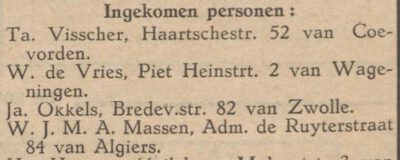
It is likely that Willem Massen completed his five-year contract, as he returned to the Netherlands in 1935. On 10 January 1936, the Aaltensche Courant reported in the ‘Arrivals’ column that Willem Massen had arrived from Algiers. He settled at Admiraal De Ruyterstraat 84, his mother’s address.
On 22 March 1943, the Twentsch Nieuwsblad reported that Willem had to appear in court for purchasing textiles without the legally required rationing coupons—a criminal offence under the rationing system controlled by the German occupier.
AALTEN
Without coupons. — The Aalten-based jointer W.J.M.A. Massen was summoned before the economic magistrate in Zutphen on Friday because he had purchased 1 tablecloth, 3 sheets, 3 pillowcases, and 47 towels without coupons. The Public Prosecutor demanded four months’ imprisonment, along with a fine of 200 guilders. The judge sentenced Massen in absentia to one month’s detention plus a 200-guilder fine (or 40 days’ detention) and confiscation of the seized goods, while acquitting him of premeditated intent.
„The Terror of the Achterhoek”
Under this headline, the following report of a session at the Zutphen District Court appeared on 1 April 1947 in the Zutphensch dagblad voor Achterhoek en Veluwezoom:
In the summer of 1946, the Achterhoek was repeatedly unsettled by burglaries and thefts. This changed when a pair of Aalten residents, known as “heavy boys” (hardened criminals), were caught and, in October, remanded in custody at the Zutphen House of Detention. On Friday, this duo had to answer to the Zutphen District Court, presided over by Mr A. H. van der Giesen. The summons charged them with acting together and in concert to steal a quantity of fabric—totalling some 600 metres in length—approximately 700 rolls of peppermint, 20 packets of fat, a quantity of yarn, and two coupons of corduroy (manchester), respectively belonging to N.V. Bontweverij in Bredevoort, F. J. W, J. D. Meijnen, and N.V. Confectiefabriek v/h D. Kamphuis and J. H. Platter.
M. had confessed to the thefts immediately and continued to maintain before the court that he had acted alone. His comrade, B. K., likewise insisted that he had not taken part in these thefts. However, there were many indications that K. had also played a role.
Firstly, there was the statement from Sergeant Klein Geltink that one man could not possibly have transported 600 m of fabric alone. Furthermore, the buyer of this fabric, J. S. from Aalten, stated that M. had been accompanied by B. K. And the man who had concealed the goods, J. A. K. from Aalten, stood by the statement he gave to the police: that M. and K. had brought the 600 m of fabric to him together, and that one or the other would subsequently come to collect portions of the stock. He had received 50 guilders for his trouble. The Public Prosecutor, Baron Mr Van der Feltz, demanded a prison sentence of 3 years for M. and K.; 1/2 year (with credit for time served) for J. S.; and 1 year for J. A. K., taking into account as an aggravating circumstance that the goods were intended for the black market. Jhr. Mr W. H. de Jonge appeared as defence counsel in the first two cases.
In his [the counsel’s] view, legal proof of theft by K. had not been established. Undoubtedly the man had played a role in the matter, but in his view, he could be accused of nothing more than receiving stolen goods. For him, the defence requested an acquittal.
The defendant M., who made a frank confession (ruiterlijke bekentenis), does not, in his [the counsel’s] view, deserve the heavy sentence demanded by the Prosecutor. The advocate outlined the man’s life story. His youth had been very difficult; his parents had been stripped of their parental rights. He had attended a weaving school, but evidently possessed adventurous blood and had been persuaded by an acquaintance to sign up for the Foreign Legion. The man had served in Morocco for five years and consequently lost his Dutch citizenship. He had found it very difficult to secure work in this country. The counsel understood that the court would impose a heavy sentence, but he requested, firstly, that the time spent in pre-trial detention be deducted and, furthermore, that a milder sentence be imposed than the one demanded by the Prosecutor.
The Public Prosecutor felt that the defence should not present the case more favourably than it was. This man was known as “the terror of the Achterhoek”. He has 12 convictions on his criminal record. The Prosecutor was, however, willing to consider the request made by Mr De Jonge to allow the court-imposed sentence to be served in a State Labour Institution (rijkswerkinrichting). Verdict in 14 days.
Earlier, on 27 March 1947, the Algemeen Handelsblad had published a shorter report of this session under the headline “The Terror of the Achterhoek before the court”. It mentioned that M. was 39 years old and came from Aalten. Based on his traceable year of birth and place of origin, M. was therefore indeed Willem Massen.
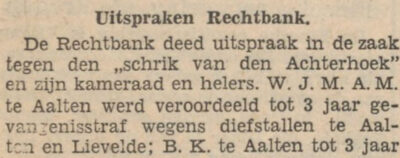
This was confirmed by the court’s verdict published 14 days later, which this time included all the initials of Willem Massen’s forenames.
Naturalisation
In 1965, Willem Massen submitted a request for naturalisation. His explanatory memorandum stated:
17 Massen, Willem Johan Marinus Anton, born in Aalten (Gelderland) 2 March 1908, jointer, residing in Aalten, province of Gelderland:
Willem Johan Marinus Anton Massen, nominated under 17, was born a Dutch citizen in Aalten in 1908. He lost his nationality by enlisting in the French Foreign Legion in 1930 without Royal consent. He has lived in the Netherlands again since 1935. His wife and children hold Dutch citizenship. As a jointer, he provides for himself and his family.
In 1967, he lived at Haartsestraat 56 in Aalten. No further information is currently available regarding his family or the date of his death. If you have more information, please let us know!
Ale Douma
Willem Massen was not the only resident of Aalten to serve in the French Foreign Legion. In 1950, Ale Douma, then living in Aalten, submitted a request for naturalisation. Douma was born on 10 August 1908 in Dronrijp (Friesland), the son of Sjerp Douma and Elisabeth Schuurmans. He served in the Legion during the same period as Willem Massen (1930–1935).
During the Second World War, Douma stayed in Germany, where he was twice imprisoned in concentration camps for aiding French prisoners of war. Ale Douma passed away on 12 January 1986 and is buried at Berkenhove Cemetery.