
In 1937, G.H. Rots described in a series of articles in the Aaltensche Courant how life used to be in Aalten in former times. Regarding the historical belief in witches, he wrote:
“According to popular belief, witches held gatherings at night, and in the Aalter Esch there was a specific spot where these nocturnal assemblies took place. That piece of land, located approximately halfway between the Linde and the Lichtenvoordsche road, was called the ‘heksenbeddestêe’. It was a piece of no man’s land to which no one laid claim.”
Anyone reading about what transpired in this field is stunned by the stories of witches and ghosts that circulated in earlier times. It reached such an extent that even educated people believed in witchcraft, and the authorities of those days intervened in this ‘evil,’ punishing those found guilty of sorcery.
To determine whether an accused person was innocent or guilty, the so-called water trial was applied: the victim was thrown into the water. If they floated, they were deemed a witch; if they sank, then what? Then they were not a witch, but they usually drowned. It was believed that those who could perform witchcraft could transform themselves into animals. Illnesses among livestock or even among people were often attributed to witches. If the milk had a blue tint, or if a clump of hair was found in a calf’s or cow’s stomach, it was all blamed on the witches.
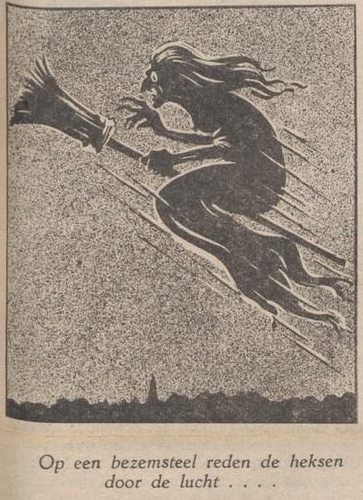
There were even people who believed themselves capable of witchcraft, claiming they had regular audiences with the devil. Witches were said to ride through the air on broomsticks and gather at the ‘beddestae’ in the Aaltenschen Esch to celebrate their nightly festivals. It should be said to the credit of the spiritual leaders of those days that they, at least, did not believe in it and repeatedly pointed out the absurdity of witchcraft to the population.
However, what is once deeply rooted is not easily dislodged, and so it took years, even centuries, before the superstition vanished. The authorities, primarily at the urging of the clergy, engaged in the suppression of witchcraft. They employed methods that were terrifying. If it was believed that someone could perform witchcraft or claimed to do so, the most severe measures were taken. Often the victims paid with their lives; even stakes were erected for burning.
Shivers down the spine
The old night watchmen could tell eerie stories of what they had experienced at night. The listener of these tales would feel ‘the shivers down their spine.’ For instance, it was told that ‘behind the hedges in the Heuksken,’ a woman dressed in white wandered every night. And then there was that mysterious light in the charnel house at the cemetery. Occasionally, mysterious animals were encountered that made the streets of Aalten unsafe. Furthermore, there were the ‘omens’ of fire. If a fire broke out in the village, one of the night watchmen had sometimes seen a ‘red glow’ above the site of the fire weeks in advance.
Berent Sweenen
Around 1600, a certain Berent Sweenen lived in Barlo. His neighbor, Geerdt Luiten, accused him of witchcraft. Luiten’s cows, pigs, and horses had regularly died of ‘unnatural sickness’ or sorcery. In the stomach of one of the cows he had cut open, ‘toads and snakes’ were found. Furthermore, Berent Sweenen’s sister ‘was also a witch.’ The whole place was hexed, and Luiten had already gone to Lichtenvoorde to complain. Berent Sweenen was summoned before the authorities and had to listen to all these accusations.
Luiten brought forward a new accusation. It was no longer possible to churn butter in his house. The cause: a hex by Sweenen. Another neighbor, Bernt Tolkamp, recounted that he had drunk buttermilk at Sweenen’s and had become ‘dreadfully ill’ from it. Tolkamp’s daughter had also fallen ill, likewise hexed by Sweenen.
More witnesses were called, namely Geerdt Winkelhorstink and Johan Merkerdink. They could only state that Sweenen had long been regarded as a sorcerer. Personally, however, they had not been troubled by him. A certain Herman Olthuys provided further incriminating testimony. Other neighbors recounted that they had hosted Berent Sweenen, who was a tailor, in their homes and that he had told them he could perform witchcraft. Eleven witnesses then took the oath and declared, invoking ‘God and His Holy Gospel,’ that what they had asserted was the truth.
Berent Sweenen, the simple tailor, maintained his innocence, but he stood alone. Eventually, under the weight of all those accusations, he gave in and said that he had understood the art of witchcraft for some 18 to 20 years. His fate was sealed, and given the punishments of those days, his head likely fell under the executioner’s axe. One case among many.
People pondered much. During the long winter evenings by primitive lighting, they saw all sorts of strange things. They heard wondrous tales, and when the old man sat in the corner by the hearth, he was asked to tell stories; then the tales of ghosts and witches would emerge, and at night in their sleep, people heard all kinds of sounds. The mystery of the unknown. That unknown, that mysteriousness, unsettled the people, and the case of Sweenen in Barlo is not unique.
Fourteen years earlier, the Bailiff of Bredevoort had already written to the Lady of the Pledge that witchcraft in Aalten was taking on ever greater proportions. One can conclude from this that the governing officials—the intellectuals of those days—also believed that witches existed. The fight against the ‘evil’ was therefore not conducted by convincing people that ‘witches’ cannot exist, but by the extermination of the individuals who carried out the evil.”
Aleida Voesters
“We wish to share one more case to provide an accurate picture of the dismal conditions in those days. It concerns a woman named Aleida Voesters. She was accused of witchcraft and thrown into prison, but was released when she promised to reform and paid a monetary fine. However, once the population views someone in a negative light, their reputation is ruined.
So it was for this woman. The population would not leave her in peace. The cup overflowed when a certain Wessel Wassink, a tailor by trade, claimed that he had fled from Mrs. Voesters’ house because he had heard devils quarreling there. The rumor reached the authorities again, and they deliberated on how to deal with this woman. The ‘executioner’ told the Bailiff that he knew a way to intervene with forceful measures. The woman was imprisoned again and transported to Bredevoort. She was thrown into the water and… she floated; she did not sink. Proof that she could perform witchcraft. They pushed her down with a long pole, but it seems that the excessive women’s clothing of those days prevented her from sinking.
The woman was then tortured with extreme cruelty. She was to be made an example. She was tied to a ladder and flogged, but the woman maintained that she could not perform witchcraft. Two days later, she was stretched on the rack again. But she did not confess. They tied a rope to her hands and hung her from a beam. At that moment, the pitiable woman let out a sound as if three men’s voices had called out. Immediately thereafter, her neck was broken. Her body was burned on a stake, made of wood that the farmers were expressly required to supply for that purpose. Such were the witch trials.”
Milk Witch
In a legal document from the Court of Bredevoort dating from 1533, we find the following story: The couple Gert and Lise Stapelkamp have a church pew in the Saint Helen’s Church in Aalten, which they claim was originally purchased by Gert’s mother, Sine Stapelkamp. However, the couple Koep and Nale Heinen claim it is their pew. During the service, Nale called Lise a ‘molkentoversche‘ (a witch who hexes cows) three times, after which Lise struck back. A significant disturbance in the church!
Sources
- ‘From Aalten’s Past’, by G.H. Rots, Aaltensche Courant, 26 November 1937 (Delpher)
- ‘From Aalten’s Past’, by G.H. Rots, Aaltensche Courant, 11 March 1938 (Delpher)
- “Wortels in de Achterhoek’, by Henk Harmsen, 1996 [p.17]