
Tubantia, 6 October 1951
Traveling—whether through one’s own country or abroad—is a pastime of all ages and all peoples. Traveling and the writing of travelogues also took place in Overijssel. The Deventer scholar Mr. G. Dumbar wrote extensively about our country in the 18th century, including Gelderland. In the ‘Tegenwoordige Staat van alle Volkeren’ (Gelderland section), he describes towns and villages in the Achterhoek, from which we derive several insights. Starting at Borculo and moving toward Lichtenvoorde, we shall recount how Dumbar viewed the old lands of the County.
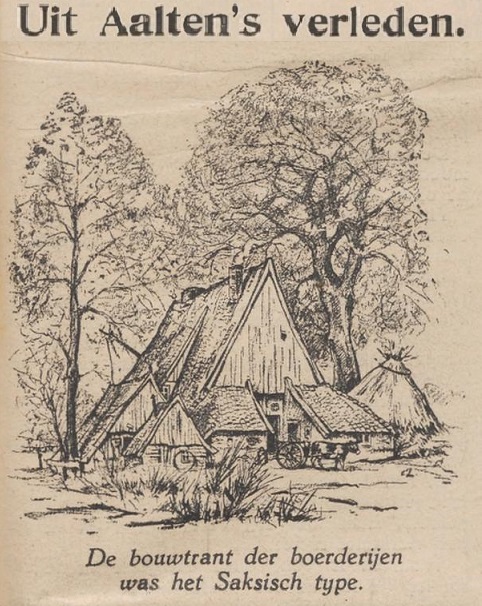
Much has changed; the heathlands and peat bogs have largely disappeared. The treacherous sandy tracks have been replaced by excellent paved roads. The impoverished, hut-like farmhouses have been transformed into proper dwellings for both man and livestock. Many forests have likewise vanished, and along with this progression over the last two centuries, numerous noble houses have gone as well. Towns and villages have changed, yet not so much that they have lost the prominence they already held to this day.
The Lordship of Bredevoort
From Neede, he moves on to the Lordship of Bredevoort, of which we read that it is of great antiquity. In 1245, the Castle of Bredevoort was granted as a fief by Herman, Count of Loon, to Otto of Nassau, Count of Gelre and Zutphen. William, Duke of Jülich and Gelre, pledged the fief in 1388 to Hendrik van Gemen for three thousand French Shields. Jacob van Bronckhorst later held the same right of pledge with the consent of the States of Gelderland. However, having chosen the side of the enemy in 1580, the town, along with the castle and the Lordship of Bredevoort, was given to Prince William I. His descendants still held the Lordship in 1741.
The Town of Bredevoort
As for the town of Bredevoort, conditions in 1741 were better than they are today. At that time, it was home to the Drost and the Richter, as well as two deputies, a Stadtholder, an Advocate-Fiscal, a Landscribe, and a Commander. Furthermore, several officers resided there. All these high-ranking gentlemen spent a great deal of money in the small town, which must have appeared very distinguished at the time. The common man living in the villages of Winterswijk—notably the largest village in all of Gelderland at the time!—Aalten, and Dinxperlo, had to dance to the tune of the Drost of Bredevoort and his clique.
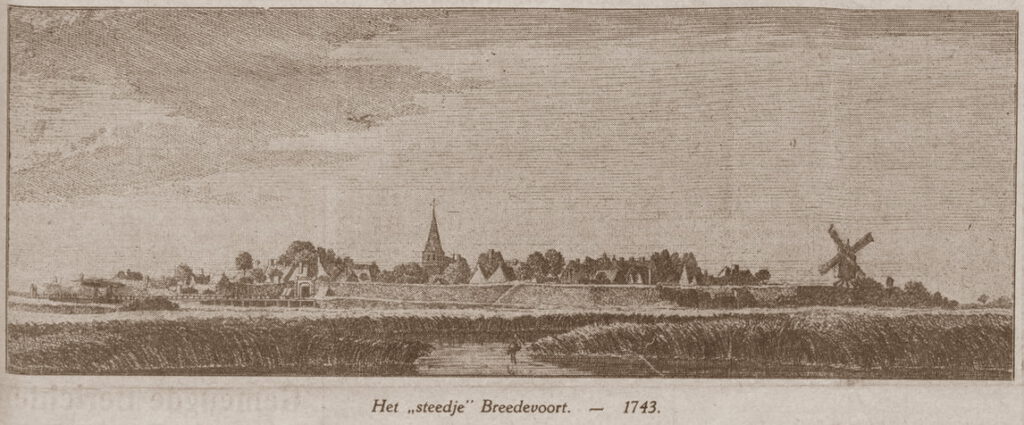
Bredevoort itself was said to be very strong in 1741. The surrounding lands consisted entirely of marshland, where no one dared to venture. Moreover, three companies of infantry were stationed there; where all these people were sheltered remains a mystery to me.
The citizens of Bredevoort made the outsiders from Winterswijk and Aalten feel that they were of a superior class. When it was bitterly cold in winter and the frost was hard, the people of Aalten and Winterswijk were required to come and chop ice for the ice cellars. The mail had to be delivered by the men of Winterswijk and Aalten for nothing. Additionally, a wagonload of twig brooms had to be delivered to Bredevoort every year. If a hunt for thieves, robbers, vagabonds, or wolves was to be held, the people of Aalten and Winterswijk were allowed to beat the bushes and carry the rifles, while enduring the insults of the gentlemen. How the people of Winterswijk and Aalten must have rejoiced when the French in 1795 put an end to this state of affairs.
Meanwhile, we now write 1951, and it must be said: the two Cinderellas, Winterswijk and Aalten, have become fine maidens since 1741 and are in a state of glowing prosperity. It is, however, the irony of history that the stepmother, Bredevoort, is now sometimes treated somewhat stepmotherly herself. When one walks across her uneven cobblestone streets, one cannot help but feel pity for the outgrown lady of two centuries ago.
Aalten Surpassed Bredevoort
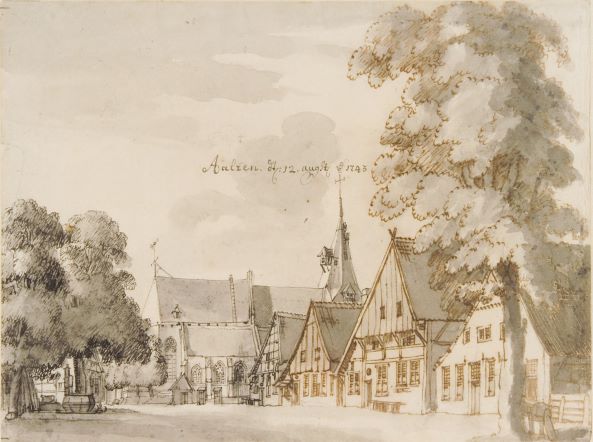
When the modern textile industry emerged, Aalten was the favorite. The Driessen family from Bocholt were the founders of Aalten’s rise, establishing themselves here as early as 1826. They attracted other industries. Although there were some dark pages in the previous century, Aalten turned the tables and is now the leader in the former Lordship of Bredevoort. Naturally, the municipality currently faces concerns as great as those of its sister municipalities, but that does not change the fact that Aalten has truly come into its own.
It is, meanwhile, astonishing how much marshland, how many vast heaths, and how many wild forests existed in 1741. If history had not been faithfully recorded and if we did not have more sources at our disposal, one could hardly believe that such conditions existed. Today, one sees prosperous lands and lush pastures that are a delight to the eye.
What we have described here is approximately all that is told of the Achterhoek. It is little. However, one must not forget that in 1741, someone from Amsterdam regarded the region we have described as a kind of jungle, which he preferred to stay as far away from as possible. It is therefore quite understandable that in earlier centuries, the population of East Gelre was much more closely related to Germany in economic and geographical terms than to the Dutch West. The attitude of the Germans has brought about a great change in this regard in recent years.
Van Coeverden — Goor.