
Emigrants from Aalten to the US
In the 19th century, thousands of Achterhoekers emigrated to the United States in search of land, freedom and new opportunities. Among them was the Heebink family from Aalten. They were among the early European pioneers who settled in Sheboygan County, Wisconsin.
On the corner of the Kerkstraat and the present Hofstraat there was once a house where the Heebink family lived. In 1801 Gradus Heebink (Aalten, 1773) married Dersken te Stroete (Aalten, 1776). They lived in this house and used part of it as a tavern. Their ‘address’ was Aalten 5.
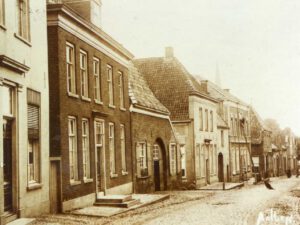
They had seven children, the first being a daughter, Elisabeth (1802). She was a vulnerable child with a deformity of the spine. This was followed by a son, Gerrit Jan (1804), named after his grandfather. He was a sturdy little fellow with all the traits of his Dutch origins. Little did they know that he would later become the father and grandfather of an entire community in America.
In 1806 daughter Hendrika was born and then another son, Derk Jan (1809). However, he died a week after his birth. This was followed by another son, Derk Hendrik (1810) and two daughters, Gerharda Johanna (1813) and Johanna Geertruid (1817).
To supplement the family income, Gradus also manufactured hats in addition to managing the tavern. Because it was customary for the eldest son to follow his father’s trade, Gerrit Jan also learned the trade of hatter. He became quite adept at it. Derk Hendrik served as an apprentice to a cooper and eventually followed that course.
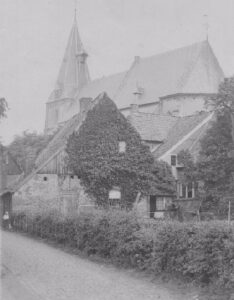
The other children helped in the house and in the garden, where they grew vegetables for the family. They also helped tend to a small plot of land outside the village boundaries, where rye and clover were grown as food for their two cows. These cows were grazed on the communal village meadow during the summer months.
Children in the poorer classes received very little education at the time. While Gerrit Jan learned to write legibly, he read poorly. This was partly due to a lack of practice and partly because he had poor eyesight.
Military service was compulsory at this time. In the period 1830-1833, Gerrit Jan served as a house guard in Breda for three years and four months. Belgium separated from the Netherlands in these years and it was one of its tasks to force apostates to be loyal to their country. Because Belgium was largely Catholic, many Dutch Catholics were positive about that country and their loyalty to the Netherlands was questioned.
Adult
The years had passed quickly for Gradus and Dersken and their family had grown up. Elizabeth had died in 1831 at the age of twenty-nine. She had always been frail because of her spinal weakness.
Hendrika was married in 1840 to Willem Heinen and they had a daughter named Johanna Aleida (1842).
Gerharda Johanna was married in 1845 to Lammert te Grotenhuis and they had two sons, Gerhardus Johannes (1847) and two daughters, Dersken (1849) and Tonia Johanna (1852). They would have another son in America, Lambertus or Bart (1856).
Derk Hendrik was married in Amsterdam in 1839 to Hendrika Geertruida van Buul. He had settled there as a cooper in the Jordaan. They had two sons, Gerhardus (1840) and Jan (1844). The eldest son had been very helpful to his parents and they depended on him for financial support to a large extent. He was a sailor and during one of his voyages he became very ill with dysentery. He died at sea and was buried in Batavia. The other son died during a storm on one of his voyages and was buried at sea. After the death of his first wife, Derk Hendrik remarried in 1850 to Elisabeth Fransiena Schagt. They had a daughter named Elisabeth Francina Hester (1853).
The youngest daughter, Johanna Geertruid, married Christoffel Schoemaker, who was also a hatter. They emigrated to America in 1848. He continued to make hats there for a while, until he became a Baptist minister. He was an inquisitive man and had an excellent command of three languages – English, Dutch and German. Joanna, his wife, died shortly after coming to America and was buried in Baltimore. Two sons were born, but they died at a young age.
After his return from military service, Gerrit Jan resumed his father’s millinery business and helped manage the inn. He became interested in a daughter of the Snoejenbos family named Johanna. She lived on the farm ‘Snoeijenbosch‘ on the Haart. They married in 1843. Gerrit Jan was thirty-nine years old at the time and Johanna twenty-four.
Gerrit Jan gradually took over his father’s business. It was common for the eldest son to continue his father’s business and support his parents during their advanced years. After the death of the parents, a settlement was reached with the other siblings for their share of the estate. Gradus was over the age of eighty and was happy to be relieved of business care.
Gerrit Jan and Johanna had four sons, Gerhardus Harmanus (1844), Herman (1846), Engelbert (1848) and Derk Johan (1852). Caring for four young sons was rather difficult for Johanna and her health suffered as a result. She became neurotic and was often ill. Gerrit Jan was a kind husband and father and helped in his calm, comforting way to share her burdens in any way she could.
America beckons
During this period in history, many Europeans became interested in the opportunities that America offered them and many families and entire communities emigrated across the Atlantic and settled in the United States. In August 1846 , Christiaan (Chris John) Snoeyenbos, Johanna’s youngest brother, had joined a group of emigrants on their way to America. He had settled in Oostburg, Wisconsin, and was now well established in the new country.
He wrote them letters, who were very enthusiastic about the opportunities in America. He urged them to come to America as well, where land was cheap and food plentiful, where the laws were so just and impartial that everyone had equal rights. Gerrit Jan and his wife became motivated and were up for it. However, they were afraid to share their wish with father Gradus, who lived with them. They believed that he was too old to undertake such a long and strenuous journey. So they carefully hid Christiaan’s letters from him. One day, Gradus found one of the letters and suggested that they also make plans to make the trip to America.
Gradus was as excited as a child about the emigration and began to make plans for the venture despite his advanced age. He collected his garden seeds and fishing nets for use in the new land. Unfortunately, his joy was short-lived. He contracted dysentery and became seriously ill. According to the doctor, he had only a few days to live. The plans for the trip were of course abandoned. Shortly before his death, Gradus called his children together and spoke to them. He told them that he wanted to be buried in his native country, which he loved, but that they should continue their emigration plans. Gradus Heebink died on August 13, 1854, just before their planned departure for the United States.
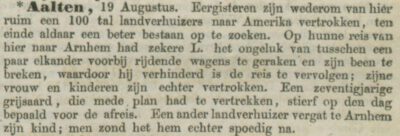
Despite the grief over the death of their kind, noble father, the Heebink family left a few days later, for their promised land. Before the emigrants left, a prayer meeting was held for them. Reverend Pape of the Reformed Church in Aalten held a farewell service. He stated that he understood the doubts and fears they would have for taking this step, but he encouraged them to have faith in God, who would help them overcome their difficulties and bring them safely to the promised land, America.
Cousins
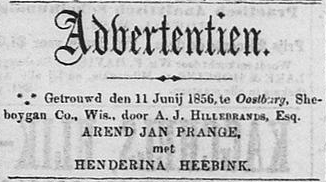
In 1852, niece Hendrina Heebink (Varsseveld, 1818) also emigrated to America. She was a daughter of Christiaan Heebink – a brother of Gradus – and Dora Willemina Doornink. Until then, Hendrina had been employed as a maid by ‘surgeon and midwife’ Servaas van Leuven and his wife Henrietta Wilhelmina Christina Theodora Rost. Until her emigration, she lived with the Van Leuven family, on the Bredevoortsestraatweg (nowadays no. 7). Hendrina married in 1856 in Oostburg with Arend Jan Prange (Aalten, 1823).
Her sister Elisabeth (Varsseveld, 1819) and brother Gerrit Jan (Vriezenveen, 1829) also emigrated to the US. Although it sounds plausible, it is not (yet) known to us whether they went together. Both married emigrants from Winterswijk. Elisabeth traveled to Sheboygan, just like Hendrina, but later moved to Iowa. Gerrit Jan ended up in Clymer, New York. His branch of the family is written as ‘Habink’ from 1860 onwards.
Across the Atlantic
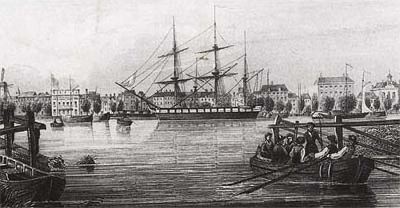
The first part of their journey, from Aalten to Arnhem, they made in covered wagons and took ten hours. At Arnhem, they boarded a boat that took them to Rotterdam, where the ship that would take them across the Atlantic Ocean was anchored.
In Rotterdam they were met by Derk Hendrik Heebink, the brother of Gerrit Jan. He lived in Amsterdam, but had come to Rotterdam by train. He came to meet the ship in a small rowing boat and brought sweets and food as farewell gifts. This was a memorable day in their lives, August 18, 1854.
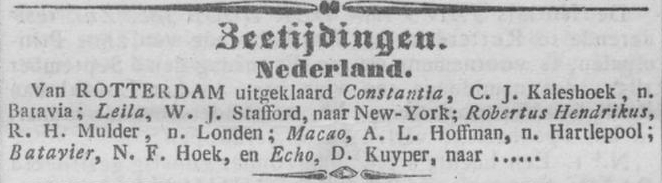
The ship was an English sailing ship named ‘Leila’, headed by Captain W.J. Stafford. There were three hundred and sixty passengers on board. Almost a third of them came from Aalten. The conditions on board were very unpleasant. The emigrants were tween deck passengers – the only type of accommodation offered. Before boarding, each passenger had to show their food to determine if it was sufficient for the trip.
Each family provided its own bedding. The bunk beds were hard and narrow. During a storm in which the boat rocked heavily, it was impossible to stay in the bunk beds. The water supply was kept on deck in large barrels. It tasted bad. The offer was limited and each passenger was only allowed to take a small part.
During such trips, deaths among travelers were no exception. Not even during this trip. On September 1, 1954, the thirty-four-year-old Anna Geertruid died in Gantvoort, according to the ship’s logbook of tuberculosis. It was common to encounter heavy storms at sea. One of them lasted two days. The ship was in total darkness and it was impossible to find anyone. Ten-year-old Gerhardus Harmanus (Gerrit) Heebink disappeared during this storm. When the captain gave the order to leave the deck, he was nowhere to be seen.
Mr. Vrieze searched all corners of the ship, but could not find him. The huge trap doors had to be closed without people knowing where Gerrit was. His parents were almost delirious, because they thought he had been washed off the deck into the ocean. There was no other option than to wait until the storm had passed to resume the search. The storm eventually ended and a sailor found him clinging to a rope with which he had saved himself during the storm. At another point, the boat hit a sandbar and all the passengers had to walk back and forth in an attempt to get it off the bank, which they eventually succeeded.
The journey became very tiring. Weeks dragged on in a month and they had not seen a land. The emigrants became concerned that their food supply would not be sufficient and they prayed daily that they would soon see land. Finally, on the forty-second day of their journey, word spread that land had been seen in the distance, and the passengers screamed with joy. At last America was in sight and on September 30, 1854, their long ocean voyage, which had lasted almost a month and a half, came to an end.
Arrival in New York
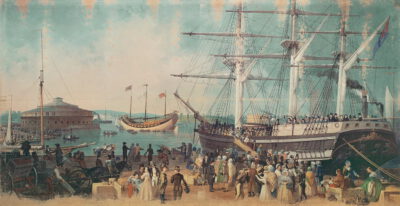
Because the water was too shallow for the ‘Leila’ to get close to the coast, the passengers were loaded into smaller boats and brought ashore. Before they were allowed to disembark, doctors came on board to examine them and determine whether there was any pestilence or diseases among the emigrants. Everything was good and the emigrants were very happy and relieved when they finally set foot on land again.
One of the first problems on the spot was the difficulty of making themselves understood, because none of them spoke English. Gerrit Jan was fluent in German and because many people in America spoke this language, it helped them considerably. From that time on, he took charge and was the spokesman for the emigrants.
Their next problem was to get a hotel for the night and find storage space for their luggage and belongings. They were advised to go to a certain hotel, not far from the dock. It was a second-rate hotel, but they were happy with it because they were hungry and tired and unable to travel far. They also found a place to store their luggage.
After reaching the hotel, Gerrit Jan was negotiating with the manager, while the other fellow travelers were waiting in the lobby near the dining room. Bessie Vrieze and Gerrit Grotenhuis were very hungry and took a cracker. One of the waiters had been watching them and had angrily beaten the young people. Gerrit Jan heard their outbursts and came to their aid and hit the waiter on the head. The manager of the hotel was called and he scolded the waiter for being so impatient with the hungry children.
They had spent the night well in the hotel and then decided to continue their journey by train. When Gerrit Jan wanted to pay the hotel bill, the clerk tried to charge him too much. Gerrit Jan strongly objected and eventually came to a reasonable settlement. They were still some 1600 kilometers away from their final destination and many more challenges would await them along the way.
Transit to Sheboygan County
They took the train from New York to Buffalo. From Buffalo to Toledo, they made the journey by ship. Gerrit Jan earned food for himself and his family by heating the boat. When they reached Toledo, they abandoned ship and arranged passage by rail. There were no passenger carriages available and one had to sit in a freight car without seats. The journey from Toledo to Chicago took three days. The train stopped at stations along the way so that they could buy bread and coffee. However, their food supply was very scarce. If the train happened to stop near an apple orchard, they often picked apples.
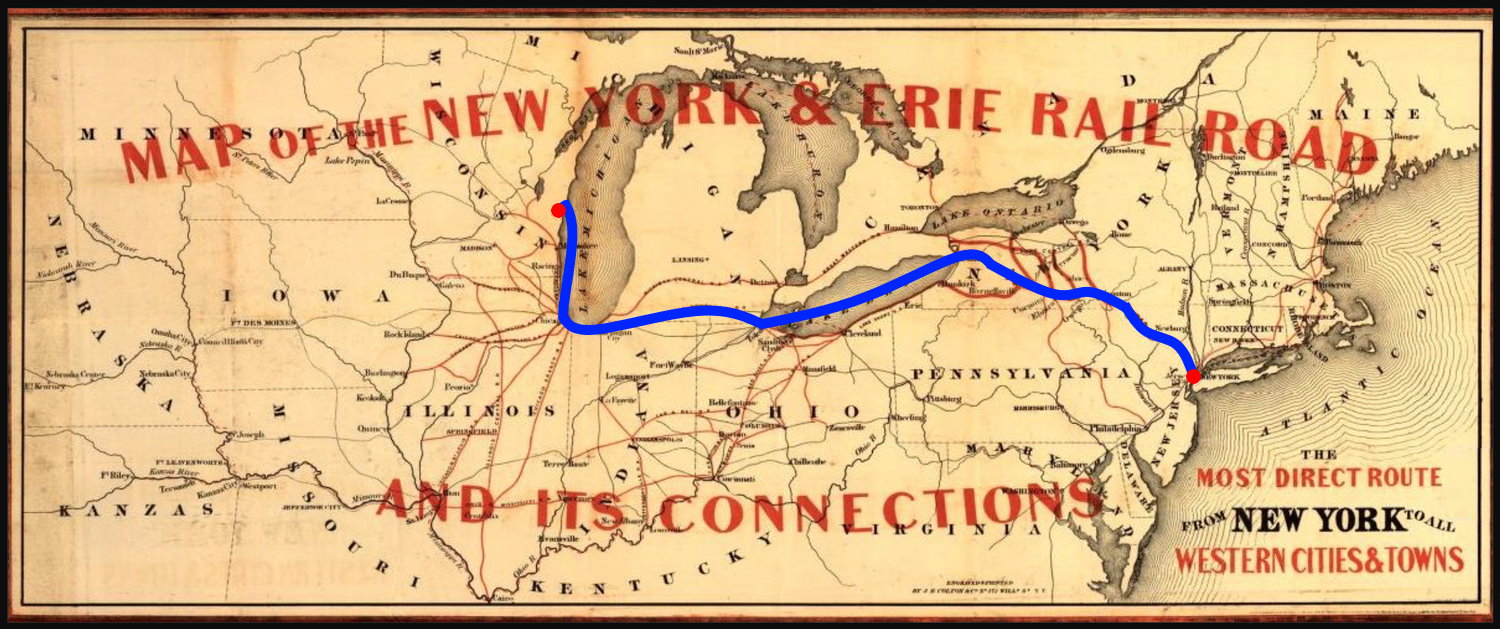
After three days they arrived in Chicago. They expected more trouble because they did not speak English, but fortunately they met a compatriot in the depot. He was a man from Zeeland. He was eager to help them and arranged accommodation for the group in a first-class German hotel. Some emigrants decided that they could better guard their suitcases and luggage when camping in the open air, so these did not go to the hotel.
It necessarily took more time to cook their meals over their campfire. As a result, they were not ready to leave when it was time to board the ship that would take them to Sheboygan. The Heebink group had been taken from the hotel to the dock in a flat cart and arrived on time on board the ship, which left at eight o’clock. The others stayed behind for the next ship.
The ship was expected to stop in Milwaukee, but to the disappointment of their friends and relatives who were waiting there to greet them, it did not. Grace Decker was one of the people waiting on the Milwaukee pier. The emigrants reached their destination Sheboygan at midnight. They were taken to the old Wisconsin House, which was owned by a German hotelier, Joseph Schrage, who treated them very warmly.
It was now only ten miles to their destination, Oostburg. Gerrit Jan and little Gerrit Heebink decided to walk to Oostburg to the house of Chris John Snoeyenbos and spread the news of their arrival. Then wagons and ox carts could be brought to bring them from Sheboygan to Oostburg. They had not yet gone far when they bumped into one of their old friends from the Netherlands, Mr. Walfort. He was on horseback and agreed to return with them. He offered them his horse to ride. They took turns driving back to Oostburg.
Arrival in Oostburg
Since there were no means of communication at that time other than a slow postal service, the relatives and friends in Oostburg did not know the exact date of their arrival, but they had agreed that the first person to hear the news would blow on a ‘dinner horn’ and this would be passed on to those who lived further away from Sheboygan. Immediately after Gerrit Jan and little Gerrit arrived, this was done.
The first farm Gerrit Jan came to was that of the Te Stroete family. They were busy threshing grain, but stopped all work to welcome the newcomers. A car was found to take them to Chris Snoeyenbos’ house, their final destination. News of their arrival had spread and a caravan of chariots and carts had gathered to meet them. They quickly left for Sheboygan where they would meet the emigrants waiting there and take them to their various destinations.
The ten-mile journey was a long, slow ride, but for the emigrants it didn’t seem long, as it was the last leg of their long journey out of Europe. Their destination was almost in sight and their new home where long-separated brothers, sisters, relatives and friends awaited them. Finally they arrived and what a joyful meeting it was! The daily activities were put aside and the day was spent visiting and welcoming the newcomers. Greetings and memories were exchanged, plans were formulated and it was a day that would never be forgotten.
Pioneering
Now the challenge followed to help the emigrants find a home. Of course, it took a while before people could buy a farm or rent a house themselves. They were all eager to find a home of their own before winter came. Their friends and relatives were happy to share the little they had with them. This trait was characteristic among the early pioneers and soon living quarters were arranged for all of them.
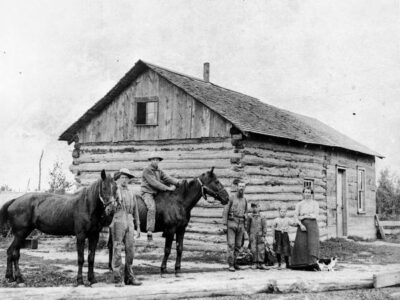
Chris John Snoeyenbos offered the Heebinks a home with him. They gladly accepted until they were able to build a hut of their own. Gerrit Jan Heebink ran a country shop from 1855 to 1861 for the convenience of his neighbors and a small part of the house was intended for this purpose. He also bought thirty hectares of heavy timber land that they began to cultivate. Later he built a small hut for his family.
In the year 1856 Gerrit Jan and his wife Johanna had their fifth child. It was a son and they named him George.
These were difficult years – not only for the newcomers, but also for the older settlers. In 1857, they underwent a depression known as the Panic of 1857. Money was very scarce and everyone lived on cheap food. There was little food for the cattle. The pigs were fed with beech nuts, which were plentiful. The Heebinks managed to earn a reasonable living from their shop and their timber land and therefore did not suffer from it.
Civil war
Then came the Civil War (1861-1865). At first, it seemed that it would be short-lived, but the true circumstances were not yet known at the time. Depression struck the community – in fact, the whole country. Food was scarce. The crops had been disappointing. Spring wheat had been a total failure, so flour was scarce. Fortunately, Gerrit Jan had sown winter wheat and winter rye and both crops had yielded a decent yield. For example, he was better prepared than many of his neighbors. He was a generous, kind man, and when his customers couldn’t buy flour, he lent it to them until they could afford it.
The war dragged on. President Lincoln needed more men, so men were called up for the army. More and more of them left, until there was no one left to do the work on the farm and it was left to the women. They took care of the supplies, worked in the fields, and it was a common sight to see threshing crews made up entirely of women.
The war dragged on to the bitter end. There was great joy in this patriotic community when they heard that the Union had won. However, they mourned the many who had lost their lives in the war. The assassination of President Lincoln on April 14, 1865 caused everyone great grief, because they had looked up to him as the only leader who could bring order to this troubled period.
The excitement of the Civil War had barely subsided when Indian rebellions broke out in Minnesota and Wisconsin. Several massacres had been reported in Minnesota, and Wisconsin also feared attacks. Bridges to Sheboygan City were raised and guns were stationed at strategic points, but fortunately the reports proved false. However, the Sauk tribe did pass through the community and caused a lot of fear and anxiety – but little damage was actually done.
A Sauk Indian Chief came to Gerrit Jan’s shop and demanded ‘firewater’. He was summoned out of the store, but before he left he showed a long-bladed knife very threateningly. Gerrit Jan was not afraid and slammed the door behind him. However, his son Bart was so shocked that he fainted.
In 1862 Gerrit Jan and Johanna had their sixth and last child. It was their first and only daughter and they named her Johanna. The following year, their eldest son Gerhardus Harmanus (Gerrit) married Gertrude Lemmenes, also an emigrant, born in Meddo.
More than ten years after their departure from Aalten, they had not yet been forgotten there. In 1865, their niece Johanna Aleida Heinen (1842-1925) wrote in a letter to her family in America: “… for I am now so very alone here. I still pass your house all the time, and Uncle Heebink also has his, and I sometimes look into it with attention.”
Happy Valley
One of the other Aalten settlers in Oostburg was aren’t Jan (John) Westendorp, born in Dale. He had become interested in land in the western part of Wisconsin known as Happy Valley in St. Croix County, 500 miles away from Oostburg. John decided to explore this area, he came back with the message that there was excellent agricultural land for sale. He had bought a plot of land there and intended to settle there in the short term.
Shortly afterwards he took his wife, Willemina (ter Haar), and his family, together with their personal belongings, to his new farm. Chris John Snoeyenbos and Gerrit Heebink Jr. accompanied them on this journey. Not long after, Herman Heebink and Lammert Vrieze also got the urge to see this pioneer country and they too left for St. Croix County on April 1, 1869.
They went from Sheboygan Falls to Fond du Lac and then by train to La Crosse, where they took a boat to Prescott. There was so much ice in the river that the boat didn’t get any further than Winona, so they took a train from there. They didn’t know that the train went directly through Prescott, so they went on to St. Paul, Minnesota. The Milwaukee and St. Paul Railway was the only one in Minnesota at the time, extending only to St. Paul. There was a small, poorly built depot near the Wabasha Bridge, and a five-cent toll was collected to cross the bridge. This was in the year 1869, and St. Paul had a population of only eight thousand. They spent the night in St. Paul in a small German hotel on Third Street.
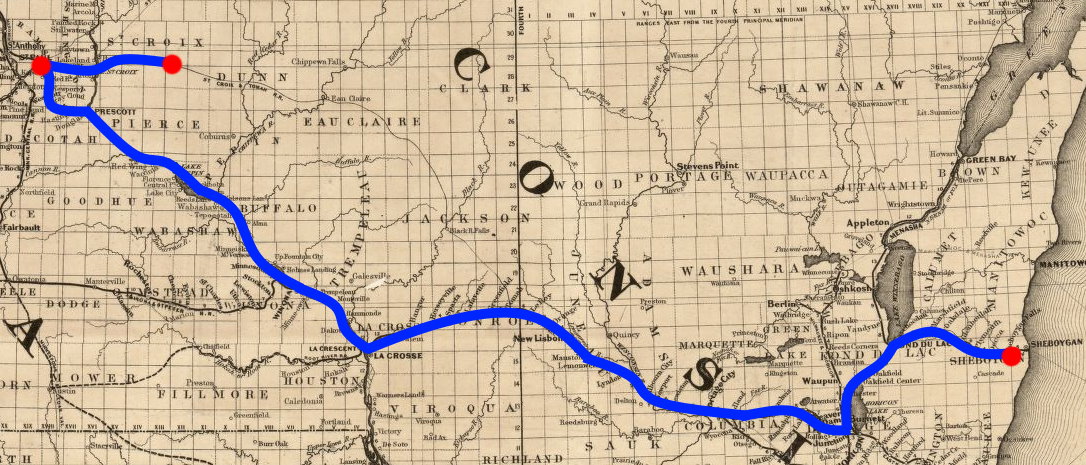
They left the next morning on foot for Happy Valley. When they reached Afton , they inquired at a farm how to cross the St. Croix River . The woman who opened the door was baking cookies and invited them to eat some of her warm cookies. They were so hungry and tired that this came to them as ‘manna from heaven’. The woman advised them to walk to the shore where they would find a trapper boat. They did so and waited for the treadle, which came at four o’clock. He was drunk and they were hesitant to cross with him, but it was their only alternative, so they decided to take the risk. In Hudson, they left their luggage and inquired about the way to Happy Valley. They were mistakenly directed to Pleasant Valley and after wandering back and forth for a mile they realized their mistake and returned to the main road.
The roads were wet and muddy, with crusts of ice and snow here and there. This made traveling on foot very difficult and forced them to rest regularly along the way. During one of their frequent rest periods, they heard a vehicle approaching in the distance. It was Chris McCabe and George Tubman who returned from Hudson with a truckload of rail studnails. They stopped to inquire where the boys were going, and when they learned it was John Westendorp in Happy Valley, they were invited to ride along while McCabe and Tubman walked. The tired boys were very grateful and would never forget their kindness. It gave them a very nice impression of their new neighbors.
At three o’clock in the morning they arrived at the Westendorp house in Happy Valley, tired, wet and almost exhausted. Because they had been on the road longer than they had expected, their money was almost gone – Herman had forty-three cents left and Lammert had two and a half dollars. They had walked no less than 70 kilometers. The Westendorp residents welcomed them warmly and gave Herman a job with them for a short time. The Herrick farm was for rent and Herman, Gerrit and Lammert decided to rent it. They each bought a yoke of oxen and rented three more yokes so that they could do their farm work well.
Baldwin, St. Croix
In 1869, St. Croix County was still very sparsely populated. Only a hundred people lived in Hammond. Four families lived on the eastern border of the township of Baldwin. Baldwin was more than 30 kilometers from Hudson’s transportation facilities, and people were anxiously awaiting the arrival of the railroad.
Herman Heebink and Lammert Vrieze soon found work. A strip of land from Woodville to Baldwin had to be cleared to make the railroad possible. They signed a contract to clear a space 30 meters wide and 20 meters of it had to be cleared of undergrowth. It was hard work to rid the land of pine trees and stumps and the felling of hardwood yielded little money, but they were happy with the little work that could be found.
For almost a year, Herman transported supplies for the stagecoach company and the railway. A beautiful road had been built for the stagecoach company. Because there was no other way to travel, the stagecoaches did good business.
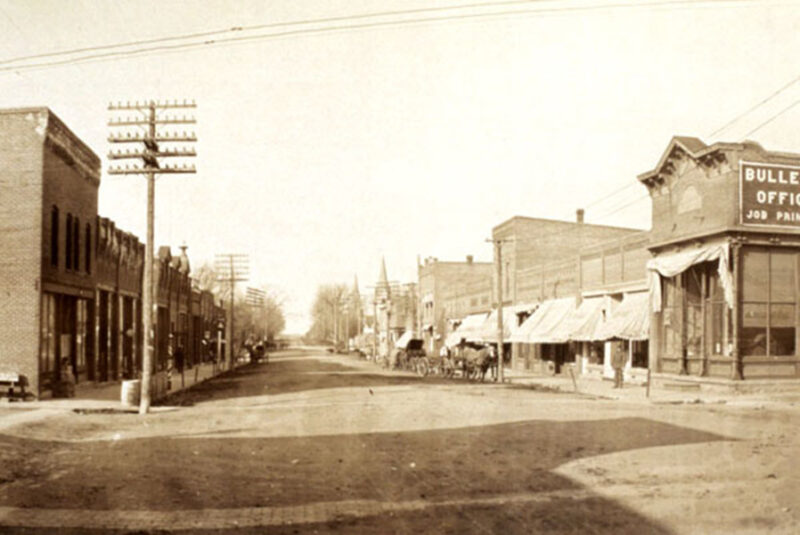
On November 24, 1871, the first train with passengers from Menomonia arrived in Baldwin. This was a memorable day. In the years that followed, more and more buildings were erected in Baldwin. Shops, a hotel, a saloon, saw and grain mills and a small school of six by nine meters. The small settlement gradually began to take on all the characteristics of a village.
Relocation
In 1872 Herman had returned to visit Oostburg and took his brother Bart back with him. Then their mother came to visit them and Bart took her back to Oostburg. Bart tried to persuade his parents to sell their property there and return with him to St. Croix County and establish a house there. After careful consideration, they decided to do so and Herman began to build a small house for them. They left Oostburg on the day after Thanksgiving Day in 1872, with Derk Johan (John), George and Johanna. The Snoeyenbos family had organized a farewell party for them where they said goodbye to their friends, neighbors and relatives in Sheboygan County. Then they started their journey through Wisconsin to Baldwin.
They were brought to the station by their cousin Gerrit te Grotenhuis . All their personal belongings were packed into a wagon and they sat on the packed boxes. Because the travel conditions by train were very bad, it took two days to cover the relatively short distance from Oostburg to Baldwin. When they arrived in Baldwin, there was no one waiting for them, so they waited in the depot for Gerrit to come and pick them up. After some time, Herman and Gerrit arrived with a team of horses and a bobsleigh to take them to their new home.
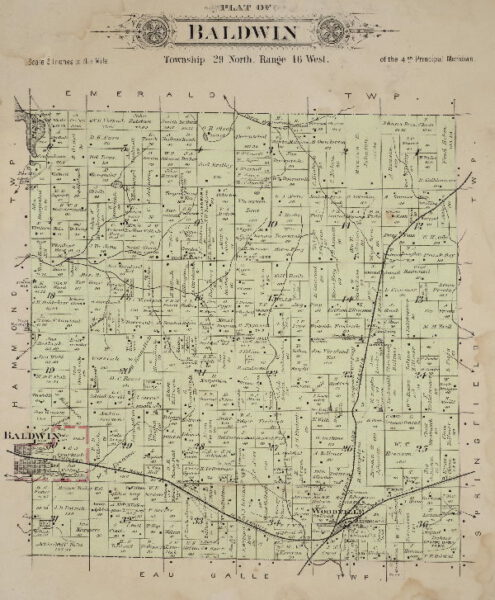
Herman had bought ten acres of land a mile south of Baldwin and built a house for them there. There had been no time to finish the interior so Herman, Bart and John finished it for them. Later they bought Herman’s house.
Bart bought 22 hectares of land in Hammond, cleared the land and built buildings there. In 1874 Bart married Gertrude Brethouwer from Oostburg, also a daughter of emigrants from Aalten, namely Adrianus Brethouwer and Geziena Rensink. For a while he engaged in diversified agriculture and then sold the land again, to acquire 65 hectares elsewhere in Hammond. He cultivated it and built a comfortable house there in 1890. Bart grew the usual crops and specialized in Hereford cattle and Poland-China pigs. He also kept brown Leghorn fowl and bred horses. Bart was a staunch Democrat and served on the school board for Hammond and Baldwin for six years. He was a member of the Presbyterian Church.
A few years later, in 1877, his brother Herman married Dena te Stroete from Oostburg, emigrant daughter of Gerrit Jan te Stroete and Janna Geertruid Peters, born in Winterswijk. Herman, Gerrit and Bart had set up a small grocery and trading business in Baldwin and did good business.
In 1885 John married Plona van Driest from Cedar Grove, daughter of Zeeland emigrants. They spent the first year and a half of their marriage with John’s parents, after which they bought a farm two miles north of Baldwin.
Gerrit and Bart both lost their first wives. Gerrit remarried in 1886 to Alice Flipse, daughter of Zeeland emigrants, and Bart in the same year to Anna Maria (Mary) Esselink, born in Winterswijk.
End of an era
In the meantime, the health of pater familias Gerrit Jan Heebink gradually declined. Although he was not ill for long, he died on December 17, 1887. His wife and family missed him greatly, for he had been a kind, generous man, loved and respected by all.
Herman had withdrawn from the trading firm and had set up a small timber yard in Baldwin. George also married, namely in 1892 with Dena Hoopman, daughter of former Aalten residents Abraham Hoopman and Johanna Berendina Wentink. For the first year of their marriage, they lived in Baldwin and later moved to a farm near Dahl, five miles northeast of Baldwin, where some of their eight children were born.
After Gerrit Jan’s death, his widow, Johanna Sr., lived for a while with her daughter Johanna and George in their house south of Baldwin. Later they moved to Baldwin in the old Norby house. Here Johanna ran a small boarding house. Later, Johanna married Neal Beaton. He was a photographer and built an establishment in Hammond where they lived for several years.
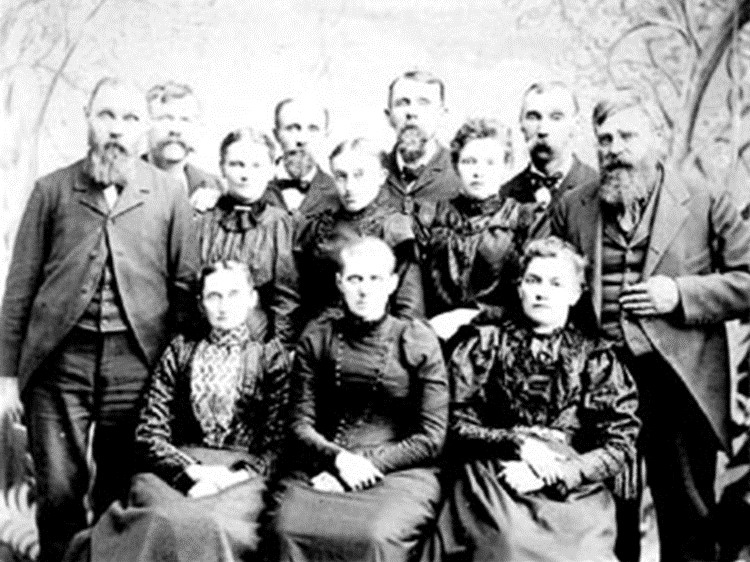
Mother Johanna Heebink-Snoejenbos then took turns living with her sons. She was in very poor health and suffered from severe rheumatism. She was unable to walk for the last seven years of her life and became helpless as a child. She died on 20 October 1898. She had been a kind, sympathetic mother, but because of her high-strung, nervous temperament and emotional nature, she had suffered much at a time when hardships abounded.
The twentieth century
The five brothers had all settled in the community in or around Baldwin. The trade and grocery trade flourished, but Gerrit had withdrawn as a partner and returned to agriculture. Bart retained his interest for a while, but the active work was taken over by Bart’s son, George B. Heebink.
John and George had a meat shop in Baldwin for a few years, but stopped to farm. George later moved to Souris, North Dakota. Johanna and Neil Beaton sold their photography shop and moved to Quebec, Canada (where Neil was born). Herman’s timber trade flourished.
After a short period of illness, Gerhardus Harmanus (Gerrit) died on March 16, 1910. His younger brother George died of colon cancer on December 9, 1919. Engelbert (Bart) died on April 9, 1934 as a result of kidney ailments. Herman reached the age of eighty-nine, after a short illness that eventually led to pneumonia from which he died on December 5, 1935. Derk Johan (John) died on 16 September 1940 in Baldwin. Johanna’s death in Canada in 1947 marked the end of this generation of Heebinks.
Around 1940, the offspring numbered almost 300 people. Most of them lived in Baldwin and the surrounding area. Many had also spread across Wisconsin, while others lived in North Dakota, Montana, Washington, Oregon, California, and West Virginia. Johanna’s children lived in different parts of Canada.
This story is largely based on ‘The Heebink History’, recorded in 1940 by Nell A. Heebink – daughter of Derk Johan (John) Heebink.
She wrote the following in her foreword:
“Family history details, unless recorded, are only stored in the minds and memories of our parents and ancestors. When they die, they are often lost to the current generation. In order to preserve a part of history for our current generation, I have collected anecdotes, stories and experiences in this booklet that may be of interest to them. It mainly relates to their former life in the Netherlands, migration to America, pioneering in eastern Wisconsin on the shores of Lake Michigan and their permanent settlement as a community in western Wisconsin. Herman and John Heebink have provided all the historical data in this booklet.”
This story was elaborated and published online in 1998 by descendant Joel Heebink and translated into Dutch in 2022 and supplemented by Remco Neerhof.
Sources
- ‘The Heebink History’, by Nell A. Heebink
- Aalten and Bredevoort in old postcards, E.M. Smilda
- delpher.nl
- Heritage Centre Achterhoek and Liemers
- sheboyganhistory.com
- UW-Madison Libraries
- wiewaswie.nl
- Wikipedia
- Wisconsin Genealogy Trails