Koningsweg, Aalten (disappeared)
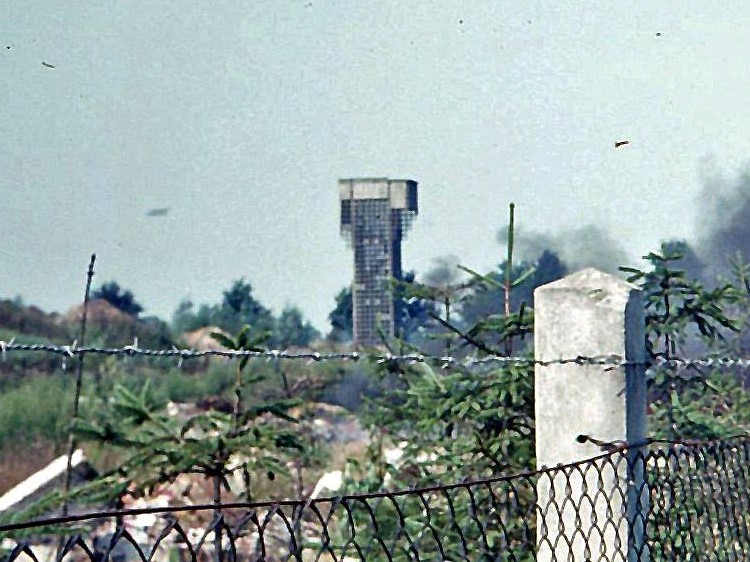
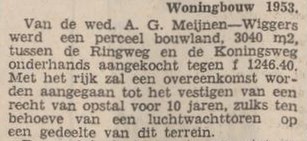
The Air Watchtower in Aalten was a concrete watchtower that was part of the national network of air watchtowers that was established in the Netherlands during the Cold War. The tower was located on the Koningsweg, on the outskirts of the village, and was intended to detect enemy aircraft flying lower than the radar systems could detect.
The Aalten air watchtower was a so-called ‘honeycomb construction tower’, recognizable by its characteristic honeycomb structure, a construction that offered both stability and strength. The tower, built of reinforced concrete, was fourteen meters high and the head of the tower was an open observation cabin with a hiding corner to protect against shrapnel. Neighboring municipalities such as Varsseveld and Winterswijk also had high lookouts, but not as characteristic as those in Aalten.
Searching for the enemy
The air watchtower in Aalten, codenamed ‘Isaac 1’, was inaugurated in 1953, at a time when the tension of the Cold War led to heightened preparedness. The tower was part of a network of 276 lookouts spread throughout the Netherlands and fell under the Air Guard Service Corps (KLD), a part of the Royal Netherlands Air Force that was under the Air Defense command. The Aalten tower was part of the command center KLD Deventer.
The purpose of the towers was to visually detect enemy, especially Russian, aircraft that flew below 200 meters and therefore remained out of range of radar equipment.
Crew and equipment
The crew of the tower consisted of two men who, regardless of the weather conditions, observed the airspace. Women were excluded from these tasks at the time. The crew members wore uniforms and were equipped with headphones and a mouth microphone. The observation was done with the help of a tripod equipped with a scope and a pointing needle. The ranks in the Aalten air guard consisted of soldier, soldier first class, corporal and sergeant. Mr. H.J. Prinzen from Aalten was local commander for a while.
The crew was trained to warn the surrounding towers in case of emergency and via a hotline also the command center. The staff was in an underground, nuclear-free bunker in Deventer. The tower was not continuously manned; only during exercises. Every two weeks there was a theory evening for aircraft recognition at a location in Aalten or Winterswijk.
Recruitment of volunteers
On May 20, 1953, a recruitment meeting was held by the Air Guard Service in the Society on the Hofstraat in Aalten. Commander Ruseler from Deventer provided information to the men who had been called up for this purpose. As an incentive to sign up, exemption from military service or participation in the Population Protection was offered. A number of men volunteered and joined the KLD.
Removal and demolition
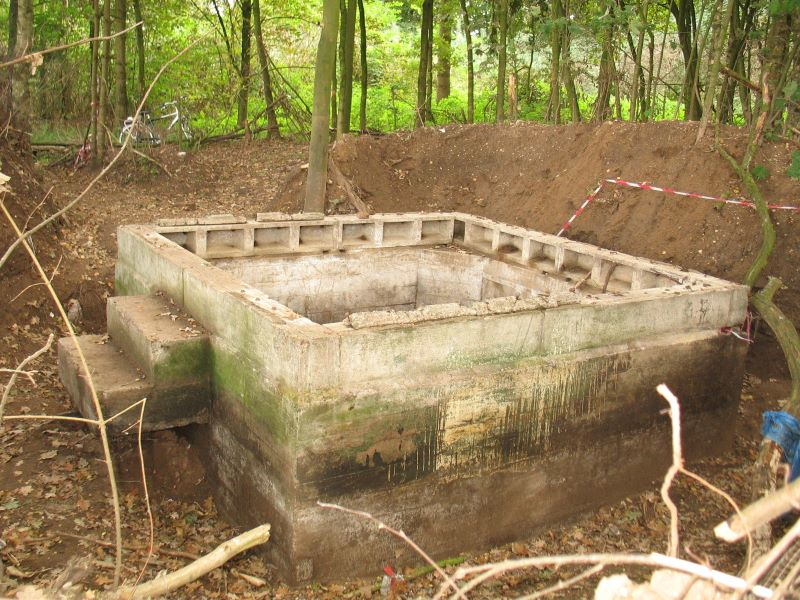
With the advent of more modern control systems and improved radar equipment, the need for visual perception became smaller and smaller in the 1960s. This eventually led to the dissolution of the Air Guard Service. The Aalten air watchtower was demolished in 1970, a spectacle that attracted a lot of interest from the local population. The heavy concrete foundation of the tower is still hidden underground and is a silent reminder of this chapter in history.
Features
| Cadastral no. | L-941 |
| Function | House |
| Year of construction | ca. 1953 |
| Demolition | 1970 |
Sources
- Municipality of Aalten
- Ina Brethouwer, CC-BY-NC
- Cadastral map
- Research by Mr. J.W. Geesink, published in Contactorgaan ADW (see Heritage Center Achterhoek and Liemers).