


During the Second World War, food became increasingly scarce. Although the severity of the situation differed per region, people everywhere had to deal with ration cards and family cards. These were wanted, but at the same time objects of irony. In a clandestine paper, which was distributed in Aalten, there was a curious recipe:
“Take the meat card, roll it in the flour card, put it in the fat card and fry it with the coal card until deliciously brown. The potato card is placed in the butter card and slowly braised in the petroleum card. Then you heat up the coffee card, add the milk card and the sugar card and dip the bread card into it. Take two bread coupons, put one meat coupon in between and you have a sandwich. After dinner, one wipes one’s mouth with the pedigree. Enjoy your meal.”
Food shipments to the west
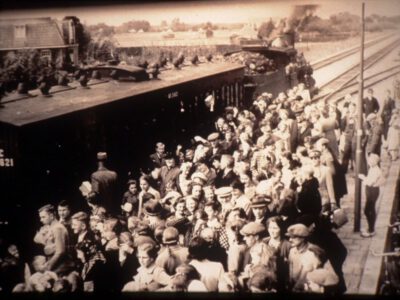
Despite the war conditions, the Achterhoekers generally did not have a bad life. Even with 2500 people in hiding out of a population of 11,000 inhabitants, people in Aalten could eat reasonably well. There was even enough food available to send large quantities to the starving West.
The bakers in Aalten stood in front of the oven for hours every day. Masses of rye bread and other foodstuffs went daily by train from half past four in the afternoon to the west. Not only in Aalten, but also at other stops on the Winterswijk-Arnhem line, food was given for the hungry population in the west of the Netherlands.
The first shipments of rye bread to the west began in 1942. In 1944, a horse-and-cart with sixty to seventy bags of rye bread drove daily from the post office to the station in Aalten. The half-past four train soon became known as the ‘Rye bread train‘ and grew into a household name. In the first annual report of the P.T.T., which appeared after the war, there was even a photo of the loading of the many rye breads.
In September 1944, the Roggebrood train came to an end due to the national railway strike.
The Rye Bread Train would run one more time
On the occasion of the 25th anniversary of the liberation, the Orange Committee and the local branch of the 1940-1945 Foundation organized liberation celebrations in Aalten from 4 to 6 May 1970. One of the highlights of these festivities would be a reunion of people in hiding and veterans. The intention was that the people in hiding would stay at their old hiding place as much as possible. On Liberation Day, 5 May, a memorial meeting with the pastors and the chaplain from the war years, and an allegorical parade were on the program. The NCRV paid attention to this Aalten initiative on Nederland 2.
The NS would use a special train for the transport of the reunionists: the old Rye Bread Train. With the same equipment with which rye breads were transported during the war, the veterans and people in hiding would return to Aalten to celebrate the 25th anniversary of the liberation. This time, however, the Rye Bread Train would run in the opposite direction, from the west to the east, to bring the reunionists to Aalten. For this special occasion, a special train ticket would even be designed.
Unfortunately, shortly before the commemoration celebrations, the organization decided to cancel the reunion, the most important part of the program. The reason for this was that there seemed to be insufficient interest among the people in hiding. Afterwards, however, there were signs that something might have gone wrong with the sending of the invitations. Anyway, the Rye Bread Train definitely remained a memory of the past