

Nijhofsweg 4, Barlo
On March 30, 1945, the Aalten rural district of Barlo was liberated by the Allies. During the relief of Barlo and the surrounding area, an air-raid shelter at the Nijhof farm was hit by an Allied bomb aimed at the retreating Germans.
During the skirmishes between the warring parties, the seven children of the Weenink family, the Elfers couple who had fled from The Hague and the Nijhof couple and daughter Wanda hid in the shelter of the Nijhof farm, which was considered a reliable hiding place.
Headmaster Weenink, who had fourteen children, lived next door to the school that had been taken over by German soldiers. When the alarm went off, he sent his children to the shelters outside the center of Barlo, because he thought it was too dangerous there. Seven children fled to the shelter at the Nijhof farm on the Nijhofsweg. The other children went to the shelter of farm ‘t Markerink. The shelter at Nijhof was not under, but next to the house. The house remained unscathed.
The last bomb dropped from an Allied plane fell on the shelter. The people in it were buried under earth and tree trunks. The Nijhof family was just at the entrance of the cellar to see if the bombing had ended and was spared by this. But five of the seven children and the couple from The Hague died. The liberation of Barlo would become a day of mourning because of this tragedy.
The seven victims were Thomas Elfers (74 yrs.), Helen Elfers-Reisenleitner (74 yrs.), André Weenink (6 yrs.), Co Weenink (17 yrs.), Jan Weenink (3 yrs.), Mien Weenink (20 yrs.) and Rudolf Weenink (6 yrs.).
Monument
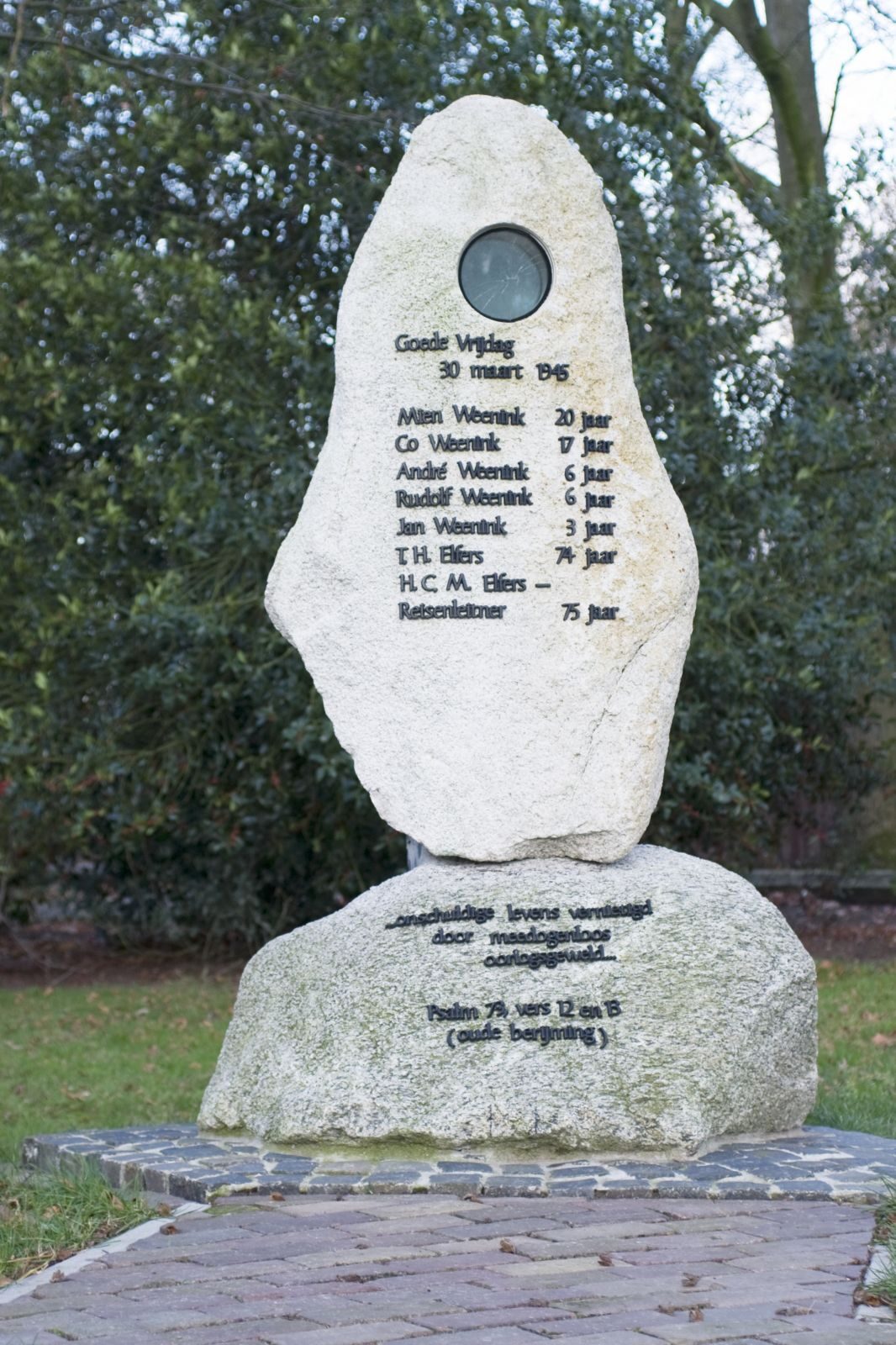
On the initiative of the Dwars door Barlo Foundation and the relatives of the victims, a monument has been erected in memory. The monument was placed at the Nijhof farm and was unveiled on March 30, 2009. The monument consists of two boulders, one standing upright on top of the other. In the top stone is a round hole with a piece of broken glass in it, as a symbol of the irreparable damage. Below are the names and ages of the victims. On the bottom stone, which serves as a pedestal, is a quote from the Bible. An information board has also been placed at the monument.
The text on the monument reads:
‘GOOD FRIDAY
MARCH 30TH, 1945
MIEN WEENINK 20 YEARS
CO WEENINK 17 YEARS
ANDRÉ WEENINK 6 YEARS
RUDOLF WEENINK 6 YEARS
JAN WEENINK 3 YEARS OLD
T.H. ELFERS 74 YEARS
H.C.M. ELFERS-REISENLEITNER 75 YEARS’.
On the pedestal is the quote:
‘INNOCENT LIVES DESTROYED
BY RELENTLESS
WAR VIOLENCE
PSALM 73, VERSES 12 AND 14
(OLD RHYMING)’.
The text on the information board reads:
‘MONUMENT IN MEMORY
ON GOOD FRIDAY, MARCH 30, 1945, THE LAST BOMB FELL
THIS PLACE WHERE AN AIR-RAID SHELTER ONCE STOOD. THIS WAS
THE END OF THE SECOND WORLD WAR IN THE
HAMLET OF BARLO. THE STRONG HIDING PLACE OF THE
NIJHOF FAMILY TURNED OUT NOT TO BE ABLE TO WITHSTAND SUCH NOTHING
RUTHLESS VIOLENCE OF WAR.
THE NIJHOF COUPLE AND THEIR DAUGHTER SURVIVED THE
WOOF; THE ELFERS COUPLE AND FIVE WEENINK CHILDREN
DIED.
THE FIELD BOULDERS SYMBOLIZE THE LEADEN AND MASSIVE
SADNESS. THE HOLE WITH THE – BROKEN – GLASS IN ONE OF THE
ERRATIC STONES SHOWS US A GLIMPSE OF A NEW
FUTURE, ALTHOUGH IT WILL NEVER BE UNSCATHED.
WE HOPE THAT THIS PLACE OF REMEMBRANCE WILL MAKE YOU QUIET
STAND BY THE GREAT GIFT OF FREEDOM THAT WE
NOW WE CAN LIVE. LET US BE CAREFUL WITH THAT
AND TO WORK TO HELP OTHERS IN THIS WAY AS WELL.
TO GIVE THE WORLD THAT FREEDOM.
FOUNDATION DWARS DOOR BARLO.’