


During WW I, Aalten offered shelter to many foreign refugees.
It was 28 July 1914 when the First World War broke out. Two days later, the Netherlands declared its neutrality. As a result, we were spared the great horrors of this war. However, the Netherlands soon faced an entirely different problem: refugees. Many escaped prisoners of war, deserters, and civilians arrived from the surrounding countries to find a safe haven here. This was also the case in Aalten.
Newspaper reports
“Italian refugees. In Aalten, the presbytery and the pastor’s house of the Christian Reformed congregation have been reserved for some Italian families who have fled from Germany.”
Het Vaderland, 22 May 1915
“We received word from the eastern border: That it is by no means easy for escaped prisoners of war to cross the border is evident from a report by the Feldwebel (sergeant) stationed near the hamlet of Kotten on the border of the municipality of Winterswijk. He stated that in the last few weeks, no fewer than 70 fugitives have been apprehended in the border zone along the municipalities of Winterswijk and Aalten. Nevertheless, during that same period, approximately 20 prisoners of war—Frenchmen, Russians, Belgians, and also an Englishman—managed to reach Dutch territory in that area.”
Arnhemsche Courant, 25 March 1916
“The flow continues. At Aalten, two Austrian and one German deserter crossed the border on Tuesday.”
Nieuwsblad van het Noorden, 1 September 1916
“Aalten, 29 Dec. The number of refugees, prisoners of war, deserters and civilians who have arrived here across the border in recent days is very large. No less than 25 Russians arrived here who had worked in the coal mines in Germany. All were transported to Rotterdam. In addition, 17 Poles, two of whom had their wives and children with them. They had come from Courland and had worked in the mines for a wage of 9 to 10 marks a day; The poor diet had forced them to move to our country. They had had a very difficult journey. Furthermore, 4 deserters and 1 escaped French prisoner of war arrived. On Wednesday another French prisoner of war arrived here, who had escaped with two others from a prison camp in Germany. One of them was shot before he reached the border, and the other wounded and taken prisoner. Yesterday afternoon two more Russians and a German deserter arrived and this morning another German deserter reported to the border guard.”
Zutphensche Courant, 30 December 1916
“Saturday evening, and Sunday morning, 9 Russian Poles, a Belgian and a Russian cavalryman-non-commissioned officer crossed the border at Aalten.”
Het Nieuws van den Dag, 16 January 1917
“In Aalten we crossed the border and left for Amsterdam on Monday a German deserter with his wife, two children and a servant. The woman was born in Argentina.”
The News of the Day, 23 January 1917
“In recent days, a lot of refugees and deserters have crossed our border again. Yesterday morning 15 Russians arrived in Aalten, fleeing from German captivity.”
Provinciale Overijsselsche en Zwolsche Courant, 26 January 1917
“At Aalten three German deserters and three French soldiers who had escaped from the camp at Mühlheim came across the border on Sunday. Among these six was the guard of the said camp, who had acted as a guide for the refugees.”
The News of the Day, 20 November 1917
“In Aalten, two French prisoners of war crossed the border on Saturday. They had escaped from a camp in Friedrichsfeld.”
Het Nieuws van den Dag, 10 June 1918
“Today, Friday, 316 French, 22 Belgian and 2 Italian prisoners of war were expected here from Winterswijk.”
Aaltensche Courant, 29 November 1918
French refugees in the Festivities Building
Towards the end of the First World War, a second wave of refugees started from northern France, mainly of French, but also Belgian citizens.
Friday, September 27, 1918 – In northern France, the German occupying forces had called on the population of some 250 towns and villages, which were located between the Hindenburg Line established by the Germans and the border with Belgium, to leave their homes. Heavy fighting was expected now that the Allies pushed the Germans back towards Belgium, so it would be better to evacuate the region. Those who responded to the call often traveled on foot through occupied Belgium, taking their meager possessions with them. The Netherlands had promised to provide temporary shelter to a large group.
Saturday, October 26, 1918 – Arnhem was a place of passage for French refugees. At 18:00, 350 refugees arrived here. They would be transferred to Borculo, Groenlo and Aalten the next day. On Sunday evening, another 800 to 900 refugees arrived, who would go to various places in Gelderland on Monday. Members of a certain group wore bands of the same color around their arm as a distinguishing sign.
Sunday, October 27, 1918 – It was a turbulent Sunday for the normally quiet Aalten. On Saturday, the mayor had received a message that in his municipality, as in other places in Gelderland, a large number of refugees, men and women, had to be accommodated. A meeting of the Committee for the Aid of Refugees, founded in 1914, was hastily convened. It was decided that the men would be housed in the Elim building and the women and children in the Festivities building . Furthermore, the necessary measures were taken to provide the refugees with food and drink.
Sunday afternoon 13.00 hours a large crowd of people had gathered at the station . The members of the fire brigade were on the platform to provide the necessary assistance in transferring the guests. It was a long train that transported not only Aalten but also a hundred refugees for Winterswijk and Groenlo. The supervisor, a merchant from Antwerp, got out and invited the 108 men he accompanied to follow his example. Groups of four lined up, the luggage was loaded onto a truck, and so the procession, surrounded by a large crowd, made its way to the Festival Building.
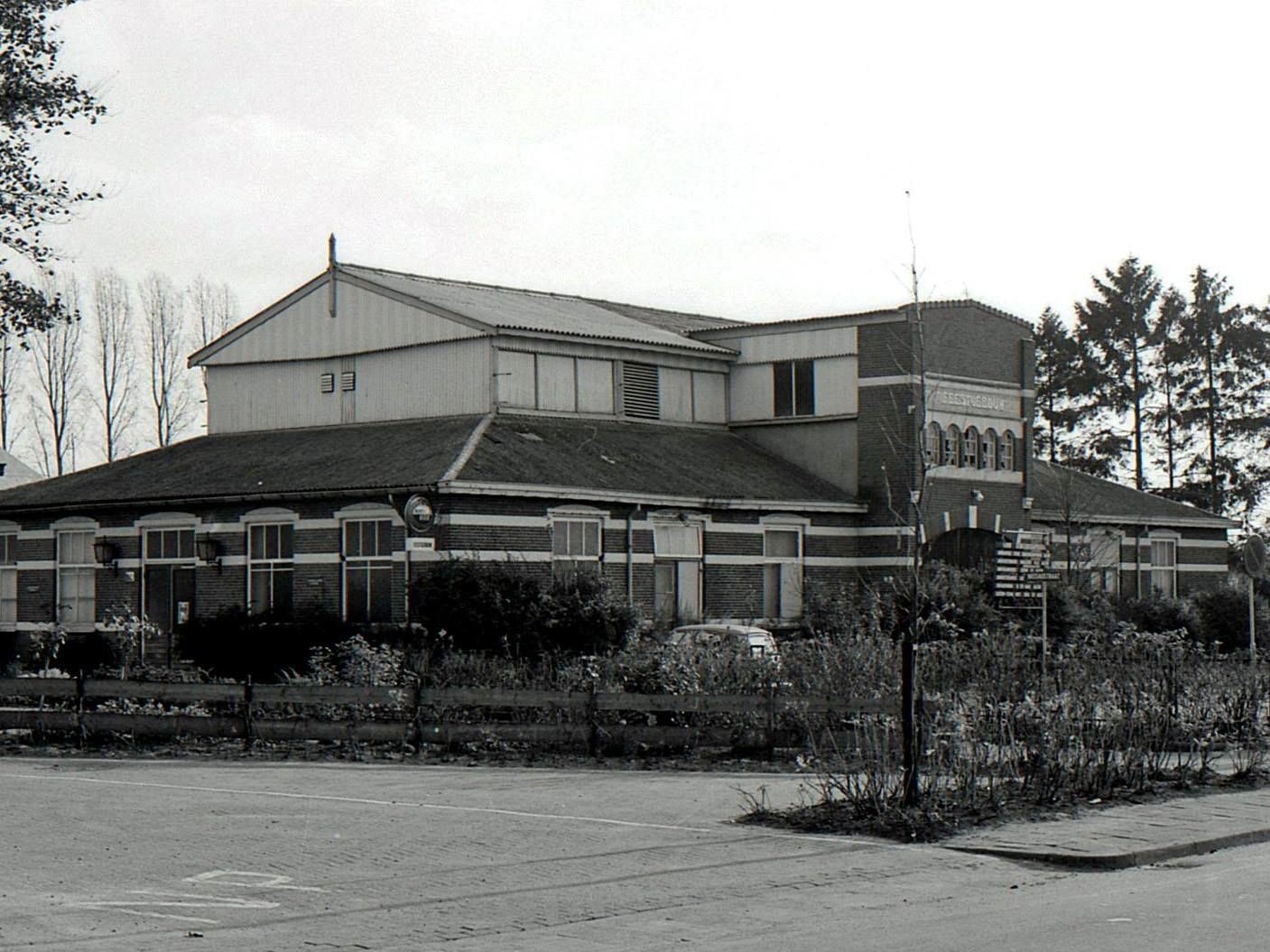
Salle Maréchal Foch
For the occasion, the Festival Hall was renamed ‘Salle Maréchal Foch‘, after France’s famous commander-in-chief.
Everything here was neatly arranged as a sleeping place for the strangers. Long tables were placed, where meals could take place. On a table were jugs of the fire brigade, which could serve as a washing set. Some refugees were so tired that they immediately lay down on their army bed of straw. No wonder, because they had all walked from Lille or Tourcoing to Brussels the week before. In the Belgian capital they were actually destined for German service, but through a ruse – most of them had a false pass – they, with thousands of others, managed to cross the Dutch border.
After the guests had refreshed themselves with coffee and bread, their names were recorded with place of residence and profession. There were: a stationmaster and two teachers, the three of whom were appointed as the regulation committee, to whom the refugees could turn with requests and complaints.
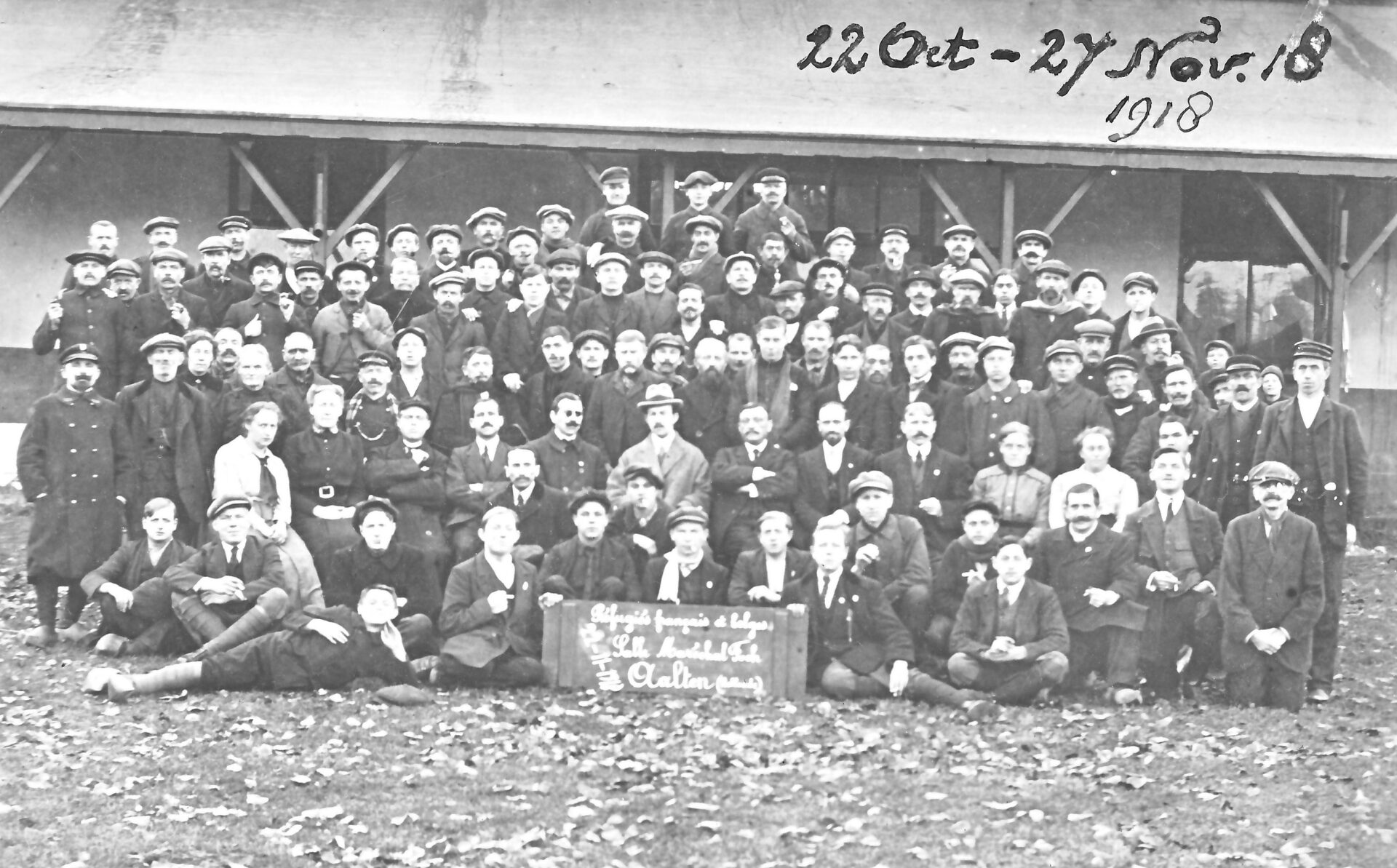
Of course, many of them felt the need to let their relatives know that they were safe and sound in the hospitable Netherlands. That is why paper and ink were made available to them, while the gentlemen Johs. Driessen and Jongen made sure that they could exchange their foreign currency for Dutch money. Thanks to the action of the committee, under the excellent leadership of Ms. Hesselink could be served lunch at 18:00, which the French enjoyed.
Certain measures had been taken to maintain order. For example, everyone had to be inside at 21:00 in the evening and the cafes were not allowed to serve them liquor.
According to the supervisor, the refugees would not stay longer than 14 days under any circumstances. They would be brought back to their homeland as soon as possible via Zeeland through liberated Belgium. Negotiations about this were already underway. It would be four weeks.
Tuesday, October 29, 1918 – Two days after their arrival, three of the refugees housed in Aalten decided to flee. After breakfast they had left the building packed and bagged, with directions from Aalten, via Varsseveld and Terborg to Arnhem. However, they were tracked down by the police and brought back to ‘t Feestgebouw.
Italians
In an interview with Mayor Monnik, he tells about Italian prisoners of war, who were killed in the factory of N.V. Textiel Mij. were accommodated: “We experienced something peculiar with those Italians. We had given them all some of our beautiful soap, of which we had a whole supply at the time, to be able to wash themselves fresh, but the next day all the soap was eaten by the Italians!”
End of the First World War
Monday, November 11, 1918 – In a forest near the French town of Compiègne, about eighty kilometers north of Paris, the armistice was concluded that ended the First World War. The more than 40,000 French refugees in the Netherlands were able to return home. This was quite a logistical organization, so it would take until January 1919 before the last French could leave. In addition, the Germans released their prisoners of war, and of course they also wanted to return to their homeland as soon as possible. A huge stream of refugees started, partly via the Netherlands.
Saturday, November 16, 1918 – In Aalten, everything was prepared to receive the stream of English refugees that was expected from Germany. In the schools and other buildings, everything was set up for this purpose so that 900 men could be housed. The rest would be forwarded to surrounding municipalities. To maintain order, a company of infantry of the 22nd regiment from Ede had arrived in Aalten. The soldiers were housed in the public school on the Herenstraat as well as in the Chr. School on the Bredevoortsestraatweg. The Nieuwe Aaltensche Courant added: “For our otherwise so quiet village a lot of hustle and bustle!“.
Tuesday, November 19, 1918 – Nieuwe Aaltensche Courant: “On the eastern border, the camp management, in anticipation of the throngs of prisoners of war, who are now being released in Germany and want to return to their homeland on their own, was no longer in control of the situation. To prevent fermentation, a deputation came to ‘s-Heerenberg to discuss transport. In order to guide the stream into a good bed, the Dutch army command has determined that Belgians and French may only pass through the narrowest strip of Limburg on our land, at the other points they will be irrevocably relegated. Only English people are admitted there. Concentration camps are being prepared in ‘s-Heerenberg, Aalten, Dinxperlo and Winterswijk.”
In Aalten, refugees from the German prison camps also crossed the border. On Saturday, November 16, a group of 21 French refugees managed to reach Aalten. They had even already found their way to the Festival Building, where they greeted their compatriots with joy. To their disappointment, however, they were informed that they would be sent back to Germany because of the above-mentioned decision. They understandably didn’t feel like it, but they had to. As a farewell, they asked to be allowed to sing the Marseillaise with their brothers from the Festival Hall, which was granted to them by the commander.
In a supplement to the above-mentioned report, the same newspaper nevertheless reported that “The initially taken decision to send the French who arrived here back to Germany has been withdrawn, so that they can be forwarded from here to Rotterdam.”
Word of thanks on departure from Aalten
Friday, November 29, 1918 – Aaltensche Courant: “So we have lost our French guests again! On Tuesday the prisoners of war and Wednesday morning the refugees left the Festivities, where the following grateful speech was given by Mr. Lopes:
“Mr. Commander. We are about to leave our camp, which you yourself have baptized “Salle Maréchal Foch,” thus showing your sympathy for France and your admiration for him who led us to victory.
Before leaving, we will repeat to you that by your benevolence and by the devotion with which you have done your difficult work so well, you have won the esteem of all the refugees. And our stay here has not always been very pleasant, because it was not feasible for you to give us all the pleasures that we hope to find again in our family; but you have done the impossible to soften our fate.
We have come to Dutch soil, M. the Commander, especially to escape the forced labor against our fatherland, against our brothers, against our fathers, against our children. We have found a refuge in this quiet country, where we have been able to recover from the fatigues and inconveniences of our long journey. If the Netherlands had offered us nothing but this satisfaction, that we know we are safe from forced labour, we would already owe it a great debt of gratitude.
But we have other reasons to keep pleasant memories of the municipality of Aalten, because at first we could think of a fairly cool reception, in the sequel we saw that the great majority of the population was well-disposed towards us. Moreover, we have material proofs of this: corrections, successively made to our lodgings, blankets have been distributed, the hall has been heated, the evening meal has been improved, soap has been distributed, postcards have been provided free of charge, smoking in the dining room has been permitted, cigars have been distributed, everyone has received a guilder, books, illustrated sheets have been donated, various games, underwear and superwear and clogs have been given, repaired shoes, mended undergarments and outerwear, yes, you gave parties and lectures, offered little memories, etc.
Moreover, the members of the Bureau, during their visits to thank the generous donors and in their friendship with several respectable families, were very surprised to find, so close to the German border, many people who knew the French language, even subscribed to newspapers from our country.
So, M. the Commandant, we will keep our stay in Aalten in pleasant memories. We will never forget a benevolence and a devotion that nothing could slacken, whatever the objections that had to be overcome. This sincere and heartfelt gratitude, of which we assure you, is the expression of the feelings of all the réfugiés in the ‘Maréchal Foch’ hall; it is unanimously brought to you (you may be proud of it!). Although we would like to thank you personally, we must not forget Mr. Chief Deputy, the entire Fire Brigade and also the police. To us, they were more friends than guards.
And as for the kind ladies who have so often honored us with her presence, and even voluntarily made themselves our servant maids at all our meals, they have reminded us too much of our wives, our mothers, our sisters, our betrothed, for us to forget them. But it is impossible for us to mention the names of all those who have taken an interest in the improvement of our lot. We therefore ask you, M. de C., to be our interpreter for these people, to thank them on behalf of the Bureau, on behalf of all comrades, on behalf of our families, on behalf even of the three twin cities of Lille, Roubaix, Tourcoing, from which we almost all come and where French and Belgians have learned to live on good terms. working side by side, one of one’s minds, long before the common suffering.
And, now that we are going to leave for our hearths, allow us to cry out loudly: Long live M. the Commander! Long live Aalten! Long live the Netherlands! Long live Belgium! Long live France!”
It has become quite empty in our streets. We were already used to seeing groups of red-trousers, or yellow- and grey-trimmed warriors in front of the shop windows. To Rotterdam by rail, they go there today, Friday, on the boat that takes them to France. How happy they will be when they can see the coast of Picardy again! No doubt the ladies, who have helped all the time that the refugees stayed here, with the distribution and distribution of the food, will be remembered by them with gratitude for a long time to come, and our brave fire brigade no less.”
French frustrations
It will come as no surprise that the conditions in which the refugees were housed were not ideal. Nor that frustrations arose after a while among some of the refugees. What is remarkable is the following publication in the Nieuwe Aaltensche Courant of 3 January 1919, more than a month after the departure of the French refugees:
“Aalten enjoyed the honor, probably for the first time, to be mentioned in the French Chamber, in the discussion of the situation of the French refugees in the Netherlands. It was said by one of the deputies that forty thousand refugees in our country are literally starving. Isn’t it beautiful? See here a sketch of the situation:
“Our refugees are housed in stables and barns, without heating and without beds. They sleep on dirty straw. Under the arrangements made, the mayors must arrange for the supply at the expense of the Relief Commission. Unfortunately, the lack of organization is felt everywhere. Everywhere it is a “pan”! Items that are requested will not be delivered. For every step, for every complaint, six instances are needed, so that everything goes into disarray. Women and children are shivering from the cold here, without coal, without warm clothes. For days there is no meat, the weakest succumb to lack of care. The bread provided by the Dutch government is inedible.”
We do not know how care was arranged in other places. But we do know that this description does not fit the treatment as the refugees have received in Aalten. Now it is not impossible that here and there the organization was not immediately punctual – would the French, in the same circumstances, have fared better? – but ‘dying of hunger and cold’ will, we trust, turn out to be a horrible exaggeration.”
In addition, the French delegate reported:
“Several French refugees, who were housed in Aalten, have lost their patience and sent the following ultimatum to our representative by telegraph: “Two hundred refugees, powerful men from Lille, Roubaix and Tourcoing, demand immediate repatriation. They will leave on foot on Thursday, if no solution is found by then.”
To whom is the blame that the refugees lost their patience? In no case to the Dutch authorities. Those who had quietly left before their time have themselves stated in a letter to the chief of the fire brigade that their departure was not caused by undue treatment or care, but solely by the fact that they longed to return to their hometown.
We hope that our government will provide a resounding protest against the false rumors spread on this subject by enemies of our country. Let them inform the French authorities themselves, so that they are not exclusively dependent on the information of the French embassy in The Hague, which is so well informed of the actual situation, that the following message has been received here in the last few days: “The French refugees who are staying in Aalten may leave on January 15th.” While they have already arrived in their respective homes in northern France a few weeks ago!“