

After the Allied powers definitively defeated Napoleon in 1815, the Northern and Southern Netherlands were unified. The new Kingdom of the Netherlands was ruled by King William I. However, problems soon arose between the south and the north. There were significant political, economic, cultural, and religious differences.
National Militia Call-up
On February 15, 1827, the Provincial Gazette of Gelderland published a Decree in which 460 men from Gelderland, including twelve from Aalten, were summoned to appear at the ‘Government Building’ in Arnhem at 8:00 AM on February 27 as reservists of the National Militia. As of March 1, they were required to be ‘under arms.’ A number of them would not return alive.
The men from Aalten called up were:
7th Infantry Division
- Joan Henricus Bennink (1807-1832)
- Hendrik Jan Bent (1807-1872)
- Reinerus Ebbink (1807-1877)
- Derk Hendrik te Slaa (1807-1827)
- Toni Stapelkamp (1807-1889)
- Reijnder Uffink (1807-1880)
13th Infantry Division
- Christiaan te Boveld (1807-1827)
- Harmen Jan te Boveld (1807-1827)
- Garrit Willem Hesselink (1807-1867)
- Dirk Jan Hoornenborg (1807-1876)
- Johannes Christianus Kötcher (1807-1876)
- Petrus Bernardus Smit (1807-1876)
More residents of Aalten served, as evidenced by the decorations awarded later (see further on in this article). However, we do not yet have a complete overview of them. Further information is therefore welcome.
The Ten Days’ Campaign
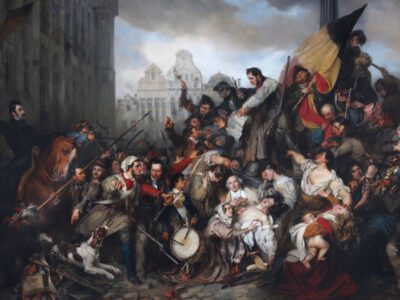
In August 1830, the Belgians revolted. At the end of September, an army was sent from the North to restore order. The Belgian resistance proved more stubborn than expected, and after a few days, the army was forced to withdraw from Brussels.
To avenge this defeat, King William I sent a larger force to Belgium on August 2, 1831. France decided to intervene and sent an army of 40,000 men to the Southern Netherlands. Consequently, William I withdrew his army. All in all, the conflict had lasted 10 days.
The Ten Days’ Campaign took place from August 2–12, 1831. The military operation was led by Prince William of Orange (the later King William II), who agreed to an armistice on August 12, 1831, after the Belgians surrendered Leuven. In the following week, the Dutch troops withdrew to North Brabant. Only the Citadel of Antwerp remained occupied under the command of Chassé (‘General Bayonet’) until the capitulation in December 1832.
In 1937, G.H. Rots wrote in the Aaltensche Courant about the Ten Days’ Campaign:
“Peace arrived, and the population returned to their labors. But peace would not last forever. The struggle between the Northern and Southern provinces ignited, and known as the ten days’ campaign, battle had to be joined once more. Once again, young men from Aalten marched off to join the struggle. This conflict was not particularly bloody, and most returned safely to their homes.”
Those who had participated in that ten days’ campaign received a medal. In our youth, there were two veterans in Aalten who wore this decoration. During national festivities, they would be seated in a landau, drawn by two horses, and took the place of honor in the procession. The names of these last Aalten veterans were Lorijn and Loohuis. The medal of the latter is now in the possession of Mr. J.S.S. Prins.”
The Citadel of Antwerp
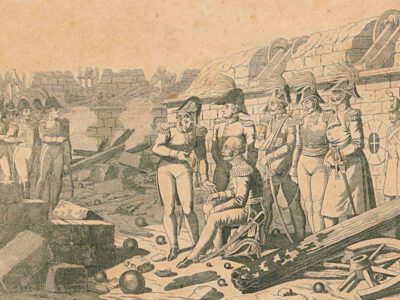
Shortly after the uprising in 1830, a portion of the Dutch military had retreated to Antwerp. At the end of October, General Chassé concentrated them in the citadel. This garrison was reinforced after August 1831. On December 24, 1832, General Chassé surrendered to the French army, which had been called to aid by the Belgians, following heavy artillery bombardments and a 25-day siege.
The French Marshal Gérard also demanded the important Scheldt forts Lillo and Liefkenshoek. These were no longer under Chassé’s command, so they could not be negotiated. Gérard then offered the choice between surrendering the forts or taking the soldiers to France as prisoners of war. Only William I could provide a solution. He refused.
Prisoners of War
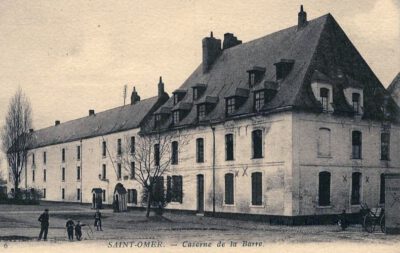
On December 29 and 30, 1832, over 4,500 Dutch soldiers departed for Northern France as prisoners of war. However, because France and the Netherlands were not at war with each other, they were effectively hostages. The journey took eight days of marching through Zwijndrecht, Melsele, St.-Niklaas, Lokeren, Deinze, Desselgem, Kortrijk, Menen, Ypres, Vlamertinge, Poperinge, Steenvoorde, and Cassel. On January 5, Saint-Omer was reached via Arques. Part of the Infantry continued to Béthune, another part with the Artillery and Engineers to Hesdin, and the Navy to Aire.
On May 21, 1833, the Convention of London brought about a partial lifting of the state of war. The prisoners of war were to be released. On June 8, four French frigates, three corvettes, and one brig set sail from Dunkirk for Vlissingen. A day later, they made landfall in Vlissingen and marched to Middelburg that same day.
It would take until 1838 before the Dutch King William I sullenly threw in the towel. With the signing of the Treaty of London in 1839, the separation of Belgium became a fact.
Awards
All those who had been under arms and were deemed to have participated in the military operations during the Ten Days’ Campaign were decorated with the Metal Cross. This commemorative medal, also known as the ‘Hasselt Cross,’ was awarded in recognition of their proven loyalty to King and Fatherland. The bronze crosses were struck from the metal of the cannons captured from the Belgian Army of the Meuse during the Battle of Hasselt on August 8, 1831.
By Royal Decree of May 31, 1833, King William I of the Netherlands instituted the Antwerp Medal 1832. This was to be awarded as a “reward to those who, during the siege of the Citadel of Antwerp in the period from November 28 to December 24, 1832, served in the citadel and subordinate forts (Vlaamsche Hoofd, Burcht, Zwijndrecht, and Austruweel), as well as on the flotilla on the Scheldt before Antwerp.”
Decorated Aalten residents
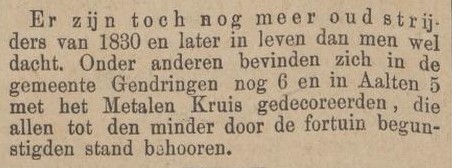
A number of Aalten residents are known to have been decorated with the Metal Cross (MK) for their participation in the Ten Days’ Campaign and/or the Citadel Medal (CM) for the defense of the Antwerp citadel. Below are the names and decorations currently known to us.
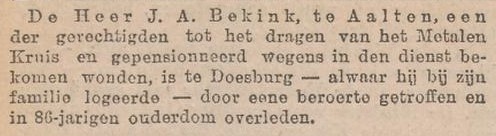
- MK: Jan Anthonij Bekink (1812-1898), lived in the Peperstraat.
- MK: Joan Henricus (Jan Hendrik) Bennink (1807-1832), lived on the Prinsenstraat. He was a flanker with the 2nd Battalion of the 14th Infantry Division when he passed away in a hospital in ‘s-Hertogenbosch.
- MK: Dirk Jan Hoornenborg (1807-1876), born at Nieuw Hoornenborg on the Haart, lived in Gorssel from approximately 1845 and passed away in Kring van Dorth.
- MK: Johannes Christianus Kötcher (1807-1876), lived in Bredevoort.
- MK: Hendrik Jan Loohuis (1812-1905), lived the final years of his life in the Avondvrede Rest Home.
- MK: Petrus Bernardus Smit (1807-1876), lived on the Hogestraat.
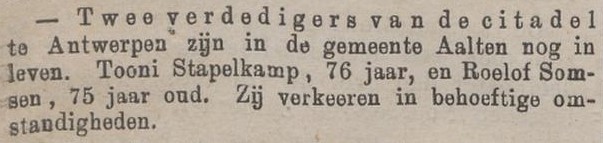
- MK+CM: Tonij Stapelkamp (1807-1889), lived on the Hogestraat.
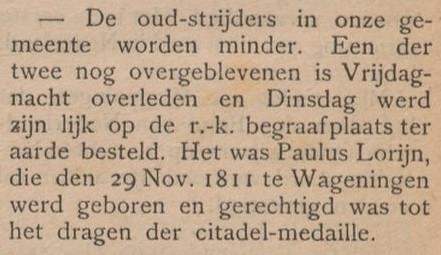
- CM: Paulus Lorijn (1811-1899), came to Aalten from Wageningen in 1844 and lived successively at the Piepert, Heurne, and the Roman Catholic hospital on the Hogestraat.
- CM: Roelof Somsen (1808-1891), lived on the Pennings farm in Dale.