On the night of October 28, 1799, the lifeless body of 47-year-old Gesina te Winkel was found on the heath, near the border between the Aalten rural district of Haart and the German town of Barlo. She lay only a few minutes from her home and had multiple stab wounds. What had happened to her?
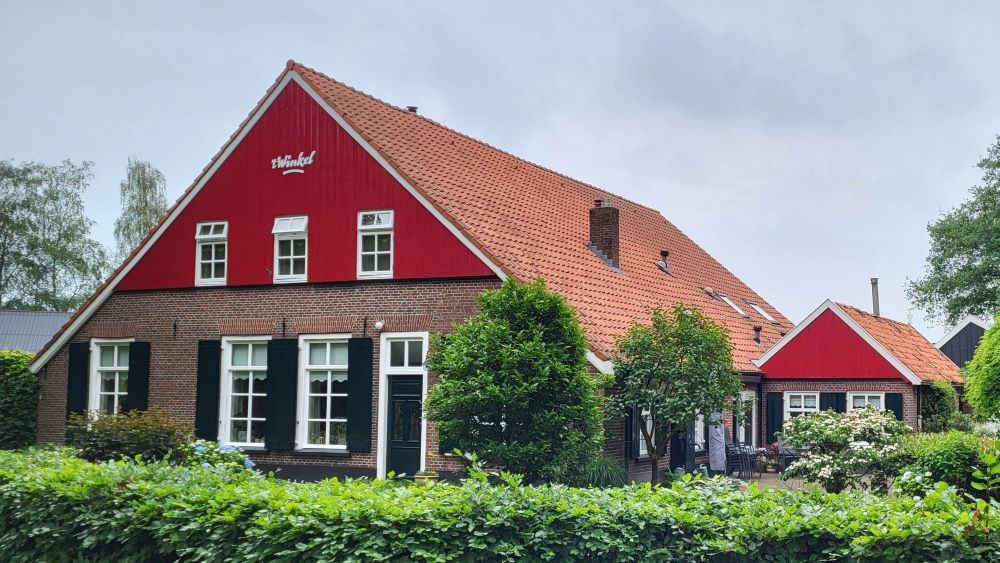
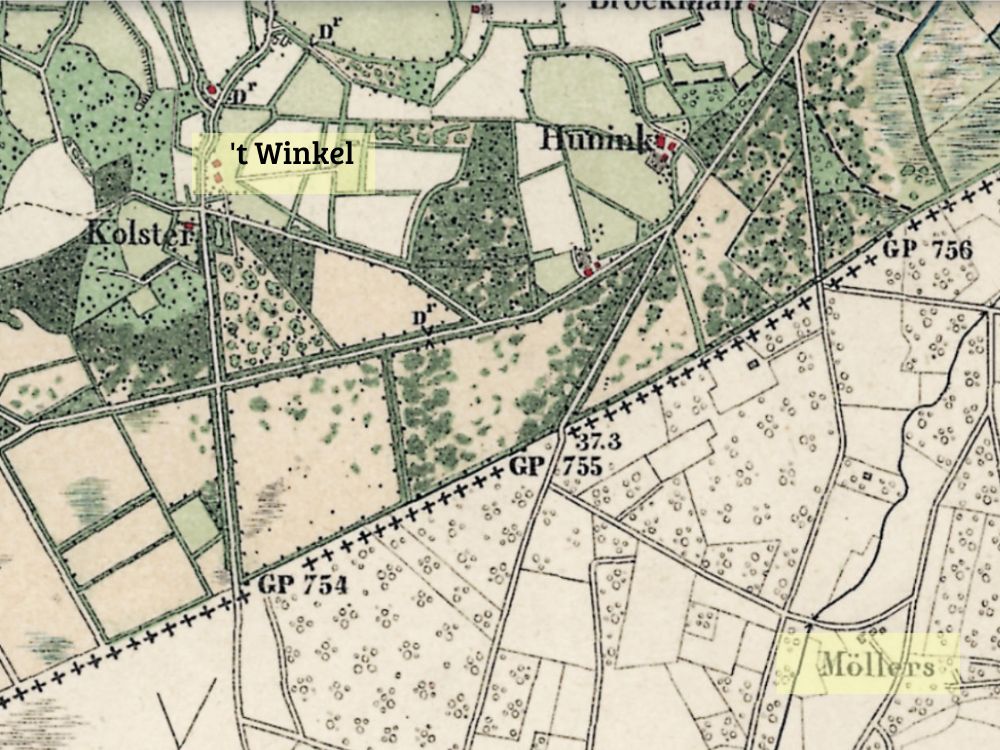
Gesina te Winkel was baptized in Aalten on April 30, 1752, as the daughter of Barent te Winkel and Enneken Dierkink.1 On April 20, 1777, she married Adolphus (Alof) Lensing2, who was later also called te Winkel. The couple lived at Gesina’s parental home, the ‘t Winkel farm in the Haart, only 800 meters away from the border with the then Bishopric of Münster, which is now part of the German state of North Rhine-Westphalia.
‘t Winkel farm in the Haart, photo: H. Schutte, 2024
The disappearance
On Sunday, October 27, 1799, around four o’clock in the afternoon, Gesina left home alone with a sandwich in her hand. She was on her way to the Möllers family to pick up some items of clothing. The Möllers lived just across the border in the Münsterland, about a fifteen-minute walk from ‘t Winkel.
When it began to get dark and Gesina had not yet returned, her husband Alof and their children began to worry. Where was she? Alof decided to go to the Möllers family’s house. He found three women there by the fire, who told him they had not seen Gesina that day.
Returning home, Alof wondered if his wife had encountered someone on the way or perhaps visited a neighbor. Upon arriving home, it turned out she was still not back. He then went out to search again, this time on the heath. When he could not find her there, he went to the Möllers’ house once more. The residents were already in bed, and when Alof knocked and asked about his wife again, the man and woman called out to him from bed that they had heard nothing of Gesina and that she had not been there that day.
Alof involved his nearest neighbor Hendrik te Kolste and the servant of his brother at Drenthel Schoppe, Harmen Swietink, in the search. Together they went out onto the heath once more to look for Gesina.
The discovery
By then it was pitch dark on the heath and they could see very little. Around midnight, one of them suddenly discovered something white. It turned out to be Gesina’s cap, with her lifeless body beside it. She was lying on her side; her feet were still warm, but the rest of her body was cold. She was found only five to ten minutes from her home. Alof had a cart brought and took her body home on it. He thought she had probably become unwell on the way and died as a result.
The following morning, Monday, October 28, Garrit Rensink, residing at the Beestmans Huisje farm in the Haart, reported to the court of the Seigniory of Bredevoort that the wife of his neighbor Alof te Winkel had been found dead on the heath the previous night.
Thereupon the court, accompanied by surgeon Steven Schaars, proceeded to ‘t Winkel. Upon examination of the body, it was determined that the woman had multiple stab wounds – three on her left side and two on her right side, presumably inflicted with a bayonet or a triangular object.
Apparently, they were not yet entirely convinced of the cause of death, because two days later the court went to ‘t Winkel again with Schaars for further investigation. During this, the deceased, who had already been placed in a coffin, was removed from the coffin and examined, whereby Schaars determined that the lower ribs on the right side were broken and that the wounds inflicted upon her had caused her death.
During interrogation, Alof, Hendrik, and Harmen stated that they initially thought they had found Gesina’s body on Dutch territory, but also that they had not been able to determine this properly due to the darkness. Upon further recollection, however, they were almost certain it must have been on Münster territory.
Hendrik and Harmen further stated that, as far as they knew, Alof te Winkel and his wife had a good relationship and that there was no question of disagreement or quarreling. They also stated that Gesina never quarreled with anyone, and that she “despite her years, looked very well.”
Arnoldus Obrink, a cooper in the Hoekstraat in Aalten, stated that he had seen Gesina around four o’clock that Sunday afternoon. He was walking on the road from Hunink to Aalten and Gesina was taking the road to the Münsterland, about 300 paces from her house. He had even spoken briefly with her while she was eating a sandwich. Furthermore, he had seen no one else in the vicinity.
An unconfirmed rumor
A rumor soon spread that Gesina had indeed been at the Möllers’ house that Sunday. According to the stories, a 13-year-old son of the family had been playing carelessly with a loaded gun, after which it accidentally went off and hit Gesina. It was even claimed that traces of the shot could still be seen in the chimney or near the hearth. However, there was no evidence for this rumor.
File to Bocholt
Because there was a strong suspicion that Gesina’s violent death had occurred on Münster territory, the drost of Bredevoort, Willem Paschen, sent a copy of the file to the court of Bocholt so that they could investigate this case further.5 Unfortunately, it is not known to us how this case ended. The tragic murder of Gesina te Winkel remains a mystery.
Funeral
In the Burial Register of the Dutch Reformed Congregation in Aalten, it is noted under October 1799: “deceased the 28th – Alof te Winkel his wife – buried the 31st” 6
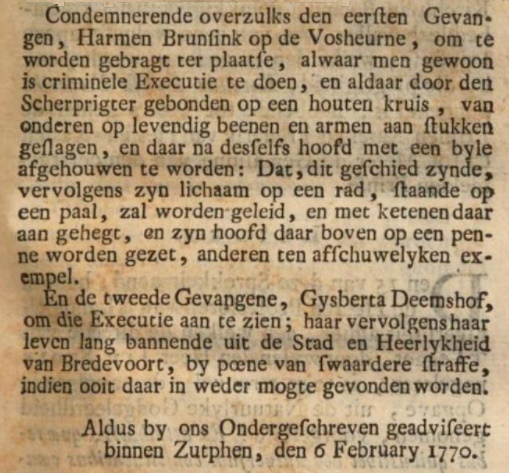
On the early morning of January 12, 1770, the neighbors of the Vosheurne farm in Lintelo were startled by a disturbing report. “The aunt is dead, she is very bloody, she may well have smashed her head,” resident Harmen Brunsink shouted. Extensive forensic investigation by the Court of Bredevoort revealed a story of a family conflict that degenerated into murder and would end with a gruesome execution.
Tensions in the House
Hendersken Tannemaat, born in 1705, had lived on the Vosheurne her entire life. Her niece, Gijsberta Deemshof, born in 1739 in Doesburg as the daughter of Hendersken’s sister Johanna, was raised by her ‘moeje’ (aunt) Hendersken from the age of three. In 1761, Gijsberta married Harmen Brunsink, born in 1729 at the Bekink farm in IJzerlo. After their marriage, Harmen moved in with Gijsberta and her unmarried aunt at the Vosheurne.
Initially, Hendersken lived with the young couple in exchange for board. In June 1768, however, she transferred all her possessions to Harmen and Gijsberta in exchange for room and board and all necessary care for the rest of her life. This was a common arrangement at the time between elderly people and their children—in this case, her niece and husband. Harmen and Gijsberta solemnly promised to fulfill this obligation.
However, the relationship between Harmen and the aunt deteriorated over the years, and tensions arose in the house. The aunt reportedly told Harmen several times that she wanted to undo the agreement “because you treat me so poorly!”
A Mysterious Death
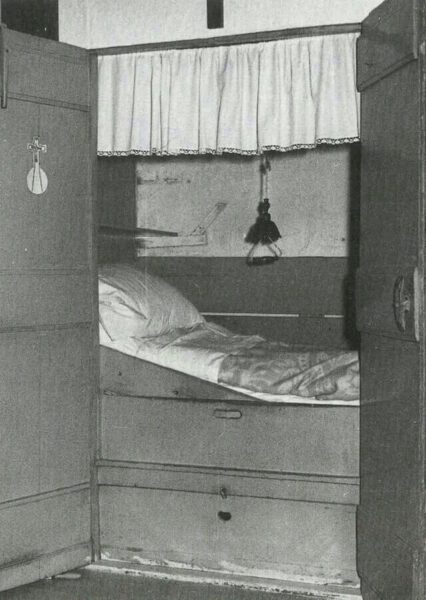
A box bed (photo for illustration)
On that fateful morning of January 12, 1770, Harmen frantically gathered the neighbors because the aunt was dead. It was customary in this region for neighbors to be called upon in the event of a death to arrange practical matters, such as the funeral and the ‘verhennekleden’—undressing the deceased and shrouding them in grave clothes. When the neighbor women entered the bedroom, they found Hendersken dead in her box bed, her hands folded over her chest. Her nose and arms were blue, and when her cap fell off, they discovered flour in her hair and blood seeping down her neck.
Gijsberta stated that she had used the flour to staunch the bleeding. Harmen added that the bruises were likely because the aunt suffered from scurvy, and that Hendersken had probably hit her head on the sharp edges of the bed plank. But the story did not add up. The neighbors did not trust it and brought the matter to the attention of the Court of Bredevoort.
The Investigation
Two days after Hendersken’s death, court officials arrived at the Vosheurne with two surgeons. Upon arrival, it appeared the body had already been coffined. In the presence of Harmen and Gijsberta, the surgeons examined the body. They discovered several severe injuries and bruises to the head. The injuries made it clear that an accident was out of the question. Suspicion immediately fell on Harmen and Gijsberta, who lived with Hendersken at the Vosheurne and could not provide a convincing account of what had happened.
Both suspects denied any involvement and claimed they had found Hendersken dead on the floor in front of her box bed that morning. They claimed to have placed her on the bed, sprinkled flour on her head to stop the bleeding, and put on her cap. However, their statements contradicted each other. Harmen had told the neighbors that he had found Hendersken dead in bed, not on the floor.
Voluntarily and without resistance, they went to Aalten, where they were taken into custody for further questioning. When the numerous head wounds were discussed, Harmen stated that these might have been the result of an epileptic seizure. Hendersken supposedly hit her head against the bed plank, the flax comb chair, the small chests, a trunk, or the beer stand. He also suggested that someone from outside the house could have broken in, as the house was in poor condition.
Further Investigation
On January 16, the Court, assisted by a doctor, a surgeon, and a prosecutor, returned to the Vosheurne with the suspects. Hendersken’s bedroom was meticulously examined.
The box bed showed a large bloodstain on the bed plank at the head end, as if the blood had splashed against the plank. But it had no sharp edges, as Harmen had claimed. Due to long-term use, the plank was actually rounded, and no sharp edges were found inside the box bed either. Other furniture in the room—small chests, a trunk, and a flax comb chair—showed no traces of blood. Nothing was found under the box bed either.
The doctor and the surgeon then examined the body even more closely. They stated primarily that there was a slight bruise on the nose, as well as severe bruising on both elbows, arms, and hands, beneath which coagulated, extravasated blood was found. These bruises could only have been caused by an external factor.
Not only on the right side of the head, at the level of the temple, were the external coverings and fleshy parts bruised, wounded, and destroyed down to the bone, but similar bruises and wounds were visible on the left side, albeit to a lesser extent. Two openings or wounds were discovered on the left side of the skull and one on the right, each about the size of a shilling. Upon loosening the external parts, it appeared that the skull had a fracture on the right side and that on the left side, the end of the skull bone was severely bent downwards and partially broken.
After sawing through and removing the skullcap, several ruptures were found. Due to these fractures and bone pressed outwards, the brain, particularly on the left side, was severely damaged. On both sides of the head, especially the left, extravasated blood was present on and under the dura mater and also within the brain itself. Furthermore, all blood vessels were completely filled with blood. This combination of injuries had inevitably caused her death.
Although the suspects continued to maintain their innocence, the suspicions raised against them were only strengthened by these findings. From the situation on-site and the condition of the corpse, there was no longer any doubt that a murder had been committed. Such a thing could not happen unnoticed in a small cottage like that of the suspects, while they claimed to know nothing. The suspects were then transferred to the prison in the Ambtshuis in Bredevoort.
Harmen’s Confession
During the subsequent interrogations, Harmen and Gijsberta initially stuck to their story: Hendersken had died in an accident. But the evidence against them mounted. On January 19, a week after the murder, Harmen broke under the pressure and confessed what had really happened: He stated that he acted alone, without the help of his wife. He had previously said to his wife in bed: “There lies such a small pebble, I shall strike her five or six times on the head with it, then she will be gone, then the quarreling will be out of the house, then we can live in peace and unity.”
Around four hours before sunrise, he had risen, lit the lamp, went to Hendersken’s room, and hung the lamp on a nail above the box bed. Upon entering the room, the aunt woke up from the light. Thereupon, Harmen jumped into bed with her, sat astride her, held her head with his left hand, and struck her five or six times on the head with the pebble with his right hand, until she lay dead under his hands.
Gijsberta reportedly tried to stop him, but without success. When the aunt was dead and bleeding heavily, he ordered his wife to sprinkle flour on her head and wash off the blood. Afterwards, he called the neighbors. The stone with which he had struck her, he threw into the ditch behind the oven, near the spot where they fetched water.
Statement of Gijsberta
Gijsberta made her confession on January 20 and 22. She stated regarding her unhappy marriage: “Oh, how unfortunate I am! I married my husband against the wishes of my entire family, and from the beginning of our marriage, he has lived poorly with me.”
In the early morning of January 12, her husband, before he even rose, had said to her: “I will no longer have the quarreling in the house, I want to take decisive action, I shall get a pebble, and give the Aunt but one blow to the head with it, then she will be gone, and then the quarreling will be out of the house.” She was very upset by this, but he tried to reassure her, kissed her, and said: “Do not be dismayed, let me take decisive action, she is an old person, then we can have a peaceful life.”
He even came to her bed with gin and said: “You must drink plenty of gin, and you must be half-drunk, otherwise you would be too dismayed; we must now bite through a sour apple; but you must never betray me, even if I should happen to die, and you get another husband, then you must never say to him that I murdered your own blood.”
She then said to him: “Could you bring yourself to kill my own flesh and blood; if it comes down to it, then I must say it,” to which he had replied: “I will nevertheless take decisive action, I want the quarreling out of the house.”
When her husband was already in the aunt’s room and began striking her, he called Gijsberta to come there. She then went to the room, grabbed his linen smock to pull him away from the aunt, and said: “Fie, fie, what are you doing!” She added that her husband had forced her to be present, saying: “otherwise you might go and report me later.”
Gijsberta also stated that she had long been afraid to lie in bed with him, fearing he would attack her with a knife. That night, too, a knife lay in his trousers in front of the bed. She therefore also said to him: ”I am afraid that you will do me harm.” To which he assured her: “Oh no, I will never do you harm.”
She also confessed that her husband could not bear it if she was kind to the aunt, and that she had had constant sorrow with her husband since the aunt lived with them.
Gijsberta stated from the outset that she did not help carry out this gruesome deed. She also did not know what her husband used to beat the aunt to death, only that in the morning, while fetching water in the ditch in front of the house by the willows, she saw a gray pebble lying in the water that had not been there before.
Both suspects finally confessed that the aunt had never suffered from epilepsy. The neighbors and friends had also never heard of it, except only after her death.
The Verdict
The Court of the Lordship of Bredevoort ruled that everything indicated that Harmen Brunsink, on the night of January 11 to 12, 1770, had murdered Hendersken Tannemaat, a defenseless person estimated to be nearly seventy years old, lying on her bed in his house, in a gruesome manner, deliberately and with premeditation. Gijsberta was charged with failing to dissuade her husband, where possible, from this abhorrent intention.
Harmen was sentenced to death: “to be brought to the place where criminal executions are customarily performed, and there to be bound by the executioner on a wooden cross, to have his legs and arms broken to pieces from the bottom up while alive, and thereafter to have his head severed with an axe. That, this having been done, his body shall subsequently be laid upon a wheel, standing on a post, and fastened thereto with chains, and his head set upon a spike above it, as a hideous example to others.” This punishment is called breaking on the wheel.
On February 10, the residents of Dinxperlo were summoned to the Hollenberg to erect the post and the wheel for the execution and to make the noose. Most refused or did not show up and were fined 30 thalers per person. 18 persons consented and erected the post and the wheel.
The sentence was carried out on the Hollenberg on February 12, 1770.
Gijsberta escaped the death penalty but was required to witness her husband’s execution. Subsequently, she was banished for life from the city and Lordship of Bredevoort. She remarried in 1776 in Silvolde to Jacob Kok and reportedly died in 1813.
Sources
Nieuwe Nederlandsche jaerboeken, of Vervolg der merkwaerdigste geschiedenissen, die voorgevallen zyn in de Vereenigde Provincien […]. Fifth volume. MDCCLXX, published by the heirs of F. Houttuyn in Amsterdam, P. van der Eyk and D. Vygh in Leiden, 1770 (link)
Klaas Nijman was baptized on January 16, 1698, in Dinxperlo as the son of Fredrik Nijman and Berentjen Eppink. At the age of fifteen, he left his parental home and began a wandering existence as a ‘beggar and vagabond’. In 1722, he was sentenced in Rhenen to a stay in a house of correction for violence and theft. His release was followed by banishment from the province of Utrecht.
Nijman then returned to the Achterhoek, where he sowed fear among the population, particularly in the vicinity of Dinxperlo and Aalten. He begged and stole, threatened people, and did not hesitate to use brute force. In 1729, he set fire to several houses and was arrested.
On October 3, 1729, following a trial in Bredevoort at ‘t Zand, Klaas Nijman was sentenced to death. He was taken to the Hollenberg, where he was strangled and subsequently set on fire. This gruesome punishment served as a deterrent to others. Nijman was 32 years old at the time.
Sentence
The following 18th-century text describes his crimes and sentence:
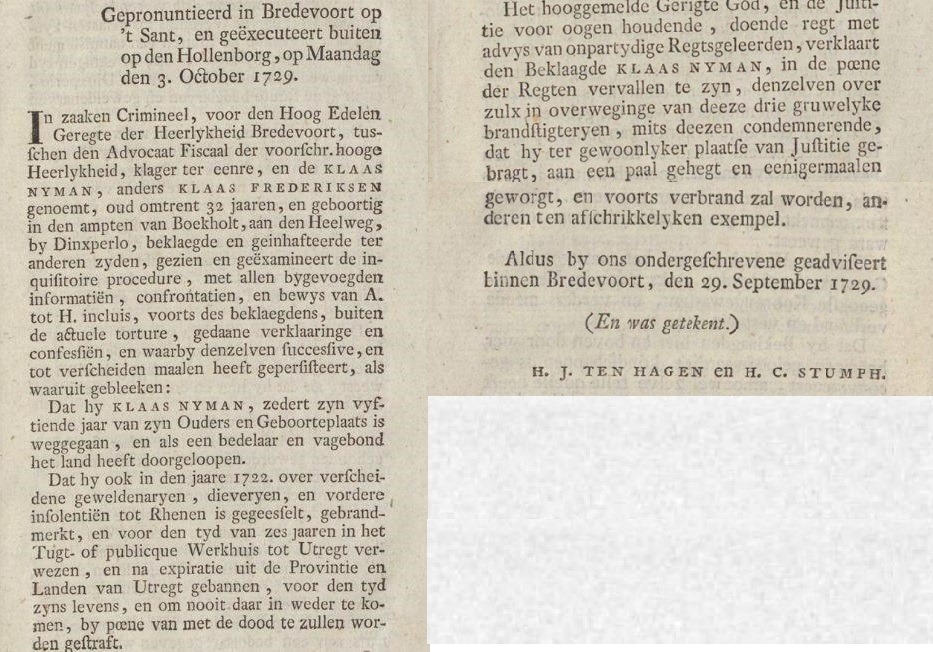
Pronounced in Bredevoort at ’t Sant, and executed outside on the Hollenborg, on Monday, October 3, 1729.
Verdict Klaas Nijman
In Criminal cases, before the Most Noble Court of the Lordship of Bredevoort, between the Advocate Fiscal of the aforementioned High Lordship, complainant of the one part, and KLAAS NYMAN, otherwise called KLAAS FREDERIKSEN, aged about 32 years, and born in the district of Bocholt, at the Heelweg, near Dinxperlo, defendant and prisoner of the other part, having seen and examined the inquisitorial procedure, with all attached information, confrontations, and evidence from A. to H. inclusive, furthermore the defendant’s declarations and confessions made outside of actual torture, and in which he has successively and at various times persisted, from which it has appeared:
That he, KLAAS NYMAN, since his fifteenth year has left his Parents and Birthplace, and has wandered the land as a beggar and vagabond. That he was also in the year 1722, for various acts of violence, thefts, and further insolences at Rhenen, flogged, branded, and committed for the term of six years to the House of Correction or public Workhouse at Utrecht, and after expiration banished from the Province and Lands of Utrecht for the term of his life, and never to return therein, upon pain of being punished with death.
That having been released from the aforementioned House of Correction or Workhouse about three-quarters of a year ago, yet the penalties of banishment remaining in force, he thereupon, or some time thereafter, returned to Dinxperlo, and continued in his bold beggaries and acts of violence. That he there, for a trifle on the public road near Dinxperlo, cut open the mouth of one DIRK WENSINK with a knife.
That he likewise, after his aforementioned release, again committed various thefts, such as of ironwork and an axe, and of linen, such as a pillowcase or sheet on the other side of Doesburg at the Steege; and also a shirt from the garden at HENDRIK te Loo or Kistershuis, between Dinxper and the Bredenbroek, and further as by the Reformations. That he, KLAAS NYMAN, has also for years past been notorious and held in suspicion by many inhabitants under Dinxperlo and Aalten, as being of no good and committing much evil.
That he also, following the . . . . of the sentence at Rhenen, was held suspect there of having committed very grave offenses. That the defendant, through his . . . . and malicious conduct and questionable language which he used here and there, has kept the good husbandman and the inhabitants in the countryside, and especially around Dinxperlo and Aalten and the surrounding area, in a state of constant anxiety and fear. That when he came to beg, he was not satisfied with what is ordinarily given to a beggar, although he was often given even more, and went away from the houses muttering to himself.
That this anxiety and fear among the inhabitants has doubled and reached its peak since fire broke out in the Parish of Aalten in this year 1729, and that further and even more burnings of houses close by followed. Such that several inhabitants ordered their people that, if KLAAS NYMAN came to their houses, they should just give him whatever he wanted, to gain his friendship and not to anger him, and that several people, out of fear of arsons, had to keep night watches at their houses during the night, whereby even some hamlets were placed in a state of near alarm.
That he, the defendant KLAAS NYMAN, is also the one who has come to such exceedingly wicked crimes that in the past Summer in the Parishes of Aalten and Dinxperlo, of this same year 1729, from June 13 to August 29, and thus within the span of a quarter-year, he has set fire to three houses, one after the other, and by no means the smallest, which houses were also totally burned down, and of which the corpora delictorum are known.
Namely, on June 13, the house at Lensink, under Aalten on the Esch at Yserlo, where he set a piece of white or spongy peat on fire by means of a tinderbox, flint, and tobacco pipe, and with that burning peat at the back on that side of the house where the wind was blowing against the house at the time, caused the fire. That eight days prior he had also set the same house Lensink on fire, and that it had already been burning, but that it was then still extinguished by the occupants.
Secondly, the house at Welink, also under Aalten on the Esch at Yserlo, on June 20, where he carried out the fire in the same manner as at Lensink with a piece of ignited spongy peat, and therewith set the house on fire from behind. That for both his arsons, at Lensink and Welink, he gives as his reason that he had done so to create anxiety and terror in the neighborhood, or among the people.
Thirdly, the house at Grevink, at ‘t Rexwinkel in the hamlet of Heurne, under Dinxperlo, on August 29, in the evening around 10 o’clock, when he caused the fire there with an ignited fuse made of linen rags, in the straw that lay at the back on the corner partition of the house. That in this aforementioned house Grevink, when it caught fire, a young woman in childbed, who had not yet been in childbed for two days, lay on the bed, and who by great fortune still having the strength to get off the bed, still escaped the fire. That he, KLAAS, gives as his reason for this arson at Grevink that he had done so because the same aforementioned woman in childbed, a long time ago when she was still unmarried, had given him a piece of pancake that had been too small for him.
That at Welink and at the last-mentioned Grevink, several pieces of live Cattle, harvested Grain crops, and further items were also burned and consumed. That he, the Defendant, is furthermore convicted by four sworn credible witnesses, although he himself has tried to deny it telle quelle, that on August 31 last he spoke those grim words at the house of ARENT OOSTENDORP, in the hamlet of Heurne, under Dinxperlo, that this or that corner would shortly be a poor corner.
That he furthermore has threatened to set fire to the house of the drummer boy within Dinxperlo, and has stood by and persisted in this, that if he had not been captured, he would indeed have done it, and similar terrible threats and dangerous utterances of the Defendant, as the information and confessions herein further set forth.
The highly-mentioned Court, keeping God and Justice before its eyes, doing right with the advice of impartial Legal Experts, declares the Defendant KLAAS NYMAN to have incurred the penalty of the Law, condemning him for the same in consideration of these three gruesome arsons, that he be brought to the usual place of Justice, fastened to a stake and somewhat strangled, and furthermore shall be burned, as a terrifying example to others.
Thus advised by us undersigned within Bredevoort, September 29, 1729.
(And was signed.)
H.J. TEN HAGEN and H.C. STUMPH
Source
Legal Treatises on Corporal Crimes by a prominent Legal Expert (Jan Jacob van Hasselt), published in Amsterdam by Hendrik Gartman, 1781 (link)
Beheer toestemming
Deze website gebruikt cookies voor een optimale ervaring en analyse van bezoekgegevens. Ga je hiermee akkoord? Zonder toestemming werken sommige onderdelen van de site mogelijk minder goed.
Functioneel
Always active
De technische opslag of toegang is strikt noodzakelijk voor het legitieme doel het gebruik mogelijk te maken van een specifieke dienst waarom de abonnee of gebruiker uitdrukkelijk heeft gevraagd, of met als enig doel de uitvoering van de transmissie van een communicatie over een elektronisch communicatienetwerk.
Voorkeuren
De technische opslag of toegang is noodzakelijk voor het legitieme doel voorkeuren op te slaan die niet door de abonnee of gebruiker zijn aangevraagd.
Statistieken
De technische opslag of toegang die uitsluitend voor statistische doeleinden wordt gebruikt.De technische opslag of toegang die uitsluitend wordt gebruikt voor anonieme statistische doeleinden. Zonder dagvaarding, vrijwillige naleving door je Internet Service Provider, of aanvullende gegevens van een derde partij, kan informatie die alleen voor dit doel wordt opgeslagen of opgehaald gewoonlijk niet worden gebruikt om je te identificeren.
Marketing
De technische opslag of toegang is nodig om gebruikersprofielen op te stellen voor het verzenden van reclame, of om de gebruiker op een site of over verschillende sites te volgen voor soortgelijke marketingdoeleinden.