


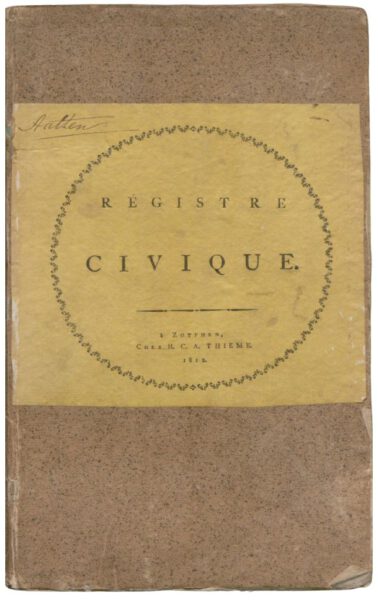
In the early 19th century, during the French occupation, a large-scale administrative reform was implemented in the Netherlands. One of the most significant changes was the introduction of the Régistre Civique, a civil register in which eligible male voters were recorded.
The Régistre Civique was introduced under the reign of Napoleon Bonaparte, who annexed the Netherlands into the French Empire in 1810. The purpose of this registration was to obtain an overview of citizens who had the right to vote and were eligible for public office.
Who was registered?
The register contained the names of men who:
- Were at least 21 years old;
- Were not dependent on public charity;
- Possessed sufficient property or income.
For many residents of Aalten and Bredevoort, this meant that only the more affluent farmers, traders, and craftsmen were registered. Day laborers and small-scale farmers were excluded from the registration.
From Régistre Civique to population register
The introduction of the Régistre Civique was one of the first steps toward a more bureaucratic government structure in the Netherlands. After the departure of the French in 1813, the need for administrative registration remained. The Régistre Civique was eventually replaced by the population register, which provided a more complete overview of all residents, regardless of their social status.
Historical value and genealogical research
Today, the data from the Régistre Civique is a valuable source for genealogical research. Images (scans) and an index (transcription) of the Aalten register are available at Genealogiedomein.nl. For many individuals included in the register, the address (house number) is also mentioned, allowing us to know where they lived at the time.
Please note: the Régistre Civique of Aalten (and likely those of other places as well) contains various inaccuracies. In particular, birth and baptismal dates for individuals not born or baptized in Aalten are often imprecise or even incorrect.