

The Liberal Gift was a one-time tax introduced in the Republic of the Seven United Netherlands in September 1747 to cover the escalating defense costs caused by the war with France.
Background
During the War of the Austrian Succession (1740–1748), the Republic was involved in a conflict against France and Spain as an ally of Great Britain and Austria. The military threat increased significantly in 1747 when French troops occupied large parts of the Southern Netherlands and even parts of the Republic, including Zeeland and Maastricht.
The Republic was poorly prepared for a large-scale war and was in a deep financial crisis. To finance the military expenditures, a one-time tax was established: the Liberal Gift, also known as the fiftieth penny.
What was the Liberal Gift?
The tax was called a ‘liberal’ or ‘voluntary’ gift, but in practice, it was not entirely optional. Every household—both poor and wealthy—was expected to contribute. The wealthy had to pay two percent of their assets (hence the name fiftieth penny). Those who possessed less than 500 guilders could determine for themselves how much they ‘furnished’ (gave). Residents had to declare under oath how much they owned. The contribution to the Liberal Gift could then be paid in four installments.
Registration of the Liberal Gift in Aalten and Bredevoort
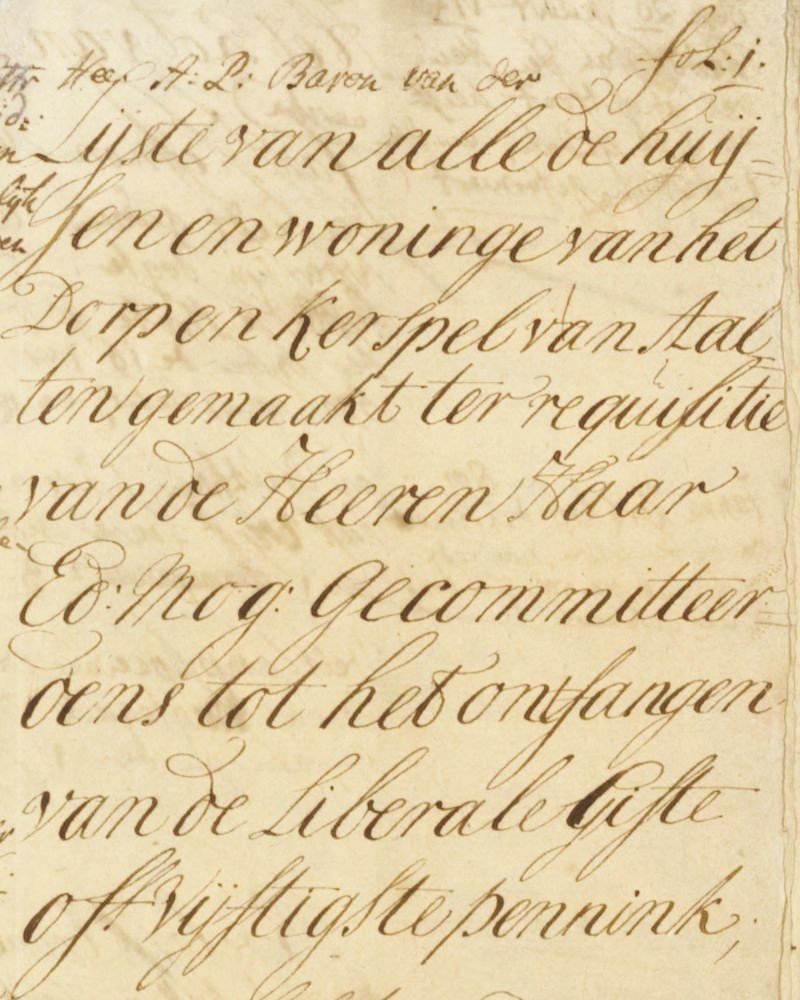
The collection of the Liberal Gift took place in 1748 and was meticulously recorded in special registers (tax rolls). In the parish of Aalten, the registration was organized by village and rural districts, and further subdivided by ‘rot’ (district). The tax roll for the town of Bredevoort is likewise subdivided by district.
In the tax rolls, information was recorded per house, such as:
- Names of the residents
- (Sometimes) the farm name
- Number of resident children (above and below 16 years of age)
- Assets (more or less than 500 guilders)
- Whether they paid anything and in which installments this was fulfilled
Scans of the tax rolls for the collection of the Liberal Gift in the lordship of Bredevoort can be consulted here.
Historical value
Thanks to this detailed registration, the Liberal Gift offers a unique insight into the composition of households and the prosperity of former Aalten residents in 1748. It not only shows where people lived—down to the district or farm level—but also provides an impression of the economic conditions within the community.