

In 1937, G.H. Rots described in a series of articles how things transpired in Aalten in former times. Regarding the years of the French occupation, he wrote:
“During the French period, Aalten enjoyed the blessings (?) of French rule. The slogan ‘Liberty, Equality, and Fraternity’ was prevalent at the time, and the liberty tree was planted on the Market Square in Aalten. A new municipal government was appointed, new laws and regulations were established; in short, a different spirit blew through the government buildings. The Batavian Republic was founded, and the House of Orange was finished.
French soldiers were also billeted in Aalten, with all the associated calamities. Although the majority were pro-Orange, people did not dare to express their opinions, and the new regime was accepted. This situation lasted from 1795 to 1799. Secretly, a large part of the population loathed the French occupation.
False hope
Then, in 1799, rumors circulated that a Dutch nobleman, A.R. van Heeckeren, also known as Suideras, had crossed the eastern borders at the head of a large army as a liberator and was victoriously driving the French out of the villages.
In other parts of the country, there were also incursions by the English and Russians, who were engaged in war with the French, and thus also with the Batavian Republic. The Orange supporters regained courage, and when Suideras marched into Winterswijk on September 5 and allowed the Orange flag to flutter from the tower once more, Aalten also prepared to receive the liberator.
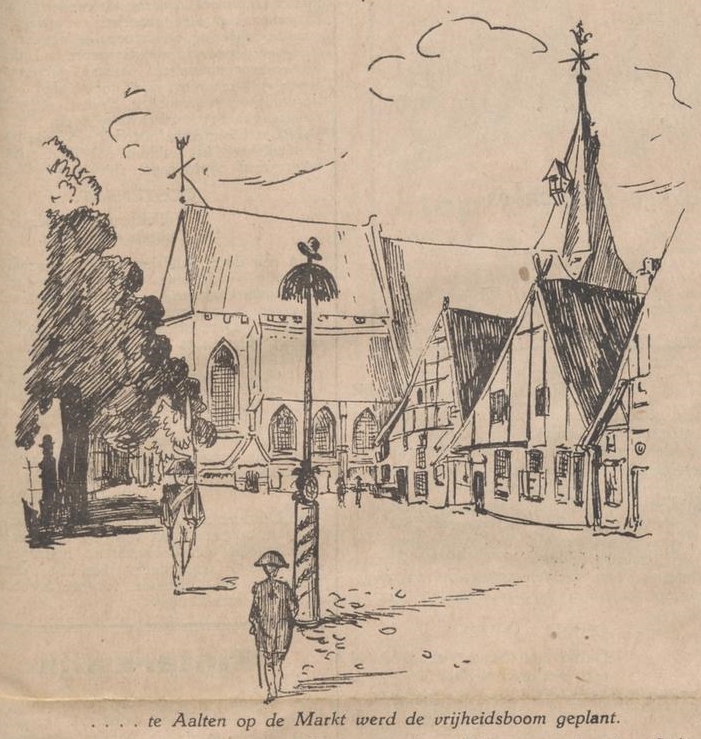
Great excitement took hold of the population. A certain Jan Derk Hoopman arrived with an axe and already began to chop down the liberty tree. In the afternoon, Suideras arrived in Aalten. The bells were rung. A large crowd welcomed the liberator while singing and dancing. People adorned themselves with Orange, believing that the suffering was finally over. It proved to be a false hope, for the French did not allow themselves to be easily defeated by Suideras.
By the following day, word arrived that a French army was approaching, and indeed, the French General Girod arrived in Aalten with his troops. Jan Derk Hoopman fled, and likely many others took to their heels as well, as house searches were conducted and heavy punishments were meted out. The joy had thus been short-lived. High taxes had to be paid, and earnings were meager.
The ministers held religious services in the open air. For instance, Reverend Westerbeek van Eerten climbed onto a farm cart and encouraged his fellow believers, who had gathered near the ‘De Pol‘ house.
A state of decline set in. The pressure of French rule became increasingly heavy. Young men had to draw lots for French conscription, and when Napoleon needed soldiers for his campaign to Russia, Aalten also had to provide a contingent. They left, never to return. Their remains rest beneath the soil of the Russian steppes, or they perished in the cold waters of the Berezina.
Liberation
Until 1813. Napoleon was defeated in the Battle of the Nations at Leipzig. The Prussians entered our country. The Prince of Orange arrived in our country from England, and once again the cry was ‘Orange Above’. There was jubilation in Aalten once more. The bells were rung again, and now the Orange flag would continue to fly.
One of the Orange scions, Prince Frederick, was at school in Berlin. Having heard of the revolution in the Netherlands, he traveled by stagecoach to The Hague. The route followed the great postal road, which we have described previously. The border crossing took place at the Heurne, and when the population heard that Prince Frederick would pass through Aalten, they went to meet the carriage, unhitched the horses, and pulled the coach through Aalten amidst loud cheering as far as the Zelhemseweg, to the spot where the lime tree stands. Well, that tree was planted then as a memorial to that event, and later the lime tree was established as the official coat of arms of Aalten.
Once more, the boys from Aalten would have to march against the French. When Napoleon escaped from Elba and equipped a large army to reclaim his former glory, the Netherlands had to place its army alongside the allies against him. Young men from Aalten also fought in the Battle of Waterloo. We know what became of Napoleon’s fate then. It had been his final convulsion.”