“Elk dörpken hef zien eigen klinkers, zien eigen spreuken en woordenschat.” (Every village has its own vowels, its own sayings, and vocabulary). This sentence is displayed on the façade of the Aalten library. It is a line from the song “Hier in de Achterhoek” (Here in the Achterhoek), by Rocco Ostermann and Matthijs Stronks. And it is entirely accurate.
The Achterhoek dialect, a variant of Low Saxon (Nedersaksisch), has traditionally been spoken in the north-east of the Netherlands and the north of Germany. Within the Achterhoek region, every municipality, and sometimes even every village, has its own nuances in the dialect, which is colloquially referred to as ‘plat’.
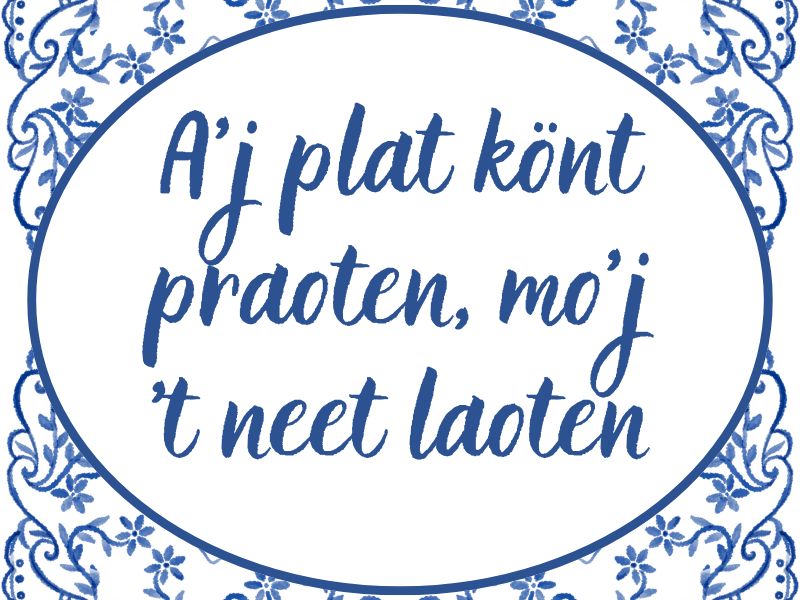
“A’j plat könt praoten, mo’j ‘t neet laoten”
The Aalten dialect possesses many ancient words and expressions that do not exist in Standard Dutch.
[To be developed: we are considering a description of the general characteristics that define the Aalten / Achterhoek dialect, perhaps including a few examples, but not an exhaustive glossary. Suggestions for this section are welcome!]
Dialect in daily life
In Aalten, the dialect still plays an important role in the daily lives of many residents. You can still frequently hear Aalten dialect spoken at home, on the street, in shops, and during local events. Many Aalten residents were raised bilingually, speaking the dialect at home and Standard Dutch at school.
Although the Aalten dialect is still spoken, younger generations are mastering it to a lesser degree. They often speak an ‘Achterhoek-flavoured’ version of Dutch, in which many of the typical old words and expressions used daily by their ancestors have disappeared. This development presents a challenge for the preservation of the dialect.
Cultural Heritage
The Aalten dialect is an important part of the local cultural heritage and forms a vivid link with the past. The history and daily life of Aalten are brought to life in stories, songs, and poems written in the dialect. The Aalten dialect thus contributes to the unique identity of the community.
To prevent the Achterhoek dialect from fading away, efforts are being made to pass it on to new generations. This is done, for example, through regional language projects in schools and cultural associations. These initiatives are essential to keeping the dialect vibrant and ensuring that it does not disappear, despite the influence of Standard Dutch and other modern languages.