Category: Business

  • The Driessen Textile Family

    The Driessen Textile Family

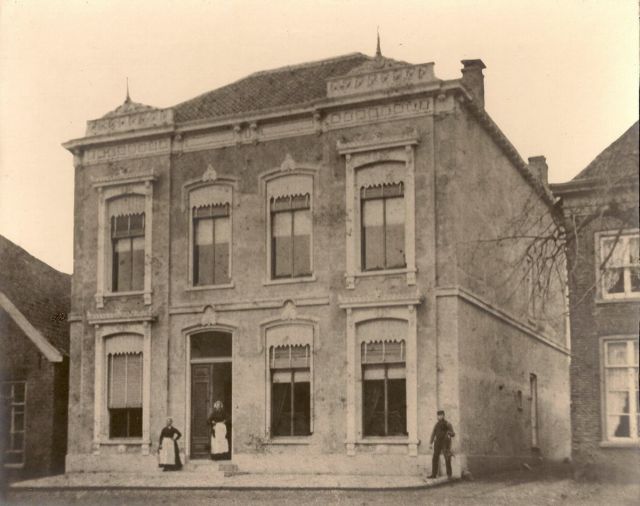
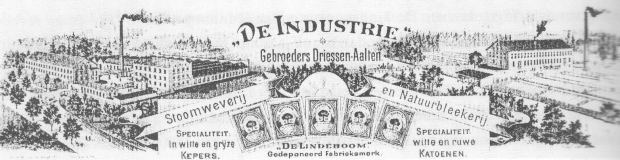
    Gebroeders Driessen, Aalten – Steam Weaving Mill and Natural Bleachery

    The Driessen family is a lineage of textile entrepreneurs, originally from Bocholt, just across the border in Germany. Members of the family were active as textile manufacturers in Bocholt, Aalten, and Leiden. It is a Catholic family, which was included in the Nederland’s Patriciaat (Blue Book) in 1961.

    The recorded lineage begins with Rutger Driessen, a weaver in Bocholt. In 1667, he paid taxes, but by 1672 he was considered too poor to be subject to taxation. Little is known about his son Johann Driessen (1663–after 1713) and grandson Gerard Driessen (1702–after 1738).

    The family’s social ascent began with Gerard’s son Bernard Driessen (1731–1772). He traded in textiles, which he purchased from home-weaving farmers around Bocholt and sold in Holland. The family likely owes its rise to the fact that, due to their poverty, they could not become members of the Boomsidenambt, the guild of cotton weavers. Guild members were prohibited from trading fabrics that had not been woven by fellow members. As the Driessens were not part of the guild, they were not bound by this rule and could trade freely in cotton produced by home-weavers.

    Thanks to this trade, Bernard became so prosperous that he was appointed schepen (alderman) of Bocholt, marking the family’s entry into the urban patriciate. However, he died at the age of 41 during a business trip to The Hague, before he could further strengthen his position.

    Expansion of the Textile Trade

    Two of Bernard’s sons continued the trade and expanded it significantly by employing hundreds of home-weavers: Peter Driessen (1756–1843) and Hermann Driessen (1765–1817). Initially, they worked together, but they later went their separate ways. Both brothers became very wealthy.

    Both married daughters of Johann Jacob Hölscher, a member of the cotton weavers’ guild and also an alderman of Bocholt. Peter married Elisabeth Hölscher, and Hermann married her sister Gertrud. These marriages demonstrated that the Driessen family had by then integrated into the local elite. Consequently, Peter Driessen served as the second mayor of Bocholt for fourteen years (1797–1811) and, in 1813, he was a member of the council of the Rees district during the Napoleonic era. In 1841, in his advanced years, he received a Prussian distinction: the Ritter des Roten Adlerordens (Knight of the Order of the Red Eagle), 4th class.

    From Trade to Manufacture

    Peter Driessen had approximately 500 home-weavers working for him around Bocholt. These weavers were formally independent but reliant on the ‘reder’ (merchant-manufacturer) who supplied the yarn and financed the loom. The rise of centralised workshops—precursors to factories—made it possible to exercise greater supervision over production. Looms could henceforth be used continuously. In this way, the merchant became a manufacturer or ‘fabriqueur’.

    Settling in Aalten

    To protect Dutch industry from British imports, King William I introduced an import duty of 25% to 45% on cotton fabrics in 1823. This made exports from Bocholt to the Netherlands virtually impossible. To circumvent this levy, two Driessen cousins settled in Aalten, just across the border: Heinrich Driessen (1794–1879, son of Mayor Peter) and Anton Driessen (1797–1879, son of Hermann). In Aalten, they established various textile enterprises, including a steam weaving mill and a bleachery.

    Over a period of more than 140 years (1826–1969), the Driessen manufacturers developed into the most significant employers in Aalten and the surrounding area. The factory buildings and private residences of the Driessens defined the village’s appearance. Until the second half of the 20th century, these manufacturers left a significant mark on the social and economic life of Aalten.

    Sources


    • ‘Geweven goed. De textielgeschiedenis van Aalten en Bredevoort’, H. de Beukelaer and J.G. ter Horst
    • Wikipedia
  • Communal Freezers in Aalten

    Communal Freezers in Aalten

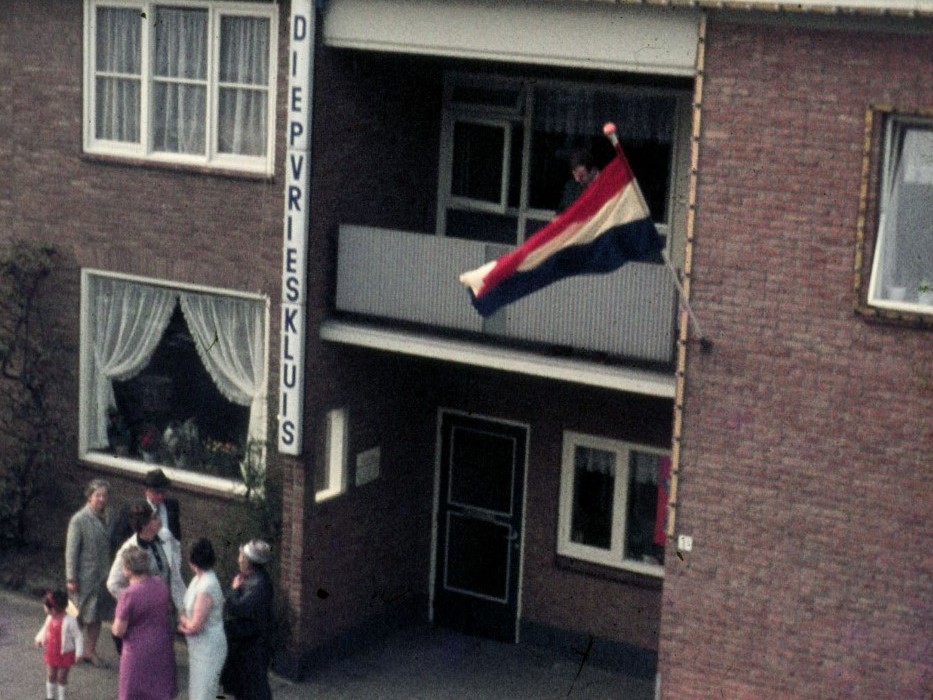
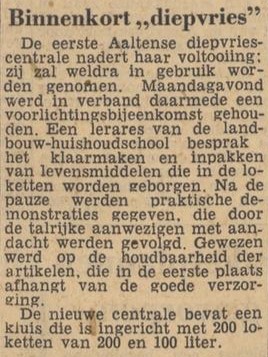
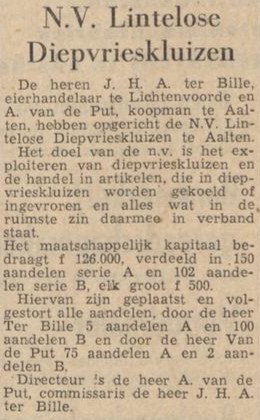
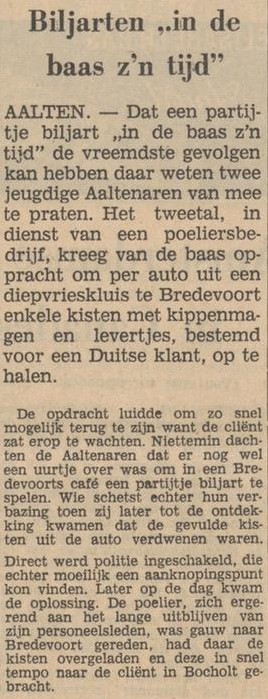
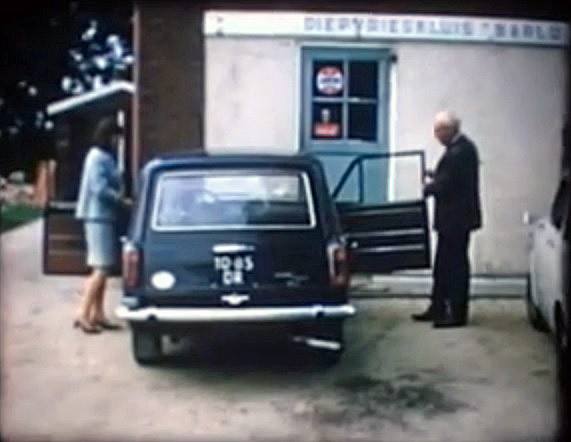
    In the 1950s and 60s, so-called communal freezers emerged in the Netherlands, particularly in rural areas. These were facilities, often established on a cooperative basis, where residents of villages or rural districts could rent one or more lockers to freeze food.

    The communal freezers provided a solution at a time when most households did not yet have their own freezer. Home-grown vegetables and fruit, or meat from home slaughtering, were primarily stored there.

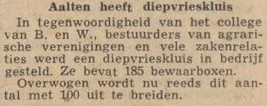
    In 1962, the Netherlands had approximately 700 of these communal freezers. However, their use declined rapidly in the 1970s, when the freezer became a common household appliance.

    Locations

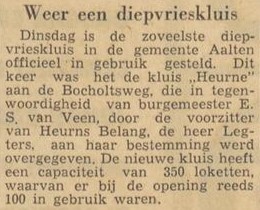
    There were also communal freezers in the municipality of Aalten. Some well-known examples (provisional list, April 2025):

    Do you have any additions or corrections to this list, or photos of (vanished) communal freezers in Aalten? Do you know if anything has been preserved? Please let us know!

    Newspaper reports

  • Anton Driessen

    Anton Driessen

    Textile manufacturer

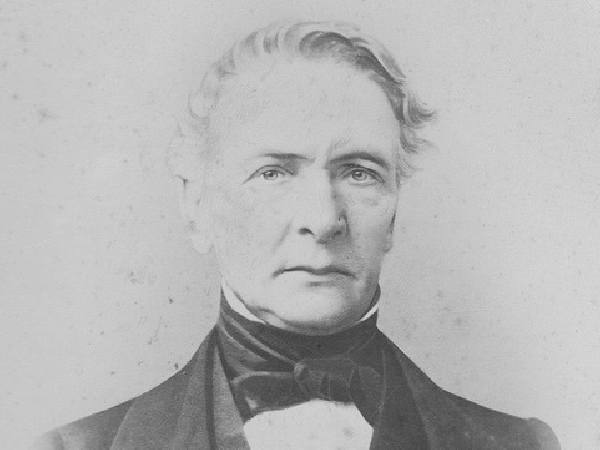
    Johan Bernard Anton (known as Anton) Driessen (Bocholt, December 5, 1797 – Aalten, March 7, 1879) was a prominent textile manufacturer in Aalten. Anton descended from a textile dynasty in Bocholt. His father Herman (1765–1817) was also a textile manufacturer, as was his brother Peter Driessen (1756–1843), who also served as an alderman and second mayor of Bocholt.

    After their father’s death, Anton and his younger brother Joseph founded the textile company ‘Gebrüder Driessen‘. In 1826, Anton and Joseph Driessen submitted a request to King William I to establish a textile factory in Aalten. The motives for the Driessen brothers’ request were the increased import duties in the Netherlands. They had chosen Aalten ‘as this place was best suited for this purpose‘.

    They requested permission to establish a fustian weaving mill and bleachery, as well as a cotton spinning mill and dye works. The Driessen brothers were granted permission for the establishment on the condition that it be located within the village center of Aalten.

    Not long after, their cousin Heinrich Driessen also requested permission from the King, which was likewise granted.

    In Aalten

    Anton moved to Aalten in 1826. He initially lived with Meijerink in the Kerkstraat. His brother Joseph remained in Bocholt, where they maintained a branch office.

    The company started “in the Barn and Garden Room of Mr. Bonninghoff”. This most likely referred to the house at Markt 18 belonging to the justice of the peace G.J. te Gussinklo, who had purchased the Borninkhof farm in 1804. Owners were often referred to by the name of their farm.

    For the processing of the yarn, Anton Driessen relied on the many home workers living in the area. Furthermore, the municipal report of 1826 mentions, among other things: “Several households have settled here, primarily from Bocholt“. The report for 1827 mentions for the first time that, alongside agriculture as the primary source of livelihood, much fustian was woven for the manufacturers from Bocholt. There were approximately 218 fustian weavers at that time, “performing the work in their homes“.

    On November 22, 1827, Anton Driessen married Isabella Dees in Bocholt.

    In that same year, the cotton spinning mill was moved from Bonninghoff’s barn and garden room to a better-equipped building in the center of the village. Driessen had purchased a house there from Manus Scholten, located at the site of the current address Landstraat 25.

    However, the relocation did not proceed without incident. Two neighbors, the schoolmaster H. Schotman and the farmer W. Obrink, submitted a formal objection to the municipal council, fearing noise nuisance and fire hazards. The municipality, however, rejected their objections. The two neighbors did not leave it at that and subsequently addressed their grievances to the Governor of the province of Gelderland. However, the Governor also saw no reason to give “any follow-up” to their objections.

    At the end of 1827, Anton Driessen was able to begin converting the house into a spinning mill. The new premises had an upper floor, which, along with the ground floor, was designated as workspace. Machines were installed on both levels.

    Beekhuize

    In 1833, Anton wished to build a new residence. To this end, he had purchased a house from the Degenaar heirs at the end of the Landstraat—now called Dijkstraat. He intended to demolish that house and build a new, modern residence with a warehouse, barn, and stables on the site. For this, however, he required more space than the existing plot. Anton Driessen submitted a plan to the municipal council with the request, “since the beautification of a Village is always one of the most pleasant duties of a Local government, to kindly grant the same, and consequently to support the undersigned in his intention as much as possible”.

    To realize Anton’s plans, both the stream and the street had to be diverted. Furthermore, a new bridge was required. Because the piles of the old bridge had almost decayed, the construction of the new bridge was not only highly necessary, but according to Driessen, the relocation was also less costly. In addition to diverting the stream and building a new bridge, Driessen also needed land for his plans. To this end, he exchanged a piece of land with the municipality. Negotiations regarding these matters lasted several years.

    In March 1835, Driessen was able to begin construction. For the production of the necessary bricks, he had meanwhile requested permission to establish a brickyard on the Schaarsheide and to excavate a three-hectare site. Due to the poor state of the roads in East Gelderland at that time, it was more practical and economical to set up a field kiln near the construction site than to purchase bricks elsewhere.

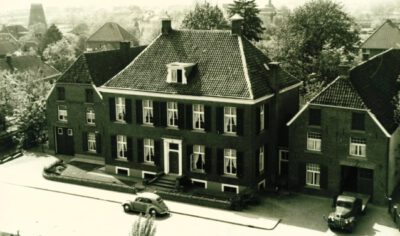
    The stately villa that Anton Driessen had built on the current Dijkstraat is known to every resident of Aalten as Beekhuize.

    Grave

    Anton Driessen is buried in the old Roman Catholic cemetery on Piet Heinstraat in Aalten.

    Sources


    • Delpher
    • ‘Geweven goed. De textielgeschiedenis van Aalten en Bredevoort’ (Woven Goods: The Textile History of Aalten and Bredevoort), H. de Beukelaer and J.G. ter Horst
  • A merchant family from Aalten around 1600

    A merchant family from Aalten around 1600

    How the Schenk-Voerknecht family grew into an international merchant dynasty

    Hanze

    At the beginning of the 17th century, Wessel Schenk and his half-brother Salomon Voerknecht from Aalten were among the largest grain traders in Europe. Their activities spanned from Amsterdam to Danzig, Königsberg, Genoa, and even the New World. Other family members were also active in trade and entered into marriages that strengthened their position. What began in Aalten grew into a network with international influence.

    The Schenk / Voerknecht family

    In the mid-16th century, a certain Jenneken ter Woert lived in Aalten. From her first marriage to Salcke Schenk, she had two children: Gertruid and Wessel Schenk. Around 1568, she remarried Johan Voerknecht, with whom she had four children: Salomon, Hans, Judith, and Anna Voerknecht.1 2

    In 1575, Johan Voerknecht was a keurnoot (lay judge) of the Bredevoort court3, a position indicating social standing. Whether the family belonged to the Aalten ‘elite’ is unknown to us. However, it is striking that all the children later became successful in trade or married partners of distinction. This suggests a connection to influential networks that enhanced their social and economic opportunities.

    Merchants in Amsterdam, Danzig and Königsberg

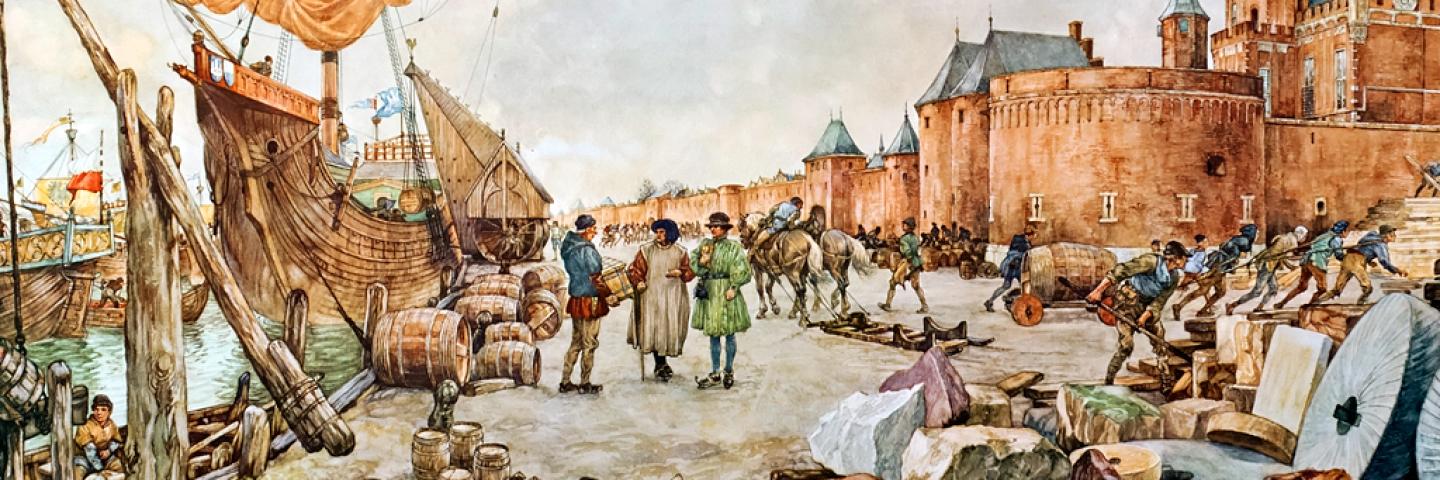
    From the late 15th century, merchants in the Low Countries specialized in the transport of bulk goods, especially grain and salt. This trade, known as the moedernegotie (mother of all trades), formed the economic foundation of Holland for centuries and made Amsterdam the most important staple market in Europe.4

    The Schenk-Voerknecht family also benefited from this. They maintained close ties with the Hanseatic cities of Danzig (Gdańsk) and Königsberg (Kaliningrad). Some family members even settled there, either temporarily or permanently.

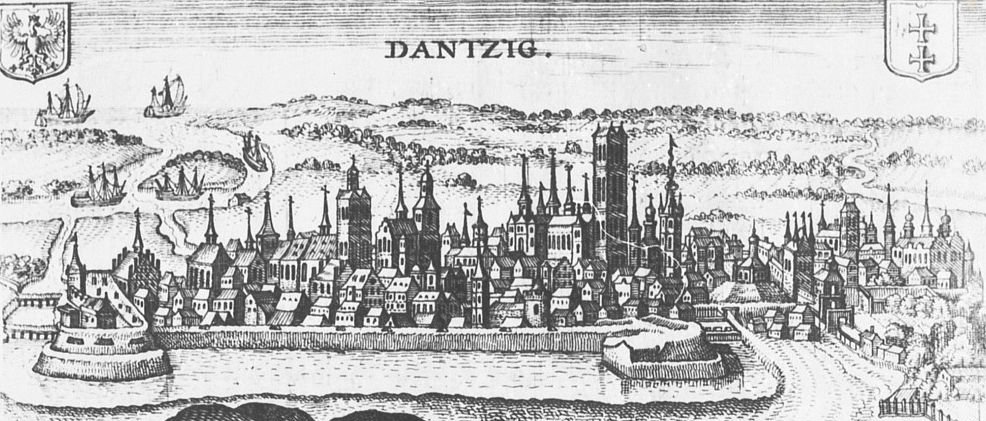
    Danzig, 1628 AD
    Danzig, 1628 AD

    The Schenk and Voerknecht children grew up during the Eighty Years’ War (1568–1648), yet they managed to break into international trade regardless. The period of the Twelve Years’ Truce (1609–1621) provided favorable conditions: a brief phase of peace and armistice. Eastern Netherlands had eight garrison towns (including Bredevoort) that were in constant need of forage, particularly grain. This was not only for bread but also for the production of beer.

    Wessel Schenk was a grain merchant and did good business in the Achterhoek during that period. He was also active in the trade route from Danzig to Genoa, Italy.5 His half-brother Salomon Voerknecht was likewise a very successful merchant.

    Largest carriers from Amsterdam to the Mediterranean, 1590–1620:

    CarriersTotalShipmentsWith a partner
    Jasper Quinget2011974
    Jan and Philippo Calandrini912566
    Guillelmo Bartolotti664224
    Caspar van Ceulen633528
    Isaac la Maire564214
    Willem Willemss49481
    Salomon Voerknecht451332
    Wessel Schenck30255

    Biographies of family members


    Wessel Schenk

    Born around 1566 in Aalten. In 1606, he lived on the Breestraat in Amsterdam. In archival documents, he is referred to as a “merchant lord.” Other sources indicate that he also regularly stayed in Danzig.

    Upon its founding in 1602, Schenk was one of the largest shareholders of the Dutch East India Company (VOC). He also saw opportunities in the New World. Together with his nephew Jan Holscher, he invested in expeditions to New Netherland, in the northeast of the present-day US. In 1614, he was a co-founder of the New Netherland Company, the predecessor of the West India Company.6

    In 1609, he included in his will that he would leave 4,000 guilders to the poor of his birthplace, Aalten. Because he was often traveling, he had a will drawn up in 1616, leaving his affairs in Amsterdam to his nephew Jan Holscher.

    In 1619, Wessel, as a citizen of Danzig, contractually transferred the annual income from two Aalten farms (Lutke Grievinck and Goorhuis) by proxy to his sister’s daughter Gertruid Tols, widow of Johan Brunss.7 In 1632, he was back in Danzig and sold by proxy “a garden or courtyard with timber structures in two parcels” outside the Regulierspoort in Amsterdam. He must have died shortly thereafter, presumably unmarried. 8


    Gertruid Schenk

    Born around 1565 in Aalten. Around 1584, she married Albert (?) Hengst van Juchteren in Anholt. After 1590, she remarried Henrick Toll. In 1600, she lived on the Nieuwe Zeedijk in Amsterdam. Gertruid was also active in the family business. In 1616, Gertruid and her brother Wessel received a letter of recommendation from the States-General addressed to the city council of Danzig—a sign that their commercial position was officially recognized. Gertruid passed away after 1628. 9


    Salomon Voerknecht

    Born around 1568 in Aalten. In 1597, he married Jannetje Hooft in Amsterdam. She was a descendant of a prominent Amsterdam merchant family that produced one of the greatest Dutch writers of the Golden Age: Pieter Corneliszoon Hooft. Father-in-law Jan Pietersz Hooft was a brother of the mayor of Amsterdam, Cornelis Pietersz Hooft, and through this marriage, he also became the brother-in-law of the later mayor Volckert Overlander.

    In 1618, Salomon, on his own behalf and as proxy for Judith and Hans Voerknecht, sold a piece of land, the Bullensche maat in Lintelo, to Roelof Damme and Catharina Smitz. In 1619, he sold—partly on behalf of his wife, and as proxy for his sister Judith, widow of De Marez, and brother Hans (“citizen of Danzig“)—their parental home in Aalten near the churchyard, including the courtyard and land, to Wessel Brethouwer and Mechteld Machtes.

    In 1637, Salomon was a senior merchant in the service of the VOC in Batavia. He had gone from Danzig to the East Indies and remarried a widow there. On October 24, 1637, in Batavia, “weak in body but still sound of mind,” he recorded his last will and presumably died shortly thereafter. His eldest son Johan became the deputy bailiff of Amsterdam in 1656. 10


    Hans Voerknecht

    Born around 1569 in Aalten. Hans Voerknecht (also called Schenk) was likewise active in trade. In 1605, he was mentioned as a merchant in Amsterdam, along with Salomon Voerknecht and Wessel Schenk. In 1608, he was in Danzig, and in 1619, he was even recorded as a citizen of that city. He presumably died there not long after. 11


    Judith Voerknecht

    Born around 1569 in Aalten. Around 1585, she married Daniel de Marez, a merchant in Danzig. He is immortalized in an almost life-sized painting of the De Marez and De Schilder families. While in surrounding countries only monarchs had themselves immortalized in this manner, here powerful merchants displayed their status. In 1619, her brother Salomon sold the parental home in Aalten on her behalf (and that of other heirs).12


    Anna Voerknecht

    Born around 1571 in Aalten. Around 1590, she married the merchant Joost Grevinckhoff, also from Aalten. A deed from the court at Bredevoort from 1615 mentions that Seigneur Wessel Schenk sold a large number of lands and tenant farms on behalf of Joost and Anna, who were then residing in Königsberg. The deed concerns a debt settlement: Joost and Anna were deeply in debt, primarily to Anna’s brother, Seigneur Salomon Voerknecht, “citizen and merchant in Amsterdam” (Seigneur was the title of address for wealthy merchants at that time). Because they could not pay, they transferred their entire property in Aalten—including their house, land, and hereditary rights—to Salomon and his wife Joanna Hooft.13


    Jan Holscher

    Born around 1584 in Dülmen (near Münster). In 1601, he came to Amsterdam, where he entered the service of his uncle, the merchant Wessel Schenk. Although he managed his uncle’s business, he also traded independently. He held shares in a company that traded with Guyana. Together with his uncle, he also participated in the Hans Claesz Company. In 1613, Thijs Volckertsz Mossel sailed for this company to the Hudson River. In 1612, Jan Holscher married Elisabeth de Hardouin from Rouen in Amsterdam.14