

The Driessen family is a lineage of textile entrepreneurs, originally from Bocholt, just across the border in Germany. Members of the family were active as textile manufacturers in Bocholt, Aalten, and Leiden. It is a Catholic family, which was included in the Nederland’s Patriciaat (Blue Book) in 1961.
The recorded lineage begins with Rutger Driessen, a weaver in Bocholt. In 1667, he paid taxes, but by 1672 he was considered too poor to be subject to taxation. Little is known about his son Johann Driessen (1663–after 1713) and grandson Gerard Driessen (1702–after 1738).
The family’s social ascent began with Gerard’s son Bernard Driessen (1731–1772). He traded in textiles, which he purchased from home-weaving farmers around Bocholt and sold in Holland. The family likely owes its rise to the fact that, due to their poverty, they could not become members of the Boomsidenambt, the guild of cotton weavers. Guild members were prohibited from trading fabrics that had not been woven by fellow members. As the Driessens were not part of the guild, they were not bound by this rule and could trade freely in cotton produced by home-weavers.
Thanks to this trade, Bernard became so prosperous that he was appointed schepen (alderman) of Bocholt, marking the family’s entry into the urban patriciate. However, he died at the age of 41 during a business trip to The Hague, before he could further strengthen his position.
Expansion of the Textile Trade
Two of Bernard’s sons continued the trade and expanded it significantly by employing hundreds of home-weavers: Peter Driessen (1756–1843) and Hermann Driessen (1765–1817). Initially, they worked together, but they later went their separate ways. Both brothers became very wealthy.
Both married daughters of Johann Jacob Hölscher, a member of the cotton weavers’ guild and also an alderman of Bocholt. Peter married Elisabeth Hölscher, and Hermann married her sister Gertrud. These marriages demonstrated that the Driessen family had by then integrated into the local elite. Consequently, Peter Driessen served as the second mayor of Bocholt for fourteen years (1797–1811) and, in 1813, he was a member of the council of the Rees district during the Napoleonic era. In 1841, in his advanced years, he received a Prussian distinction: the Ritter des Roten Adlerordens (Knight of the Order of the Red Eagle), 4th class.
From Trade to Manufacture
Peter Driessen had approximately 500 home-weavers working for him around Bocholt. These weavers were formally independent but reliant on the ‘reder’ (merchant-manufacturer) who supplied the yarn and financed the loom. The rise of centralised workshops—precursors to factories—made it possible to exercise greater supervision over production. Looms could henceforth be used continuously. In this way, the merchant became a manufacturer or ‘fabriqueur’.
Settling in Aalten
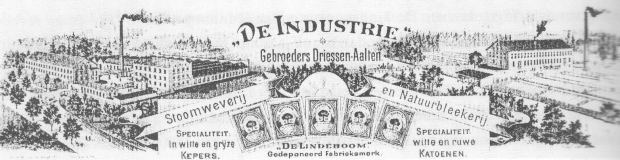
To protect Dutch industry from British imports, King William I introduced an import duty of 25% to 45% on cotton fabrics in 1823. This made exports from Bocholt to the Netherlands virtually impossible. To circumvent this levy, two Driessen cousins settled in Aalten, just across the border: Heinrich Driessen (1794–1879, son of Mayor Peter) and Anton Driessen (1797–1879, son of Hermann). In Aalten, they established various textile enterprises, including a steam weaving mill and a bleachery.
Over a period of more than 140 years (1826–1969), the Driessen manufacturers developed into the most significant employers in Aalten and the surrounding area. The factory buildings and private residences of the Driessens defined the village’s appearance. Until the second half of the 20th century, these manufacturers left a significant mark on the social and economic life of Aalten.
Sources
- ‘Geweven goed. De textielgeschiedenis van Aalten en Bredevoort’, H. de Beukelaer and J.G. ter Horst
- Wikipedia