

In the second half of the 20th century, a large-scale land consolidation process took place in the municipality of Aalten. During this radical process, agricultural lands were reorganized to enable more efficient operations. The objective was to create larger and more accessible plots for farmers, with less fragmentation and improved infrastructure. However, this change also had significant consequences for the landscape and nature.
Why was land consolidation necessary?
Due to inheritance divisions and changes in ownership over the centuries, agricultural plots had become increasingly smaller and more irregular. It became progressively difficult for farmers to work efficiently. The solution was land consolidation. This involved merging and reorganizing plots so that agricultural businesses could operate more effectively. This was achieved through:
- Enlargement and reorganization of agricultural plots;
- Improved accessibility via paved roads;
- Adjustment of water management systems;
- Reduction of old legal restrictions such as easements.
Effects on the landscape
The traditional Achterhoek ‘coulisse’ landscape, with its alternation of small fields, meadows, and hedgerows, was affected in many places by land consolidation. This varied and small-scale landscape, which gave the area its picturesque character, gave way to larger, more efficiently designed agricultural plots. As a result, many hedgerows, copses, and dirt tracks disappeared.
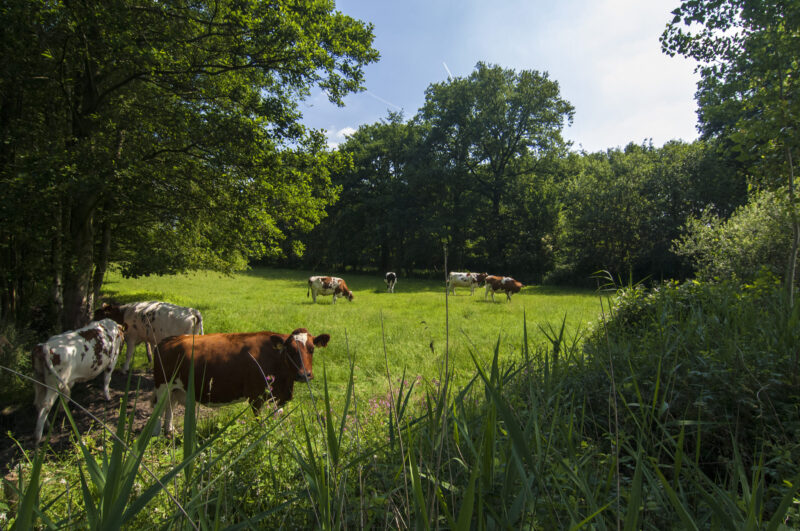
This reorganization allowed farmers to work more easily with modern machinery, but it also made the landscape more open and uniform. Roads such as the Eskesweg and the Aladnaweg were constructed to make agricultural lands more accessible, but this came at the expense of old dirt tracks and characteristic plot boundaries.
Consequences for water and nature
In addition to the changes in the landscape, water management was also adjusted. Streams and ditches were straightened and deepened to drain water more quickly. While this prevented flooding, it led to drought issues in some areas. Much of the wetland nature disappeared, which had consequences for biodiversity.
Despite the benefits for agriculture, part of Aalten’s traditional landscape was lost. The small-scale and varied character of the region gave way to larger-scale agricultural lands with less room for nature and historical landscape elements.