
Huisstededijk, IJzerlo (just before the Keizersbeek bridge)
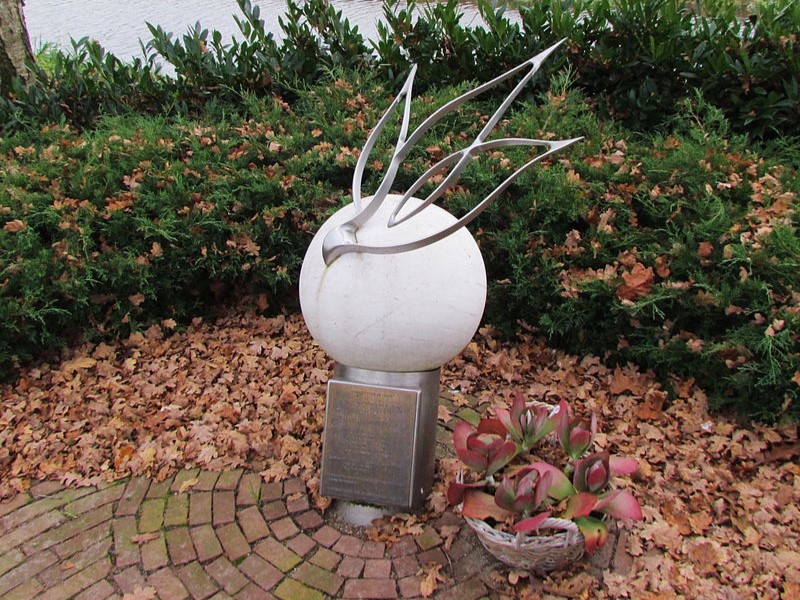
The ‘Flying for Peace’ (Vliegen voor de Vrede) monument is a commemorative memorial located on Huisstededijk in the Aalten hamlet of IJzerlo. The monument was erected in memory of the crash of a British bomber during the Second World War, which came down in a nearby potato field on the night of 26 June 1943.
On that particular night, over 400 British bombers flew over the Achterhoek on a mission to bomb the petrochemical industry in Gelsenkirchen. One of these aircraft, a Short Stirling BK767 of 214 Squadron, Royal Air Force, with seven crew members on board, had taken off just before midnight on 25 June.
At approximately 01:20, the aircraft was set ablaze by night fighter pilot Oberleutnant Ludwig Meister, flying a Messerschmitt Bf 110 G-4 that had recently scrambled from Venlo airfield. The Stirling crashed into a potato field between the farms of the Van Lochem family on Huisstededijk and the Ter Horst family on Veldweg.
Of the seven crew members, only two survived the crash. They were later captured near Hemden and spent the remainder of the war in German prisoner-of-war camps. The other five crew members perished and were buried following a brief ceremony on 29 June 1943 at Berkenhove Cemetery in Aalten.
The following day, many Aalten residents flocked to the cemetery. On the middle grave, members of the underground resistance laid a wreath with ribbons bearing the text: “Gebroken vleugels, onsterfelijke roem” (Broken wings, immortal fame). By order of the occupying forces, these words had to be removed, but they live on through the monument today.
The fallen crew members were:
• F/O B.H. Church , 21
• Sgt W. Th. Davis , 21
• Sgt F. Mills , 20
• Sgt W.H. Thompson , 21
• F/O J.F. Tritton , 28
Survivors (taken prisoner):
• F/O K.A. Nielson
• Sgt E.G. Taylor
The Monument
In 2003, a monument was unveiled at the spot where one of the crew members’ bodies was found, near the cycle bridge over the stream on Huisstededijk. The creator, Wim Westerveld, gave it the name ‘Flying for Peace’ and designed an artwork containing multiple layers of symbolism.
The monument consists of a white stone sphere topped with a metal sculpture that, from certain angles, represents a dove and, from others, flames. The sphere rests on a metal pipe angled into the ground, to which a plaque is attached. One of the two survivors, navigator Edwin Taylor (born 1922), was present at the unveiling of the monument.
Significance
The sculpture represents the Earth with a dove of peace on top, symbolising the desire for peace. However, from certain viewpoints, the dove transforms into flames, symbolising the tragic event of the crash and the fiery dedication of the crew to their mission. The flames also refer to the fire of the bomb load the aircraft was carrying. The broken wings on the monument are a symbol of the crew’s abruptly ended mission.
The monument serves not only as a memorial to the crew of Stirling BK767 but also conveys a broader message. It acts as a warning against war and reminds us of the freedom we enjoy today. It calls upon us to cherish this freedom and to grant it to others as well.