

Textile manufacturer
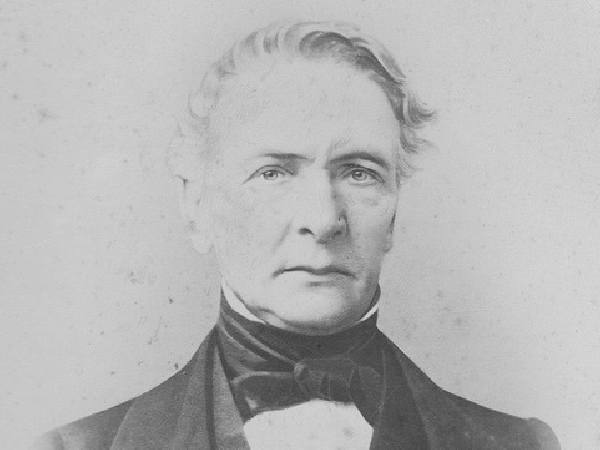
Johan Bernard Anton (known as Anton) Driessen (Bocholt, December 5, 1797 – Aalten, March 7, 1879) was a prominent textile manufacturer in Aalten. Anton descended from a textile dynasty in Bocholt. His father Herman (1765–1817) was also a textile manufacturer, as was his brother Peter Driessen (1756–1843), who also served as an alderman and second mayor of Bocholt.
After their father’s death, Anton and his younger brother Joseph founded the textile company ‘Gebrüder Driessen‘. In 1826, Anton and Joseph Driessen submitted a request to King William I to establish a textile factory in Aalten. The motives for the Driessen brothers’ request were the increased import duties in the Netherlands. They had chosen Aalten ‘as this place was best suited for this purpose‘.
They requested permission to establish a fustian weaving mill and bleachery, as well as a cotton spinning mill and dye works. The Driessen brothers were granted permission for the establishment on the condition that it be located within the village center of Aalten.
Not long after, their cousin Heinrich Driessen also requested permission from the King, which was likewise granted.
In Aalten
Anton moved to Aalten in 1826. He initially lived with Meijerink in the Kerkstraat. His brother Joseph remained in Bocholt, where they maintained a branch office.
The company started “in the Barn and Garden Room of Mr. Bonninghoff”. This most likely referred to the house at Markt 18 belonging to the justice of the peace G.J. te Gussinklo, who had purchased the Borninkhof farm in 1804. Owners were often referred to by the name of their farm.
For the processing of the yarn, Anton Driessen relied on the many home workers living in the area. Furthermore, the municipal report of 1826 mentions, among other things: “Several households have settled here, primarily from Bocholt“. The report for 1827 mentions for the first time that, alongside agriculture as the primary source of livelihood, much fustian was woven for the manufacturers from Bocholt. There were approximately 218 fustian weavers at that time, “performing the work in their homes“.
On November 22, 1827, Anton Driessen married Isabella Dees in Bocholt.

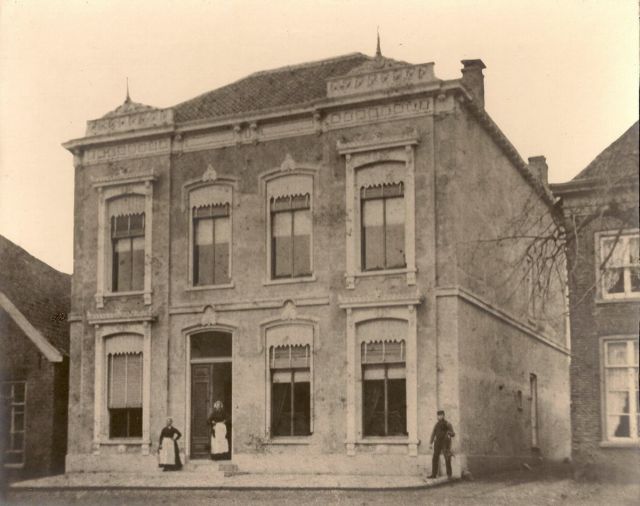
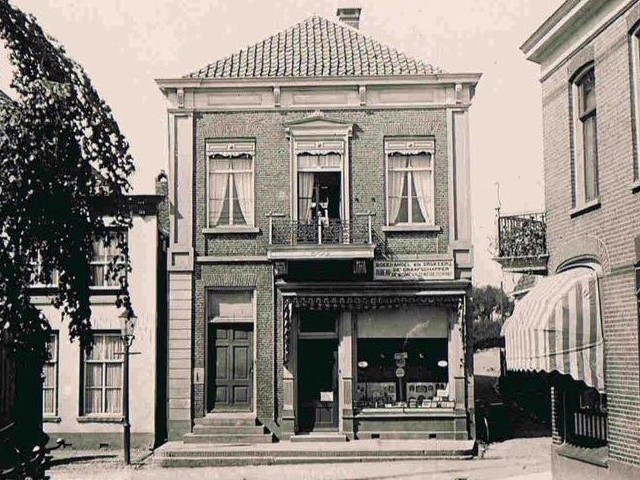
In that same year, the cotton spinning mill was moved from Bonninghoff’s barn and garden room to a better-equipped building in the center of the village. Driessen had purchased a house there from Manus Scholten, located at the site of the current address Landstraat 25.
However, the relocation did not proceed without incident. Two neighbors, the schoolmaster H. Schotman and the farmer W. Obrink, submitted a formal objection to the municipal council, fearing noise nuisance and fire hazards. The municipality, however, rejected their objections. The two neighbors did not leave it at that and subsequently addressed their grievances to the Governor of the province of Gelderland. However, the Governor also saw no reason to give “any follow-up” to their objections.
At the end of 1827, Anton Driessen was able to begin converting the house into a spinning mill. The new premises had an upper floor, which, along with the ground floor, was designated as workspace. Machines were installed on both levels.
Beekhuize
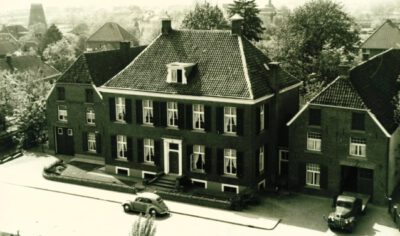
In 1833, Anton wished to build a new residence. To this end, he had purchased a house from the Degenaar heirs at the end of the Landstraat—now called Dijkstraat. He intended to demolish that house and build a new, modern residence with a warehouse, barn, and stables on the site. For this, however, he required more space than the existing plot. Anton Driessen submitted a plan to the municipal council with the request, “since the beautification of a Village is always one of the most pleasant duties of a Local government, to kindly grant the same, and consequently to support the undersigned in his intention as much as possible”.
To realize Anton’s plans, both the stream and the street had to be diverted. Furthermore, a new bridge was required. Because the piles of the old bridge had almost decayed, the construction of the new bridge was not only highly necessary, but according to Driessen, the relocation was also less costly. In addition to diverting the stream and building a new bridge, Driessen also needed land for his plans. To this end, he exchanged a piece of land with the municipality. Negotiations regarding these matters lasted several years.
In March 1835, Driessen was able to begin construction. For the production of the necessary bricks, he had meanwhile requested permission to establish a brickyard on the Schaarsheide and to excavate a three-hectare site. Due to the poor state of the roads in East Gelderland at that time, it was more practical and economical to set up a field kiln near the construction site than to purchase bricks elsewhere.
The stately villa that Anton Driessen had built on the current Dijkstraat is known to every resident of Aalten as Beekhuize.
Grave
Anton Driessen is buried in the old Roman Catholic cemetery on Piet Heinstraat in Aalten.
Sources
- Delpher
- ‘Geweven goed. De textielgeschiedenis van Aalten en Bredevoort’ (Woven Goods: The Textile History of Aalten and Bredevoort), H. de Beukelaer and J.G. ter Horst