

Textile manufacturer – “den veursten Dreessen”
Johann Heinrich Joseph (known as Heinrich) Driessen (Bocholt, 10-07-1794 – Aalten, 04-07-1879) was a prominent textile manufacturer in Aalten. Heinrich descended from a Bocholt textile dynasty. He was the only son of Peter Driessen and Maria Hölscher. His father held a distinguished position in the Prussian town, just across the border from Aalten. In addition to being a textile manufacturer, he served there as a magistrate and, from 1797 to 1811, as deputy mayor.
Heinrich received a thorough education at the Jesuit College in Amsterdam and spoke excellent French, so that in 1812, when Napoleon’s troops passed through Bocholt, he was the only one capable of acting as an interpreter between the municipal authorities and the French generals.
Peter Driessen & Sohn
In 1810, Heinrich joined his father’s business. On December 2, 1820, he married Lisette Sträter in Rheine (Germany), a descendant of another prominent textile family. They had nine sons and two daughters. In 1826, he was entrusted with the management of the firm Peter Driessen & Sohn.
In that same year, his cousins Anton and Joseph Driessen submitted a request to King William I to establish a textile factory in Aalten, which was granted by William I. Not long after, Heinrich Driessen also requested permission from the King to settle in Aalten. The firm Peter Driessen & Sohn also received the requested establishment permit.
In Aalten
His father Peter continued to live in Bocholt while his son Heinrich settled in Aalten. He initially lived with the Meijerink family on Kerkstraat, one of the few remaining Catholic families in Aalten, in the same building as his cousin Anton Driessen.
In Aalten, Heinrich established a branch of his father Peter Driessen’s fustian trade and hand-spinning mill. They already owned the necessary land in Aalten and Varsseveld, and in 1826 he expanded his activities to Groenlo. There, Heinrich had purchased a house from De Heyder. That house was converted into a spinning mill. He made the yarn spun there available to home weavers who processed it into cloth.
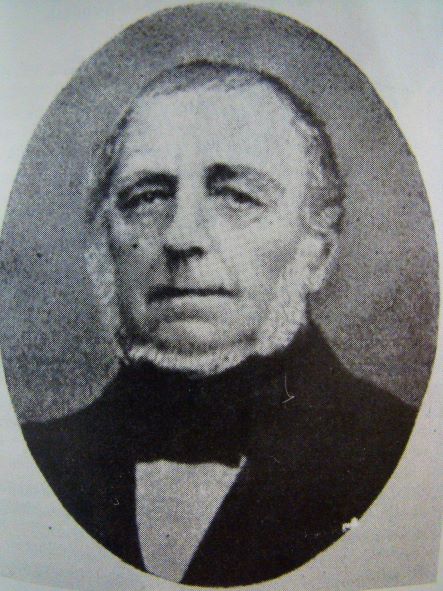

Heinrich was an enterprising man. By 1832, he had approximately 500 linen weavers in Aalten and the surrounding area working for him, and three years later, along with Blijdenstein in Enschede, he was among the largest fustian manufacturers in the eastern Netherlands. He was one of the first in the Netherlands to utilize steam in his bleachery.
‘Den veursten Dreessen’
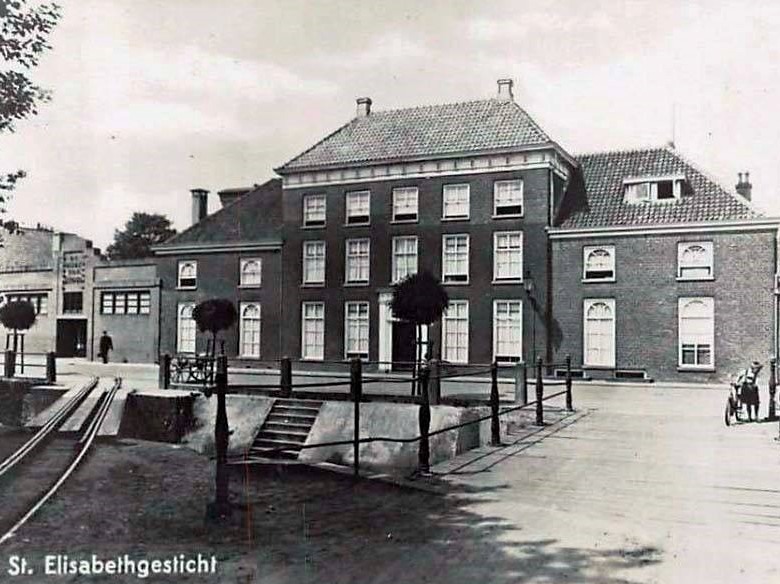
In 1837, he had a grand residence built at the beginning of Dijkstraat. For this reason, he was popularly known as ‘den veursten Dreessen’ (the front Driessen), while his cousin Anton, who built Beekhuize a little further along, was called ‘den achtersten Dreessen’ (the back Driessen). Heinrich’s eldest son, Theodoor, laid the first stone on June 29, 1837. Business premises were also located at the residence, primarily serving as storage for yarns and woven fabrics. These fabrics were transported by a wagon, often pulled by an ox, to the bleachery in Dale. The driver bore the fitting nickname Ossen Willem (Oxen William). After Heinrich’s death, the house was repurposed as a convent.
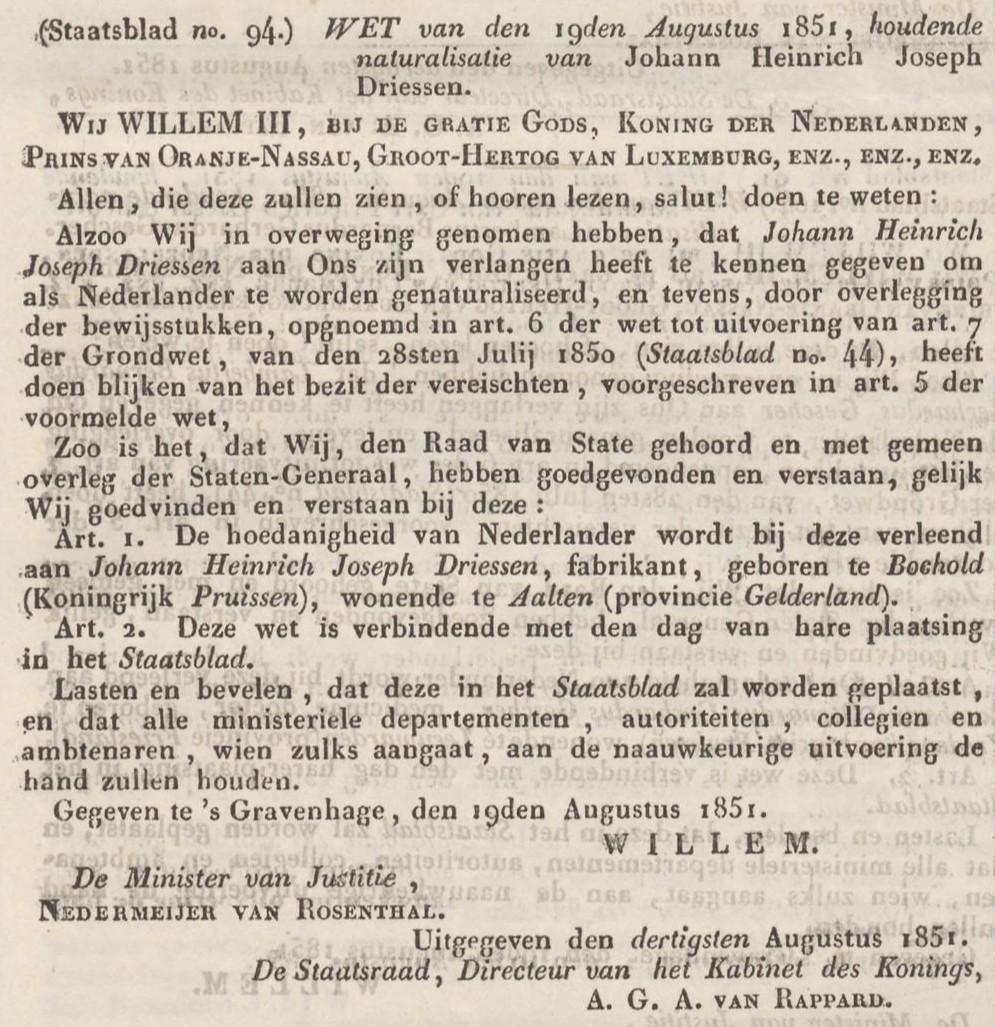
Following his father’s death in 1843, Heinrich became the sole owner of Peter Driessen & Sohn. His eldest son Theodor (1821-1878) was then placed in charge of the management in Bocholt. In 1851, King William III granted Heinrich Dutch nationality.
In 1849, Heinrich established a steam spinning mill on Hogestraat in Aalten, the first of its kind in the Achterhoek region. This was soon expanded with several ‘power looms’ (steam-driven weaving looms). After this factory burned down on the night of August 19 to 20, 1859, he did not rebuild the business.

To Leiden
Heinrich shifted his focus to Leiden. There, in 1846, together with his nephew (his sister’s son), the soap boiler Ignatz van Wensen, he had purchased the declining textile printing and dyeing works De Heyder & Co., later known as the Leidsche Katoenmaatschappij (Leiden Cotton Company). He had his second son Louis (1823-1904) come over from England to take charge in Leiden. With the knowledge he had acquired in Manchester, Louis soon managed to make the company profitable.
Heinrich’s son Eduard (1824-1895) continued to look after the company’s interests in Aalten. Initially, the bleachery there remained operational, but over time Eduard primarily focused on the trade in cotton and yarns. The branch in Bocholt, managed by Theodor, was closed after he and his brother Peter (1832-1895) started a blue-dyeing and printing works there in 1854, named the firm Theodor and Peter Driessen.
Catholic
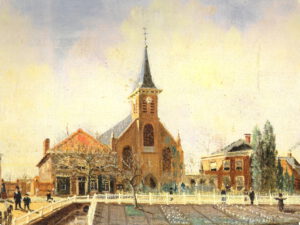
The Driessen family was also of great significance to the Aalten Catholic community, which had been a minority in the Reformed village since the Reformation of 1596. Not only through their prestige and influence, but also through various donations from the Driessens, the Catholic church in Aalten was able to grow into a fully-fledged church community. Both Heinrich and his cousin Anton played important roles as churchwardens and overseers of the poor, roles that were continued by their descendants.
Heinrich Driessen was very strong-willed in his conduct and often followed his own path in ecclesiastical matters as well. For instance, during the disputes between the Catholics and the Reformed in 1842 regarding the ringing of the bells. Pastor G.H.J. Wansing of Aalten wrote a letter about this to the Archpriest of Gelderland, M. Terwindt, which was co-signed by the churchwardens Th.W. Meijerink, H. Vulting, and A. Driessen. Heinrich Driessen, although a member of the church board, had not signed this letter and addressed two personal letters to Terwindt himself.
What stands out in these letters is that he stated, among other things, that the pastor seemed a priori prejudiced against Aalten and expressed the hope that the Aalten parish would receive a new shepherd who would be to everyone’s liking. He requested Terwindt to take his reflections into consideration when making his choice and assured him that he preferred to employ everything that was conducive to the honor of their holy religion. But at the same time, Driessen wrote that—because the old pastor showed him the greatest respect and because he himself esteemed the pastor as a man whose moral conduct could serve as an example to an entire province—he trusted that it would also please the Archpriest that the contents of the letters never be disclosed to others.
New church
A subsequent problem arose when it was decided around 1853 to build a new church. This led to serious disagreements within the church board. For instance, churchwarden Heinrich Driessen again found it necessary to act independently by contacting the Archbishop behind the backs of the other board members. In a letter to the Archbishop, he referred to the approval the latter had given to the plans for the construction of the church, on the condition that the confessional or confessionals be placed inside the church and not in the sacristy or in separate extensions on the side walls. Based on that condition, a plan had been sent to the King for approval.
However, during Driessen’s absence, the tendering for the church had taken place, in which an extension was nevertheless planned, contrary to the archiepiscopal approval. An extension to the church for the purpose of the confessional would, according to Heinrich, only disfigure a church. He had tried to convince the pastor of this, but had not succeeded. Driessen preferred to see the confessional inside the church, as was common in the Münsterland, rather than in an extension. According to him, the error could still be rectified, even though the masonry on that side was already in full swing. In his letter to the Archbishop, he therefore requested that instructions be given to the church board as soon as possible. The outcome of the matter is unknown. This action, however, is characteristic of Heinrich Driessen, who was apparently accustomed to getting his way and took the necessary steps on his own initiative to achieve it.
Wealthy
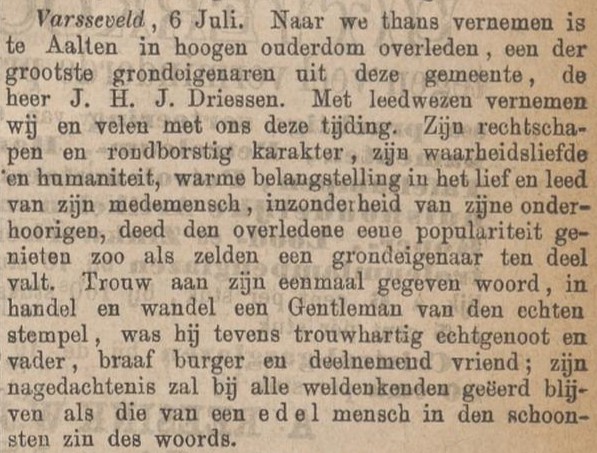
At the end of his life, Heinrich was a wealthy man. He held shares in spinning mills in Enschede, Gronau, and Rheine. Rheine was his wife’s birthplace, and her relatives managed textile enterprises there. Furthermore, he owned many lands and farms in the vicinity of Aalten, Varsseveld, and Bocholt.
Heinrich reached the advanced age of nearly 85 years. Several of his children and grandchildren entered the textile industry.
Sources
- Biografisch Woordenboek Gelderland
- Annex to De Graafschapbode, 23 July 1937
- Delpher
- Nijver in het groen. Twee eeuwen industriële ontwikkeling in Achterhoek en Liemers, H. de Beukelaer
- St.-Helena’s ommegang. De geschiedenis van de Aaltense katholieken, H. de Beukelaer
- Geweven goed. De textielgeschiedenis van Aalten en Bredevoort, Aalten 1992, H. de Beukelaer en J.G. ter Horst
- Stammbuch und Chronik der Familien Driessen, Giessing, van Wensen, Schwartz, Sträter, Hölscher, F. Schwartz