
Military officer and governor of Bredevoort
Captain Wolf Misslich was the commander of the States’ garrison in Bredevoort during the early 17th century. In 1629, he participated in the capture of Wesel, for which he was rewarded by the States-General. Later that same year, he was appointed governor of the Lordship of Bredevoort. His substantial legacy to the poor established him as one of the greatest benefactors in the history of the town.
From soldier to governor
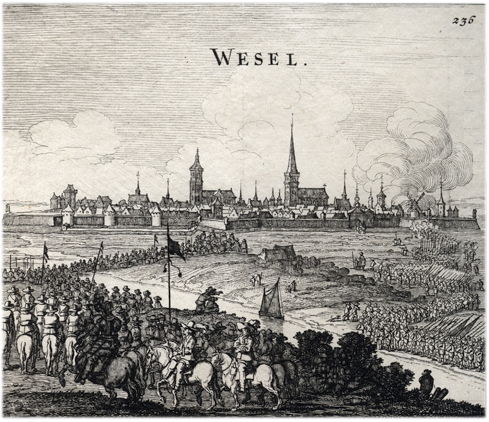
In August 1629, during the Eighty Years’ War, Gooswijn van der Lawick and Wolf Misslich (respectively the drossaard and military commander of Bredevoort) were ordered by Prince Frederick Henry to march to Emmerich with six hundred soldiers to participate in the capture of Wesel, a major fortified city then held by the Spanish.
Misslich and his troops captured two Spanish redoubts on the Lippe. For his services, he received a gold medal valued at one hundred rijksdaalders from the States-General.1
Following these military successes, Misslich was appointed governor of Bredevoort, a strategically located fortified town in the east of Gelderland.
Family, legacy, and charity
In a deed dated June 27, 1629, Misslich is referred to as “van Paterborn” (Paderborn), indicating his place of origin.2 He was initially married to Catharina van Jeveren; from this marriage, a daughter, Anna Margaretha, was born. Anna Margaretha married Captain Robert van Giffen; they had a daughter named Catharina. Both Anna Margaretha and her daughter passed away in the summer of 1639, shortly before Misslich himself. After the death of his first wife, Misslich remarried his maidservant, Nelleke Servaes.3
In a will dated December 26, 1628, Misslich already demonstrated his philanthropic nature. In it, he bequeathed, among other things, 500 Carolus guilders to the poor of Emmerich; he named his daughter Anna Margaretha as the heir to the rest of his estate and also left five hundred guilders to his nephew (his namesake, Sergeant Wolf Misslich), three hundred guilders to his—then—maidservant Nelleken, and twenty rijksdaalders and a cloak to his servant Jurrien. 4
His charitable work took further shape in the following years. In 1637, he purchased a house with a barn, garden, and appurtenances within the town of Bredevoort from the Deputies of the County of Zutphen, with the provision that the property would pass to the poor after his death.5 On July 13, 1639, he bequeathed 6,000 Carolus guilders to the New Orphanage in Zutphen and 100 rijksdaalders to the poor of Lochem.6
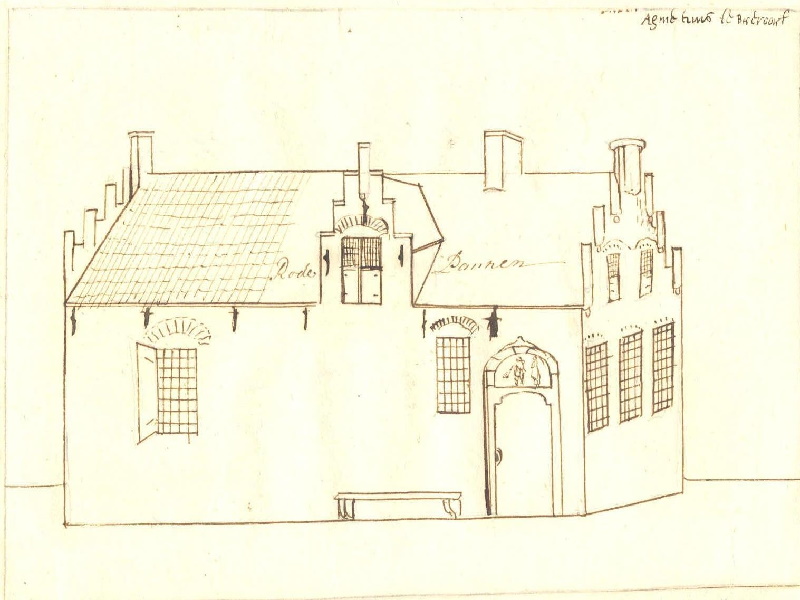
However, the most well-known part of his legacy went to the poor of Bredevoort. According to his will, he left his house, garden, and associated lands to the city’s poor relief—a donation later estimated at 15,000 guilders, an exceptionally large sum for that time. This gift gave rise to the local saying: “The poor of Bredevoort are rich.” 7
Misslich’s house was likely located near the Ambthuis. The rental income from the property was entirely dedicated to poor relief. Until the nineteenth century, the fund resulting from his legacy was still managed by the church’s deacons and provisors. In 1808, the fund still represented a value of over 6,000 guilders.
One of the properties that passed to the poor of Bredevoort was the Erff und Guedt Lenckhoff in Aalten, which Misslich had purchased in 1638 from Count Georg Ernst van Limburg Stirum.8 This estate was situated in the area between the current Bodenvoor, Bredevoortsestraat, and Haartsestraat (later known as Lankhaverstegge) and extended to the Smees. The Lankhofstraat is named after it.
Death
On August 1, 1639, Misslich transferred part of his assets to his son-in-law Robert van Giffen, including an estate in Nieuw Vossemeer near Steenbergen and significant annuities in the Veluwe and Emmerich.9
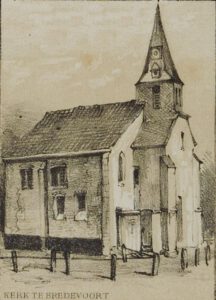
Shortly thereafter, Misslich passed away; on August 17, 1639, his will was opened.10 He was buried in Saint George’s Church in Bredevoort.11
In 1661, he is still mentioned in the archives as “the stern and valiant governor” in connection with the sale of a house “for the benefit of the poor”.12
Wolf Misslich was not only a capable military officer and administrator but also a man with a profound social conscience. His generous donations ensured that the poor of Bredevoort received support for generations. Nearly four centuries after his death, his name lives on in the history of the town he served.
Sources
- J.P de Bordes, ‘De verdediging van Nederland in 1629’ ↩︎
- Volontaire Protocollen Bredevoort, 27 juni 1629 ↩︎
- Volontaire Protocollen Bredevoort, 18 mei 1640 ↩︎
- Volontaire Protocollen Bredevoort, 26 december 1628 ↩︎
- Volontaire Protocollen Bredevoort, 1 mei 1637 ↩︎
- Volontaire Protocollen Bredevoort, 13 juli 1639 ↩︎
- H.A. Hauer, ‘Breevoort can ick vergeten niet’, 1956 ↩︎
- Volontaire Protocollen Bredevoort, 20 maart 1638 ↩︎
- Volontaire Protocollen Bredevoort, 1 augustus 1639 ↩︎
- Volontaire Protocollen Bredevoort, 17 augustus 1639 ↩︎
- Bredevoort.nu ↩︎
- Volontaire Protocollen Bredevoort, 21 augustus 1661 ↩︎