
In the east of the Netherlands, the concept of naoberschap is widely known. This phenomenon, also referred to as neighborly duty or neighborly aid, refers to the tradition in which neighbors support one another during both joyful and sorrowful events.
In 1874, J. ter Gouw, with the cooperation of E.F. Avenarius, a teacher in Lintelo, and Is. de Waal, a former minister in Aalten, described the customs and duties of the naoberschap as they were common in Aalten at that time.1 The article is presented below.
N.B. In the original article, naoberschap is spelled with oa. Because we are Oud Aalten and the article concerns Aalten, we have chosen to adapt this term to the WALD spelling, thus using ao.2
“Although these customs are still in vogue in the municipality of Aalten, they nevertheless belong to the olden days. They are remnants of ancestral morals, mere fragments that still live on there, but which may also disappear after only a few years.“
New Construction
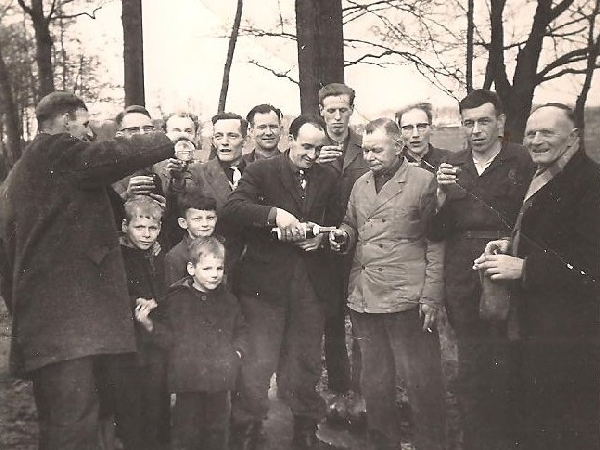
When building a new home, the future resident visits eight or twelve of the nearest neighbors and asks them if they wish to be his “naober.” This is usually accepted, as a refusal is considered an insult, and terminating the naoberschap also signifies the breaking off of all mutual social interaction.
Mutual obligations rest upon the naobers. For instance, every naober is obliged to help erect the wooden frames and the roof free of charge when a house is being built. In the evening, the naober youth then place the May trees (a few pines) in front of the house, for which the owner must treat them.
This is followed by a so-called “rigtemaal” (topping out meal) for the naobers, who also take this opportunity to give the new building a name, by which name the resident is subsequently called, and often better known than by his family name.
Before the new home is occupied, the naober women, or their daughters or servants, arrive with baskets full of peat and wood to “aan te bueten” the fire, which is to say: to light it. And if the new resident is among the needy, his more affluent naobers often bring him such a large quantity of fuel that he can provide for his hearth for several months.
J. ter Gouw
Marriage
When a young man or young woman is to enter into marriage, the other young people from the naoberschap go to the residents with whom the newlyweds will take up residence, before the second marriage banns take place, and ask the bridegroom or the bride if they may “make it beautiful.” This beautification consists of planting four tall pine trees in front of the door, which are interconnected with arches, wound with palm, and adorned with small flags of colored paper; while in the center a crown is hung, wound with cut paper and decorated with gilded eggs. Inside this crown hangs a wooden dove, as the symbol of love, which is neatly covered with gold paper.
These wedding crowns are held in high honor and preserved for as long as possible. At many farms, one can still see the crowns that were hung at their grandfathers’ weddings.
The fetching of the bridegroom or the bride to bring them to their destined home is also performed by the naober youth. The wagon is decorated with greenery and often drawn by four horses; the girls from the naoberschap take their places upon it, and while singing or rather shouting out: “To Austria we wish to sail, almost across the heath, etc.”, they set off on their way.
If it is a bridegroom fetching his bride, he sits at the front of the wagon smoking a long Gouda pipe — if possible a steel pipe, decorated by his naober girls with red, white, and blue silk ribbon. Now, that is of course long out of fashion; bridegrooms now smoke cigars or do not smoke at all. But in the time of pipes, a bridegroom had to smoke. I have seen some who actually belonged to the non-smokers, and yet sat with the bridegroom’s pipe between their teeth during the ‘bride’s tears’ and at the wedding, and had to pack and light it every now and then.
Upon arriving at the bride’s home, a bouquet of colored and gilded paper is fastened to the left side of his hat, so that many would take him for a coachman with a cockade on his hat. The bride receives a similar bouquet on the left side of her chest.
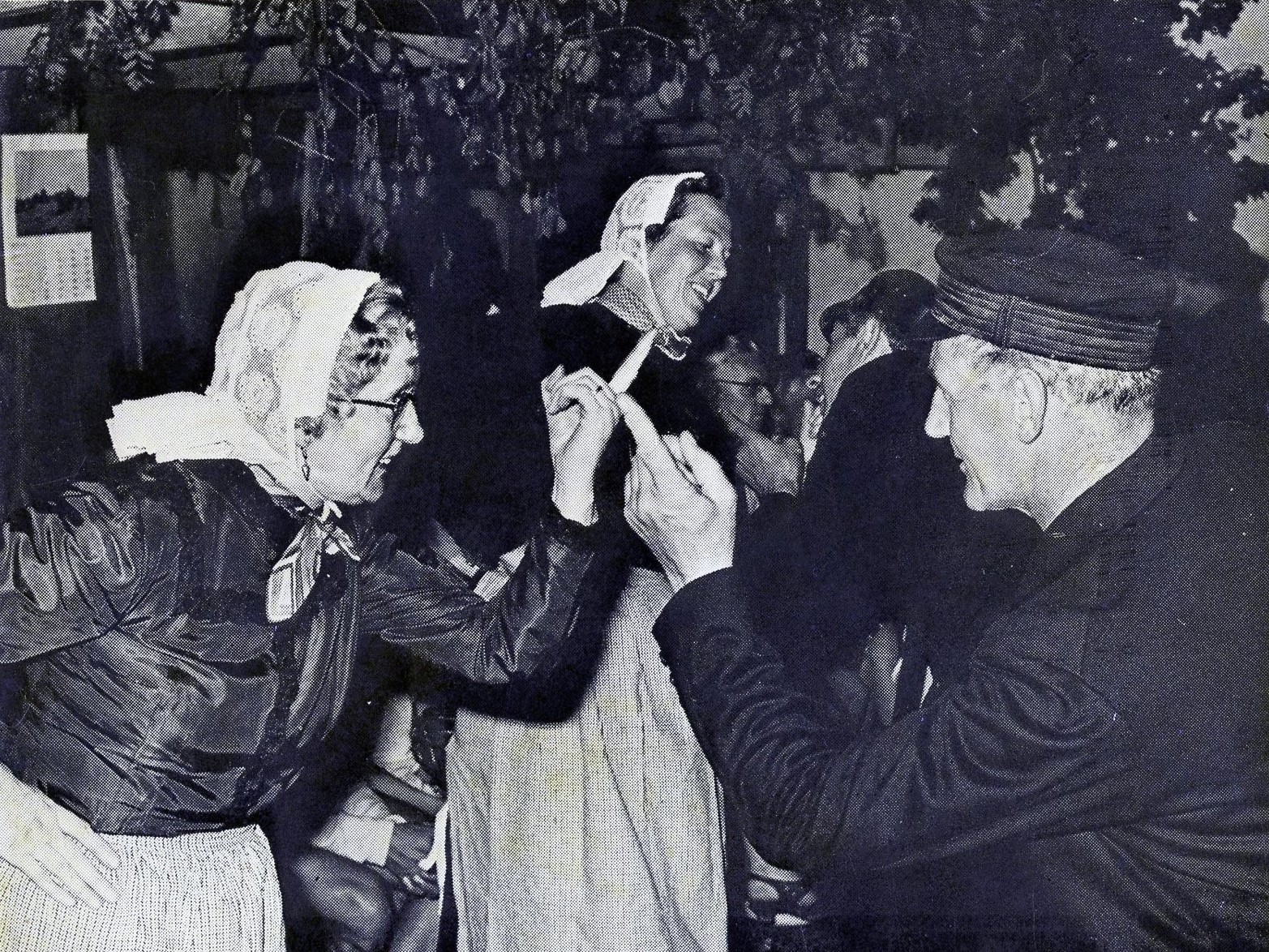
Once some bread and coffee have been consumed, the bride is led to the wagon by a naober boy and the bridegroom by a naober girl, while the other naober boys fetch the “bride’s cow” from the stable and lead it behind the wagon. If the bride’s parents are well-to-do people, the naober boys take the liberty of also bringing some sausage, bacon, meat, chickens, and more of that nature for the newlyweds.
Often, the bride’s cupboard, well-stocked with rolls of linen, napkins, and table linens, along with eight or twelve chairs, a spinning wheel, and a reel, has already been brought to the future home the day before.
When the bridal wagon has arrived there, the naober youth spend not only the evening but also a large part of the night drinking “foesel” (gin) and shouting out all kinds of songs, for one cannot call it singing, and finally return to their homes to pay for the frequent use of that “plague drink,” as some call it, with headaches and listlessness the following day.
Sometimes the wedding or “broedlagt” follows weeks, even months later, or is combined with the ‘kinderbier’ (child-beer) of the first offspring.
J. ter Gouw
Death
In the event of a death, the obligations of the naobers are even more numerous. As soon as someone dies in a household, one of the nearest naobers is notified, if none are present, and he immediately goes around the entire naoberschap; thereafter, the naobers go together to the house of the deceased to “verhennekleeden” the dead, which is: to remove their clothes and shroud them in the burial garment.
The next day, the passing of the deceased is tolled, and the naobers must announce the death to the family, even up to a distance of five hours away. In the evening, two or three naobers bring the coffin and place the body inside. If the deceased died of a contagious disease, or if the unpleasant odor already indicates decomposition, he is given a glass of “plague drink.” But this is then also the only gin used in a house of mourning.
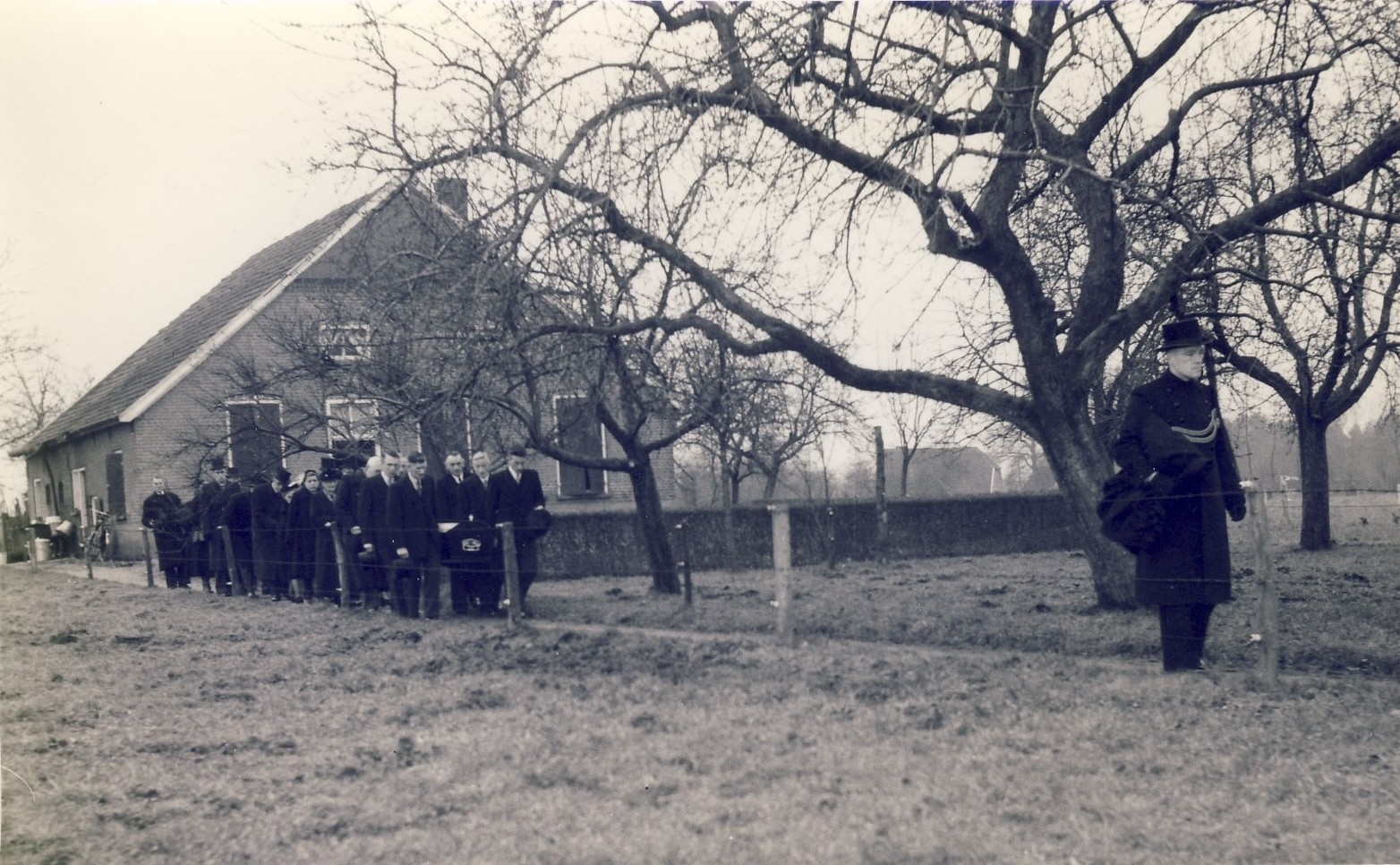
From the time of death until the funeral, the naobers manage everything. They must take the grain required for the funeral meal to the mill and provide everything else that is needed. The naober women must sift the flour and bake bread, and because of this, there is a bustle in the house of mourning that is bothersome to the relatives, who would prefer to be alone with their beloved dead. One can form an idea of that bustle when one knows that more than a hundred households may be invited to a funeral or ‘groeve’.
(This was the case with one of my farmers, who was quite well-to-do but still had only a small farm, when there was a ‘groeve’ at the house upon the death of his elderly mother. On that occasion, four mud of rye were baked, yielding 75 loaves of bread, and since the bread was intended for four people, they had counted on three hundred eaters. Furthermore, the following was purchased: one full Leiden cheese and one nearly full, together 33 old pounds; twelve old pounds of coffee, and 1.25 old pounds of white sugar lumps. A barrel of beer was ordered from the brewer, which they expected would not be sufficient. The bell-ringers drank three guilders’ worth of gin.)
On the day of the funeral, at ten o’clock in the morning, the body is placed on “den deel” (the threshing floor), and the coffin is opened far enough so that the face of the dead is visible. The naober women now pour coffee and present bread to the guests, while that naober woman whose husband must drive the body to the cemetery has the privilege of serving the immediate family, and thus every naober woman has her specific task according to her rank and status.
After all the guests, which include the naobers and the residents of het rot (the district), have satisfied themselves with bread and coffee, everyone goes to the threshing floor to see the deceased for the last time. If a minister is present, he gives a speech by the open coffin; he seeks to comfort the bereaved, reminds everyone of the memento mori, and concludes with an appropriate prayer.
Now the coffin is placed on the back of a wagon, and the two closest relatives of the deceased sit at the foot of the coffin, followed by the next two, and so on until all seats are occupied. The women have a black rain cloak or ‘folie’ hanging over their heads and know how to indicate their relationship to the deceased very precisely by covering themselves entirely or partially with it.
The procession to the grave forms a long, sometimes endless line, as not only the relatives but also the naobers and those belonging to the ‘rot’ follow the body, and moreover, as soon as the funeral procession approaches the village, many from there also join in; so that not infrequently one hundred and fifty men, women, and children take part in that procession.
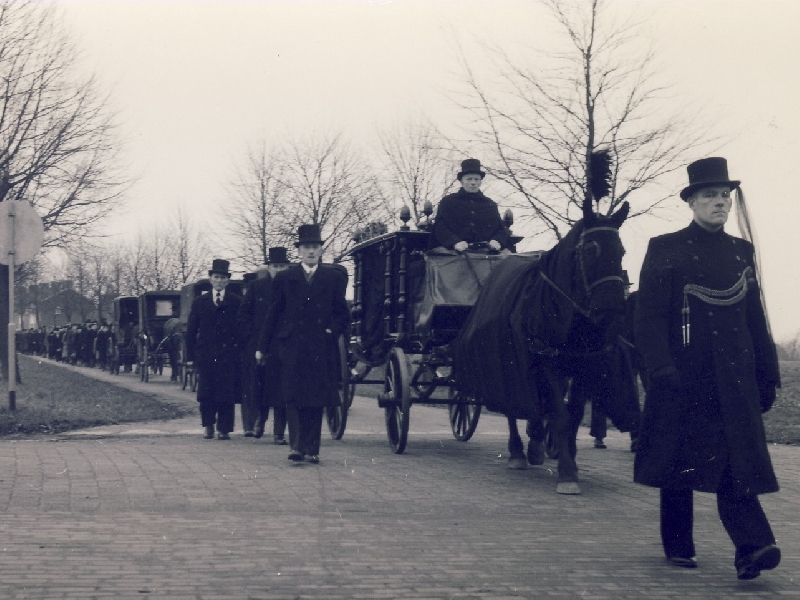
From the moment the procession comes into view of the village until it has left the cemetery again, all the bells are tolled, and from the grave, they go to the brewer, where a few drink tea, but most drink beer, and the latter in very generous amounts. From the brewer, they return to the house of mourning; here bread and coffee are consumed once more, and the ceremony is concluded.
But the next day, a small after-reflection follows. Already at the crack of dawn, the poor stand at the door (fifty or a hundred sometimes) to be able to carry away “a morsel” from the house of mourning. They are given the not very carefully sifted bran from the consumed rye and the leftover bread.
In the afternoon, the naober women come to the house of mourning once more; they again consume coffee and a sandwich, and thereafter each gathers her borrowed cups, saucers, knives, etc., and departs with the customary: “I wish you the best.”
Lintelo, E.F. Avenarius
In the village
What has been communicated by my friend Avenarius, and to which I have added a few remarks, specifically concerns the naoberschap among the country folk. In the center of the municipality, one has the same theme but with some variation.
Upon moving into a home, an offer soon comes from the naobers who belong to the house (according to a choice once made) to “aan te bueten a fire,” i.e., to light it. This being accepted and the hour determined, the naobers send daughters or maidens (servants) with fuel — “kluwen” or dredged peat from one, wood from the other — and everything is piled up at the empty hearth, as if it were to be set ablaze immediately. If one wishes to make it truly beautiful, a wreath of colored paper is placed over everything. After this “fire-lighting,” a glass of “foesel” (gin) is immediately expected, and if there is something to go with it, all the better; thereafter the naobers themselves are “geneugd” (invited), and consequently, the heads of the families are received for “a cup of coffee” with “kluntje” (sugar lump), currant bread, and finally “foesel with sugar” (gin with sugar).
Also after the conclusion of a wedding and funeral, the naobers are invited in the same manner, and then Jew and Christian, Roman Catholic and non-Roman Catholic, rich and poor, sit together in brotherly friendship; and such an evening leaves pleasant memories behind, while one feels newly inclined to perform for one another all the services that the duties of naoberschap prescribe.
Within the town, funerals are generally not arranged on such a large scale as we have just heard; yet the gathering is sometimes so numerous that the minister, who leads in prayer before the refreshments are consumed, must sometimes place himself between two spacious rooms in order to be heard in both. It even happens that a third room is necessary, where the guests must then make do with a few sounds from a distance.
Middelburg, Is. de Waal