
In former times, November was the season for slaughtering. At that time, slaughtering did not yet take place at slaughterhouses, but simply on the farmer’s yard. It was usually outsourced to a ‘home slaughterer’, a butcher who performed the slaughter at the client’s home. Regarding home slaughtering in Aalten and the customs surrounding it, G.H. Rots wrote the following in 1937:
“The busiest and most significant days of the year were when slaughtering had to take place. When November arrived in the land, the slaughtering period began. The ‘wieme’ (drying rack) was empty, and in every household, people thought about slaughtering one or more pigs or a ‘small beast’. The home slaughterers had their hands full.
If the slaughtering had taken place in the morning, the ‘fat-praisers’ would arrive around half past eleven. The neighbors would then judge whether the ‘kidneys were well-covered in fat’. The thickness of the bacon was estimated, and finally the lady of the house appeared with the ‘bottle’, for teetotalers were unknown in those days. On slaughter days, people made sure they had something ‘in the bottle’. The slaughterers received their first ‘drink’ in the morning, the fat-praisers in the afternoon, and in the evening came the great celebration: the slaughter visit.”
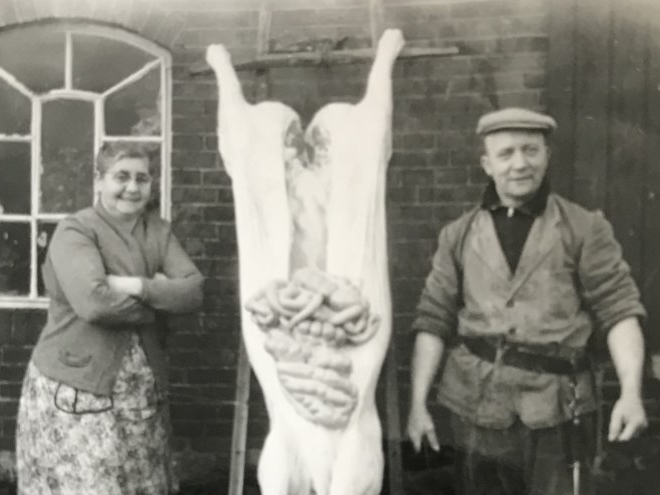
How the slaughtering process worked
In the 1950s and 1960s, it was still permitted to perform home slaughtering yourself. A large boiler pot with plenty of water was brought to a boil. The pig was killed using a captive bolt pistol, which fired a pin into its head. The pig became unconscious. The animal’s throat was then slit, and the blood was collected in a special flat pan.
The pig was cleaned and doused with boiling water so that the hair could be removed more easily, a process known as ‘scraping’ the pig. The animal was then hung from a ‘ladder’ and cut open.
The entrails were collected in a large tub. The intestines were cleaned. First, they were rinsed with water and then scraped clean so they could be used to make sausage. The intestines were tied shut with sausage pins and hung from the ceiling.
Every part of the pig was used. The head meat was used to make ‘head cheese’ or brawn. The sausages and hams were hung from the ceiling to dry. Slaughtering and processing a pig took a week of work but provided meat for personal use for an entire year. One way to prevent meat from spoiling was salting. The meat was placed in a tub of salt, and the salt was rubbed thoroughly into the meat. Meat could also be preserved in canning jars. This allowed the meat to be kept for many months.
A well-known home slaughterer in Aalten and the surrounding area was Bertus ter Maat. The above interview with the then 77-year-old Aalten resident was filmed in 1991 by FilmAalten.
Slaughter visit
Regarding the slaughter visit, Rots wrote: “Those slaughter visits were the social evenings for the population. Neighbors would gather and enjoy each other’s company. It began with a cup of coffee and a rusk. Then the bottle appeared on the table. On those evenings, the events of the time were discussed. One person knew this, another had heard that, and a third had ‘recently read the newspaper’, and thus knew for certain. And the women told each other the secrets of the civil registry and related matters. Meanwhile, the hostess would invite them again: ‘Have another drink’. ‘The pigs turned out well’. And finally, when it was time to go home, everyone was in the merriest of moods.
One should not imagine that all the pigs that had been fattened were intended for personal use, as you can understand. At least one pig had to be sold, and from the other that was kept, the hams or gammons were also sold, because keeping the hams yourself ‘was just for the sake of using them up’; no, they had to be turned into cash. And if a heifer or ‘bull’ was slaughtered, the nagelhout (smoked beef) was certainly sold. There were several buyers who salted and smoked these finer meats and sent them to the larger towns. The money the pigs brought in was often intended for the payment of hay, mortgage interest, etc., or at least for extraordinary expenses.”
Sources
- ‘From Aalten’s Past’, by G.H. Rots, Aaltensche Courant, 5 November 1937 (via Delpher)
- Photo: collection Leo van der Linde, with thanks to Anton Stapelkamp
- Aalten Vooruit, 29 September 2019
- Interview with Bertus ter Maat, FilmAalten