
In 1937, G.H. Rots described in a series of articles how things were in Aalten in former times. Regarding New Year’s Eve and Day, he wrote:
“Towards the end of the year, one could see two men walking with a large ‘arm basket’, going from house to house in the village. They were the night watchmen selling almanacs. Not a single household was without an almanac, especially the Zutphen almanac. By offering and selling the almanacs, the night watchmen simultaneously provided the residents with the opportunity to give an unsolicited contribution for the guarding of their property at night. Depending on the financial means of the residents, the aforementioned literature was paid for above the asking price.”
New Year’s Eve
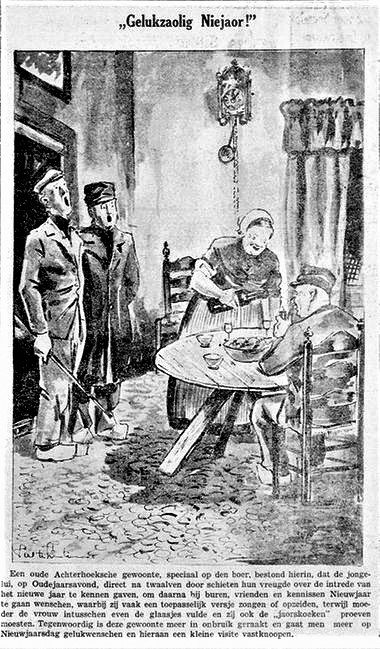
“Then came New Year’s Eve. The cafés had permission to stay open until one o’clock in the morning. The transition from the old to the new year was then celebrated in these establishments, mainly by the local youth. Once the clock had struck twelve, the night watchmen began to deliver their New Year’s wishes. They started with the municipal secretary. A song was sung during this process. The rounds were made to several notables and café owners. It goes without saying that the night watchmen were followed by a large group of curious onlookers, who diligently sang along… and there were free drinks.”
And now the song that the Night Watch and their followers sang on New Year’s Eve:
The old year has now passed by,
The new has now arrived.
So I wish you with a joyful heart,
And you, and all the pious:
A new spirit in the new year
And a pious life together,
So let us praise God here.
How many began the previous year
In good health with us,
Who have indeed through death
Spun out their thread of life.
They live in eternity,
Life is still prepared for us,
So let us now praise God.
It is God who brought forth the light,
Who makes the sun and moon rise,
To show us the passage of day and night,
And month and year.
Let us for the past year
With thanks to the Supreme Blesser,
Praise the God of ages.
The first two stanzas were original creations. The third is from the Evangelical Hymns no. 159 verse 1. Verse 3 of that hymn was also occasionally sung.
One can imagine that these New Year’s greetings on New Year’s Night took quite some time, and the solemnity of it likely faded, especially towards the end of the rounds, particularly as the sound of spirits played the leading role. But for the elderly, the memory of this event is not lost. Especially when reading these articles, the old incidents are recalled and discussed once more, and many look back with nostalgia to the days of yore, remembering, during sleepless nights or when watching over the sick or injured in the quiet of the living room, the monotonous step of the man who traversed Aalten’s streets: “Hark, there is the night watchman!”
“On New Year’s Day, the youth were active again. They and the poorer folk went from house to house to wish people a Happy New Year. One can understand that the population was glad when noon arrived, as it was no longer applicable after that. The downside of all this was that King Alcohol swayed his scepter on those days. In the numerous cafés and taverns, many sacrifices were made to that monarch. Gin was cheap. There were several gin distilleries or ‘branderijen’ in Aalten. Four of these distilleries can still be named. It is no wonder, then, that the use of strong spirits was prevalent on almost all occasions.”
Carbide Shooting
In parts of the eastern Netherlands, including Aalten, it is a tradition to shoot carbide on New Year’s Eve. A small amount of carbide (calcium carbide) is placed in a milk churn, paint tin, or modified gas cylinder, water or saliva is added, and the churn is sealed with a (plastic) ball. Ethyne gas forms, and after waiting about 30 seconds, the gas is ignited through a small touch-hole (or with a spark plug). The gas explodes with a booming bang, launching the ball out of the churn, where it can land dozens of meters away.
The history of carbide shooting is not well known. The tradition may date back to Germanic Yule festivals. In the 19th century, it was customary in both rural and urban areas to make noise on special days. Carbide shooting likely evolved from this practice.
Before acetylene gas was available in cylinders, most village blacksmiths used carbide for welding. It was therefore easy to obtain.
Winning the New Year
ADW article by Evert M. Smilda
New Year’s Eve, a day like any other. Yet, around four o’clock in the afternoon, many become restless. It is about to happen. There is no other day in the year when we check the clock so often. Outside, in the twilight, we smell the frying of ‘oliebollen’ in the thin winter air. Among children between the ages of four and twelve, a certain tension can be sensed. Tomorrow is the day. Then they will go ‘winning the New Year’.
Winning the New Year in exchange for a treat is a very old custom whose origins are difficult to trace. In our region, it occurs in the former Lordship of Bredevoort, but not in the Roman Catholic enclave of Lichtenvoorde-Groenlo. It possibly relates to religion and the practices surrounding it.
Long before the Reformation, November 11 was an important day: Saint Martin’s Day. According to legend, he gave half of his red cloak to a beggar. He was the patron saint of Utrecht, among other places. The city’s coat of arms is a red-and-white divided shield—red from his cloak and white from his undergarment after he cut part of his cloak away with his sword. This gesture strongly appealed to the popular imagination. As a folk saint, he was venerated and depicted as a rider on a white horse. This was true not only in neighboring Germany but also in the south of our country, in North Holland, Groningen, and Friesland. On his feast day, a mock Saint on a white horse would lead a lantern procession through villages and towns, distributing treats. In Bocholt, just across the border, there was a large lantern procession through a completely darkened city in 1988 and later years. A fairy-tale sight. Upon arriving at the Market, he stood there on a white horse in front of the beautiful town hall, bathed in spotlights. A martial figure. All the children were allowed to walk past him and receive a bag of sweets.
It is not inconceivable that after the Reformation, people wanted to move away from the veneration of saints. A ‘Sint’ was out of fashion. At a meeting of the Zutphen classis in 1668, much was discussed. They wanted to abolish bird shooting, goose pulling, ‘boksebier’, and other irregularities. These were called superstition, or ‘popish insolence’. It is possible that a shift occurred from November 11 to January 1 so as not to forget the children and the needy. Perhaps also because New Year’s Day moved several times on the calendar. Such shifts happened frequently. Moreover, Saint Martin himself had already replaced an old Germanic autumn festival with thank-offerings for the harvest to Wodan.
When shifting the date, other special days had to be taken into account. Saint Nicholas was not an option. This may be how they arrived at January 1. It is an assumption, but not an unlikely one. At that time, they were also troubled by Saint Nicholas; Calvinist ministers wished to do away with it thoroughly. They did not succeed. Bird shooting also continued.
Originally, in the countryside, laborers went to the farmer and his wife—their employers—to wish them a Happy New Year. Belief in omens was strong. If the person delivering the wish was a woman or girl, one was assured of a fertile year with many heifer calves. It seemed almost a competition to be the first to deliver the good wishes. It still is to some extent. There was a firm belief that the wished-for luck would return to the one who spoke the wish first. This was duly rewarded.
In times of great poverty, which were frequent, it could happen that food items were given. It is known that during times of potato shortages, people gave a few potatoes. These were then taken home in a knotted red handkerchief. In the last century, children went out in groups in the neighborhood to ‘win the New Year’. After speaking the good wishes, red handkerchiefs were spread out on the chairs in the kitchen, and all sorts of treats appeared: peanuts, a ‘pöfferken’, ‘opzettertjes’, meringues, figs, an ‘oliebol’ or currant bun, and an apple. Over the years, many customs have disappeared, but ‘winning the New Year’ has remained in our border region.
It has, however, adapted to the times. No red handkerchiefs spread out on chairs with rush mats. Between 1950 and 1980, plastic conquered the world. The red handkerchiefs have made way for well-filled plastic bags, sometimes prepared by businessmen or charitable institutions.
Nowadays, fireworks play an important role on New Year’s Eve. Twenty-five years ago, New Year’s Day was more important. It had to happen on the first day of the new year. Excitement for the children. First to the neighbors. What abundance when they saw thirty or more bags lying on the kitchen counter there. After speaking the good wishes, hands went up almost automatically to take the ‘toete’ (bag).
The older boys would grab their bikes and rush from one house to the next. Formerly with a shoebox under the luggage strap, later with a plastic bag on the handlebars. They were told to look people in the eye and speak politely, but they didn’t allow themselves much time to talk. It was as if they sensed it might be the last time. Once home, the harvest was sorted and placed in portions. Eating until you were sick was something you did on the way. Mother would also start rummaging through it. Cookies went into a tin and sweets into a jar. You could snack on it for a month. It seemed as if that variety symbolized a great number of wishes.
In our time, the fun ends when children are in the first year of secondary school. At most, they shout as they cycle past: ‘Happy New Year, do you have the bags ready?’
Sources
- ‘From Aalten’s Past’, by G.H. Rots, Aaltensche Courant, 19 November 1937 (via Delpher, part IV & part VI)
- Wikipedia
- Article ‘New Year’s Day in Aalten and surroundings’, ADW, E.M. Smilda