


Klaas Nijman was baptized on January 16, 1698, in Dinxperlo as the son of Fredrik Nijman and Berentjen Eppink. At the age of fifteen, he left his parental home and began a wandering existence as a ‘beggar and vagabond’. In 1722, he was sentenced in Rhenen to a stay in a house of correction for violence and theft. His release was followed by banishment from the province of Utrecht.
Nijman then returned to the Achterhoek, where he sowed fear among the population, particularly in the vicinity of Dinxperlo and Aalten. He begged and stole, threatened people, and did not hesitate to use brute force. In 1729, he set fire to several houses and was arrested.
On October 3, 1729, following a trial in Bredevoort at ‘t Zand, Klaas Nijman was sentenced to death. He was taken to the Hollenberg, where he was strangled and subsequently set on fire. This gruesome punishment served as a deterrent to others. Nijman was 32 years old at the time.
Sentence
The following 18th-century text describes his crimes and sentence:
Pronounced in Bredevoort at ’t Sant, and executed outside on the Hollenborg, on Monday, October 3, 1729.
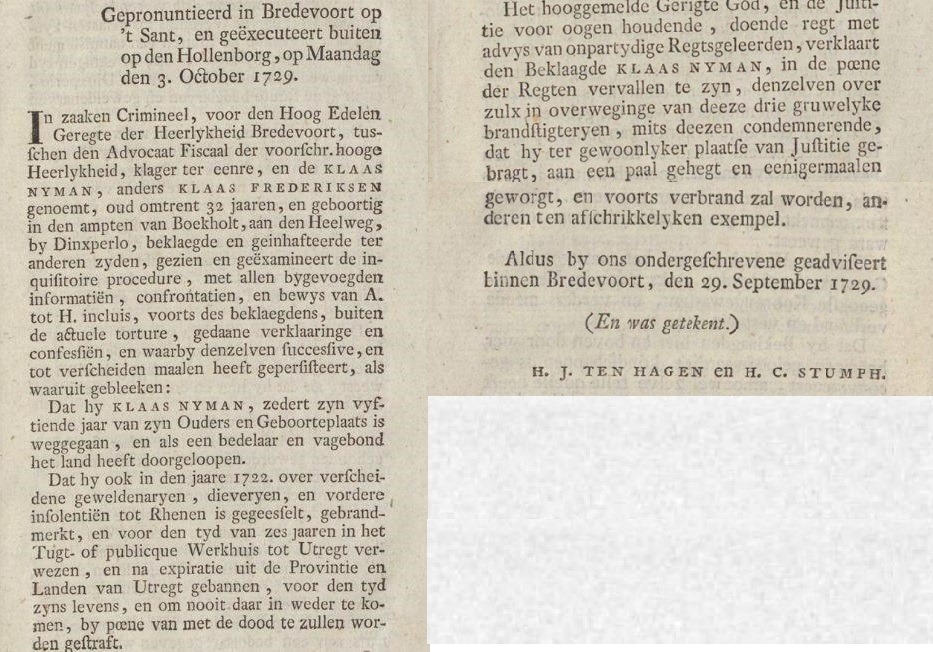
In Criminal cases, before the Most Noble Court of the Lordship of Bredevoort, between the Advocate Fiscal of the aforementioned High Lordship, complainant of the one part, and KLAAS NYMAN, otherwise called KLAAS FREDERIKSEN, aged about 32 years, and born in the district of Bocholt, at the Heelweg, near Dinxperlo, defendant and prisoner of the other part, having seen and examined the inquisitorial procedure, with all attached information, confrontations, and evidence from A. to H. inclusive, furthermore the defendant’s declarations and confessions made outside of actual torture, and in which he has successively and at various times persisted, from which it has appeared:
That he, KLAAS NYMAN, since his fifteenth year has left his Parents and Birthplace, and has wandered the land as a beggar and vagabond. That he was also in the year 1722, for various acts of violence, thefts, and further insolences at Rhenen, flogged, branded, and committed for the term of six years to the House of Correction or public Workhouse at Utrecht, and after expiration banished from the Province and Lands of Utrecht for the term of his life, and never to return therein, upon pain of being punished with death.
That having been released from the aforementioned House of Correction or Workhouse about three-quarters of a year ago, yet the penalties of banishment remaining in force, he thereupon, or some time thereafter, returned to Dinxperlo, and continued in his bold beggaries and acts of violence. That he there, for a trifle on the public road near Dinxperlo, cut open the mouth of one DIRK WENSINK with a knife.
That he likewise, after his aforementioned release, again committed various thefts, such as of ironwork and an axe, and of linen, such as a pillowcase or sheet on the other side of Doesburg at the Steege; and also a shirt from the garden at HENDRIK te Loo or Kistershuis, between Dinxper and the Bredenbroek, and further as by the Reformations. That he, KLAAS NYMAN, has also for years past been notorious and held in suspicion by many inhabitants under Dinxperlo and Aalten, as being of no good and committing much evil.
That he also, following the . . . . of the sentence at Rhenen, was held suspect there of having committed very grave offenses. That the defendant, through his . . . . and malicious conduct and questionable language which he used here and there, has kept the good husbandman and the inhabitants in the countryside, and especially around Dinxperlo and Aalten and the surrounding area, in a state of constant anxiety and fear. That when he came to beg, he was not satisfied with what is ordinarily given to a beggar, although he was often given even more, and went away from the houses muttering to himself.
That this anxiety and fear among the inhabitants has doubled and reached its peak since fire broke out in the Parish of Aalten in this year 1729, and that further and even more burnings of houses close by followed. Such that several inhabitants ordered their people that, if KLAAS NYMAN came to their houses, they should just give him whatever he wanted, to gain his friendship and not to anger him, and that several people, out of fear of arsons, had to keep night watches at their houses during the night, whereby even some hamlets were placed in a state of near alarm.
That he, the defendant KLAAS NYMAN, is also the one who has come to such exceedingly wicked crimes that in the past Summer in the Parishes of Aalten and Dinxperlo, of this same year 1729, from June 13 to August 29, and thus within the span of a quarter-year, he has set fire to three houses, one after the other, and by no means the smallest, which houses were also totally burned down, and of which the corpora delictorum are known.
Namely, on June 13, the house at Lensink, under Aalten on the Esch at Yserlo, where he set a piece of white or spongy peat on fire by means of a tinderbox, flint, and tobacco pipe, and with that burning peat at the back on that side of the house where the wind was blowing against the house at the time, caused the fire. That eight days prior he had also set the same house Lensink on fire, and that it had already been burning, but that it was then still extinguished by the occupants.
Secondly, the house at Welink, also under Aalten on the Esch at Yserlo, on June 20, where he carried out the fire in the same manner as at Lensink with a piece of ignited spongy peat, and therewith set the house on fire from behind. That for both his arsons, at Lensink and Welink, he gives as his reason that he had done so to create anxiety and terror in the neighborhood, or among the people.
Thirdly, the house at Grevink, at ‘t Rexwinkel in the hamlet of Heurne, under Dinxperlo, on August 29, in the evening around 10 o’clock, when he caused the fire there with an ignited fuse made of linen rags, in the straw that lay at the back on the corner partition of the house. That in this aforementioned house Grevink, when it caught fire, a young woman in childbed, who had not yet been in childbed for two days, lay on the bed, and who by great fortune still having the strength to get off the bed, still escaped the fire. That he, KLAAS, gives as his reason for this arson at Grevink that he had done so because the same aforementioned woman in childbed, a long time ago when she was still unmarried, had given him a piece of pancake that had been too small for him.
That at Welink and at the last-mentioned Grevink, several pieces of live Cattle, harvested Grain crops, and further items were also burned and consumed.
That he, the Defendant, is furthermore convicted by four sworn credible witnesses, although he himself has tried to deny it telle quelle, that on August 31 last he spoke those grim words at the house of ARENT OOSTENDORP, in the hamlet of Heurne, under Dinxperlo, that this or that corner would shortly be a poor corner.
That he furthermore has threatened to set fire to the house of the drummer boy within Dinxperlo, and has stood by and persisted in this, that if he had not been captured, he would indeed have done it, and similar terrible threats and dangerous utterances of the Defendant, as the information and confessions herein further set forth.
The highly-mentioned Court, keeping God and Justice before its eyes, doing right with the advice of impartial Legal Experts, declares the Defendant KLAAS NYMAN to have incurred the penalty of the Law, condemning him for the same in consideration of these three gruesome arsons, that he be brought to the usual place of Justice, fastened to a stake and somewhat strangled, and furthermore shall be burned, as a terrifying example to others.
Thus advised by us undersigned within Bredevoort, September 29, 1729.
(And was signed.)
H.J. TEN HAGEN and H.C. STUMPH
Source
- Legal Treatises on Corporal Crimes by a prominent Legal Expert (Jan Jacob van Hasselt), published in Amsterdam by Hendrik Gartman, 1781 (link)