

How the Schenk-Voerknecht family grew into an international merchant dynasty
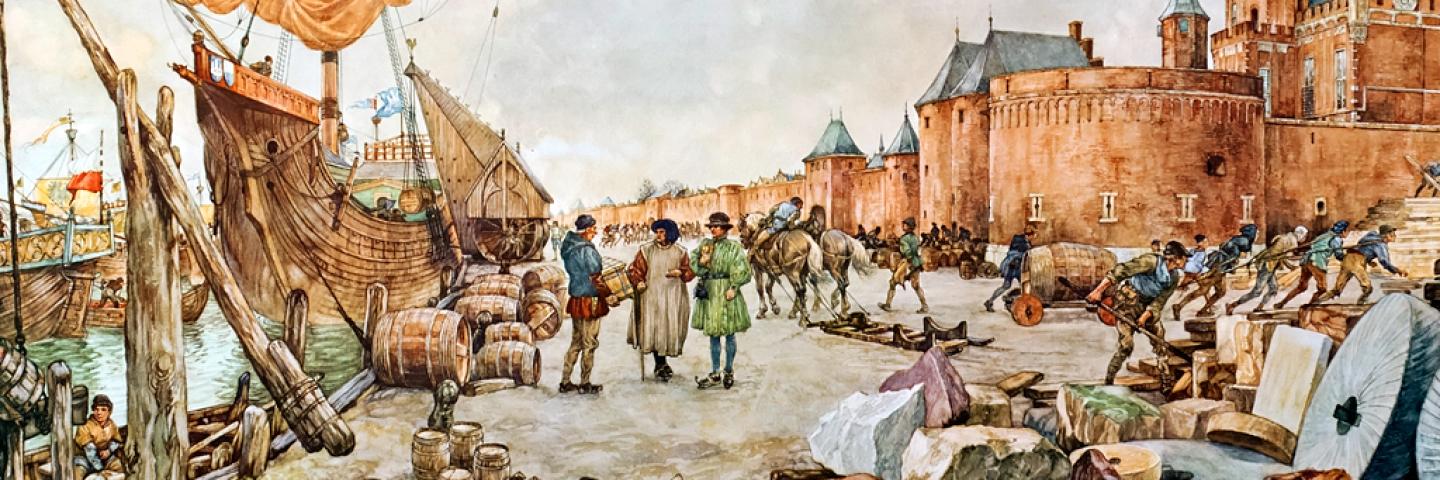
At the beginning of the 17th century, Wessel Schenk and his half-brother Salomon Voerknecht from Aalten were among the largest grain traders in Europe. Their activities spanned from Amsterdam to Danzig, Königsberg, Genoa, and even the New World. Other family members were also active in trade and entered into marriages that strengthened their position. What began in Aalten grew into a network with international influence.
The Schenk / Voerknecht family
In the mid-16th century, a certain Jenneken ter Woert lived in Aalten. From her first marriage to Salcke Schenk, she had two children: Gertruid and Wessel Schenk. Around 1568, she remarried Johan Voerknecht, with whom she had four children: Salomon, Hans, Judith, and Anna Voerknecht.1 2
In 1575, Johan Voerknecht was a keurnoot (lay judge) of the Bredevoort court3, a position indicating social standing. Whether the family belonged to the Aalten ‘elite’ is unknown to us. However, it is striking that all the children later became successful in trade or married partners of distinction. This suggests a connection to influential networks that enhanced their social and economic opportunities.
Merchants in Amsterdam, Danzig and Königsberg
From the late 15th century, merchants in the Low Countries specialized in the transport of bulk goods, especially grain and salt. This trade, known as the moedernegotie (mother of all trades), formed the economic foundation of Holland for centuries and made Amsterdam the most important staple market in Europe.4
The Schenk-Voerknecht family also benefited from this. They maintained close ties with the Hanseatic cities of Danzig (Gdańsk) and Königsberg (Kaliningrad). Some family members even settled there, either temporarily or permanently.
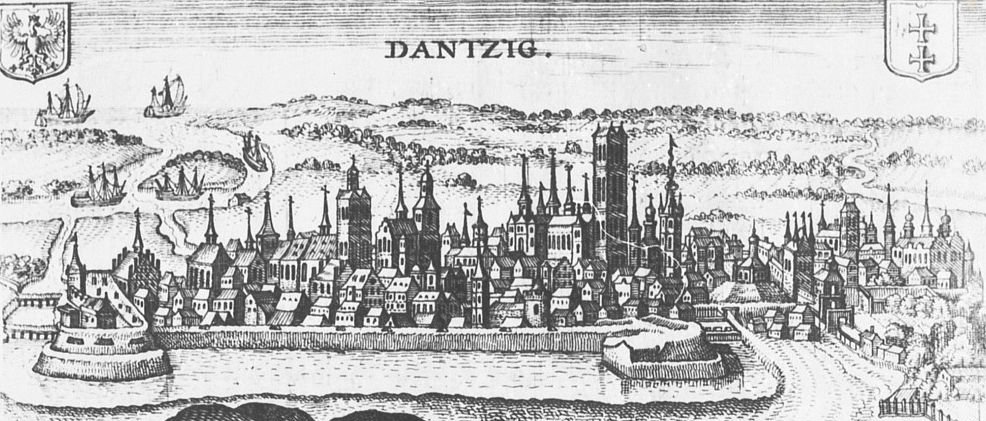
The Schenk and Voerknecht children grew up during the Eighty Years’ War (1568–1648), yet they managed to break into international trade regardless. The period of the Twelve Years’ Truce (1609–1621) provided favorable conditions: a brief phase of peace and armistice. Eastern Netherlands had eight garrison towns (including Bredevoort) that were in constant need of forage, particularly grain. This was not only for bread but also for the production of beer.
Wessel Schenk was a grain merchant and did good business in the Achterhoek during that period. He was also active in the trade route from Danzig to Genoa, Italy.5 His half-brother Salomon Voerknecht was likewise a very successful merchant.
Largest carriers from Amsterdam to the Mediterranean, 1590–1620:
| Carriers | Total | Shipments | With a partner |
|---|---|---|---|
| Jasper Quinget | 201 | 197 | 4 |
| Jan and Philippo Calandrini | 91 | 25 | 66 |
| Guillelmo Bartolotti | 66 | 42 | 24 |
| Caspar van Ceulen | 63 | 35 | 28 |
| Isaac la Maire | 56 | 42 | 14 |
| Willem Willemss | 49 | 48 | 1 |
| Salomon Voerknecht | 45 | 13 | 32 |
| Wessel Schenck | 30 | 25 | 5 |
Biographies of family members
Wessel Schenk
Born around 1566 in Aalten. In 1606, he lived on the Breestraat in Amsterdam. In archival documents, he is referred to as a “merchant lord.” Other sources indicate that he also regularly stayed in Danzig.
Upon its founding in 1602, Schenk was one of the largest shareholders of the Dutch East India Company (VOC). He also saw opportunities in the New World. Together with his nephew Jan Holscher, he invested in expeditions to New Netherland, in the northeast of the present-day US. In 1614, he was a co-founder of the New Netherland Company, the predecessor of the West India Company.6
In 1609, he included in his will that he would leave 4,000 guilders to the poor of his birthplace, Aalten. Because he was often traveling, he had a will drawn up in 1616, leaving his affairs in Amsterdam to his nephew Jan Holscher.
In 1619, Wessel, as a citizen of Danzig, contractually transferred the annual income from two Aalten farms (Lutke Grievinck and Goorhuis) by proxy to his sister’s daughter Gertruid Tols, widow of Johan Brunss.7 In 1632, he was back in Danzig and sold by proxy “a garden or courtyard with timber structures in two parcels” outside the Regulierspoort in Amsterdam. He must have died shortly thereafter, presumably unmarried. 8
Gertruid Schenk
Born around 1565 in Aalten. Around 1584, she married Albert (?) Hengst van Juchteren in Anholt. After 1590, she remarried Henrick Toll. In 1600, she lived on the Nieuwe Zeedijk in Amsterdam. Gertruid was also active in the family business. In 1616, Gertruid and her brother Wessel received a letter of recommendation from the States-General addressed to the city council of Danzig—a sign that their commercial position was officially recognized. Gertruid passed away after 1628. 9
Salomon Voerknecht
Born around 1568 in Aalten. In 1597, he married Jannetje Hooft in Amsterdam. She was a descendant of a prominent Amsterdam merchant family that produced one of the greatest Dutch writers of the Golden Age: Pieter Corneliszoon Hooft. Father-in-law Jan Pietersz Hooft was a brother of the mayor of Amsterdam, Cornelis Pietersz Hooft, and through this marriage, he also became the brother-in-law of the later mayor Volckert Overlander.
In 1618, Salomon, on his own behalf and as proxy for Judith and Hans Voerknecht, sold a piece of land, the Bullensche maat in Lintelo, to Roelof Damme and Catharina Smitz. In 1619, he sold—partly on behalf of his wife, and as proxy for his sister Judith, widow of De Marez, and brother Hans (“citizen of Danzig“)—their parental home in Aalten near the churchyard, including the courtyard and land, to Wessel Brethouwer and Mechteld Machtes.
In 1637, Salomon was a senior merchant in the service of the VOC in Batavia. He had gone from Danzig to the East Indies and remarried a widow there. On October 24, 1637, in Batavia, “weak in body but still sound of mind,” he recorded his last will and presumably died shortly thereafter. His eldest son Johan became the deputy bailiff of Amsterdam in 1656. 10
Hans Voerknecht
Born around 1569 in Aalten. Hans Voerknecht (also called Schenk) was likewise active in trade. In 1605, he was mentioned as a merchant in Amsterdam, along with Salomon Voerknecht and Wessel Schenk. In 1608, he was in Danzig, and in 1619, he was even recorded as a citizen of that city. He presumably died there not long after. 11
Judith Voerknecht
Born around 1569 in Aalten. Around 1585, she married Daniel de Marez, a merchant in Danzig. He is immortalized in an almost life-sized painting of the De Marez and De Schilder families. While in surrounding countries only monarchs had themselves immortalized in this manner, here powerful merchants displayed their status. In 1619, her brother Salomon sold the parental home in Aalten on her behalf (and that of other heirs).12
Anna Voerknecht
Born around 1571 in Aalten. Around 1590, she married the merchant Joost Grevinckhoff, also from Aalten. A deed from the court at Bredevoort from 1615 mentions that Seigneur Wessel Schenk sold a large number of lands and tenant farms on behalf of Joost and Anna, who were then residing in Königsberg. The deed concerns a debt settlement: Joost and Anna were deeply in debt, primarily to Anna’s brother, Seigneur Salomon Voerknecht, “citizen and merchant in Amsterdam” (Seigneur was the title of address for wealthy merchants at that time). Because they could not pay, they transferred their entire property in Aalten—including their house, land, and hereditary rights—to Salomon and his wife Joanna Hooft.13
Jan Holscher
Born around 1584 in Dülmen (near Münster). In 1601, he came to Amsterdam, where he entered the service of his uncle, the merchant Wessel Schenk. Although he managed his uncle’s business, he also traded independently. He held shares in a company that traded with Guyana. Together with his uncle, he also participated in the Hans Claesz Company. In 1613, Thijs Volckertsz Mossel sailed for this company to the Hudson River. In 1612, Jan Holscher married Elisabeth de Hardouin from Rouen in Amsterdam.14
Sources
- WikiTree – Jenneken Schenk ↩︎
- WikiTree – Johan Voerknecht ↩︎
- Gelders Archief (Arnhem), Archief Nassause Domeinen (toegang 0357), inv.nr. 13B – Hofboek Bredevoort 1506-1596, p. 605 ↩︎
- Wikipedia – Moedernegotie ↩︎
- Eppink, A. (2016) – Het wereldnetwerk van Seigneur Wessel Schenck uit Aalten. ↩︎
- Wikipedia – Nieuw-Nederland Compagnie ↩︎
- Heerlijkheid Bredevoort, Oud-Rechterlijk Archief Bredevoort – Volontaire protocollen 1619 (transcriptie) ↩︎
- WikiTree – Wessel Schenk ↩︎
- WikiTree – Gertruid Schenk ↩︎
- WikiTree – Salomon Voerknecht ↩︎
- WikiTree – Hans Voerknecht ↩︎
- WikiTree – Judith Voerknecht ↩︎
- WikiTree – Anna Voerknecht ↩︎
- WikiTree – Johan Holscher ↩︎