

Letters from Gradus Heinen from America
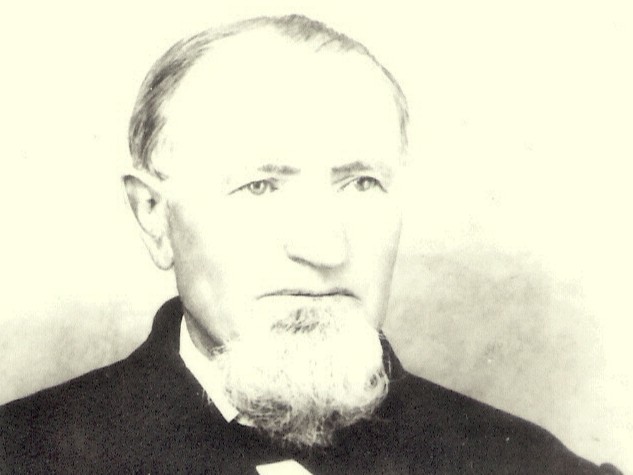
Gradus Heinen was born on 19 October 1827 on the Nijenhuis farm in Dale, the son of Jan Heinen and Harmina ten Brinke. On 21 July 1854 he married in Aalten with Willemina Wandrina Wisselink, who was born on 30 January 1826 on the Bullens farm in Barlo, as the daughter of Garrit Jan Wisselink and Johanna Nijeboer.
When Gradus married, he was a servant at geneverbrander (gin distiller) Salomon ten Bokkel in the Hoekstraat in Aalten.
A few weeks after their marriage, on 21 August 1854, Gradus, Willemina, Gradus’ brother Abraham with his wife Johanna Scholten and three of their children left Rotterdam for the New World on the three-masted Leila . Willemina’s brother Berend Hendrik Wisselink and his wife Fredrika Wamelink traveled with them.
The crossing
Gradus Heinen described the course of the journey in a letter to his family, dated October 31, 1854:
On 21 August, the group left Rotterdam for Hellevoetsluis. The next day, on August 22, the crossing to America began. However, the sea was turbulent, causing almost everyone on board to become seasick. Fortunately, the majority recovered within two days. The rest of the trip went well, with favorable weather. Of the approximately 224 passengers on board, three died during the crossing: the eldest daughter of the Gantvoort family and two children.
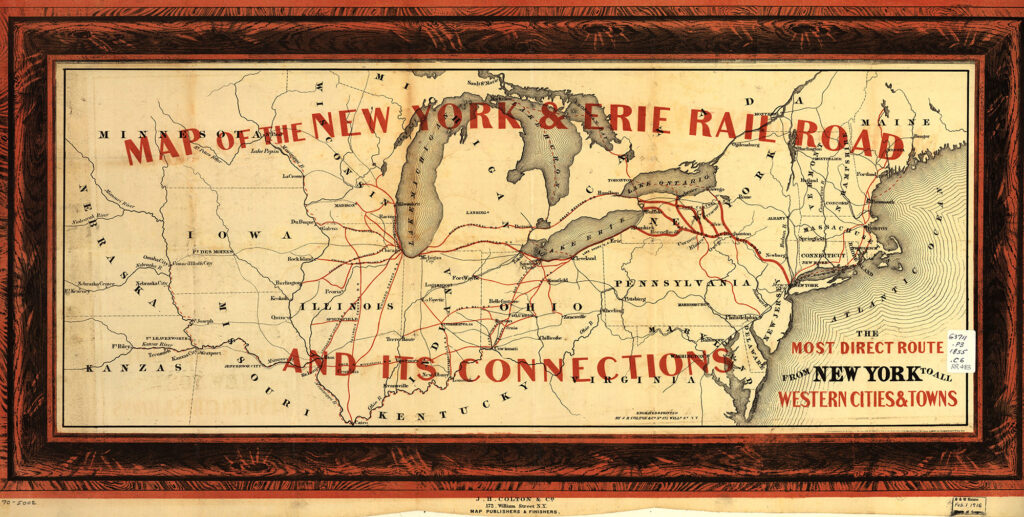
On the morning of September 29, they saw land. At five o’clock in the afternoon they arrived in New York. After one day they traveled on. First they sailed for two hours by steamer (presumably to Piermont, the starting point of the New York & Erie Railroad), followed by a train journey to Dunkirk. From there, they took another steamer to Toledo, traveled by train to Chicago, then by steamer to Milwaukee, and then by another steamer to Sheboygan. Finally, a two-hour journey followed, after which they reached their final destination in Lima Township.
There were three empty houses there, so they had shelter.
Work and Daily Life in America
In his letters to family in the Netherlands, Gradus described how he went to work with his cousin Hendrik. He earned 25 shillings a day, including room and board. According to him, it was possible to earn as much in one day as in the Netherlands in a week, while the cost of living was lower. He also described the daily diet and the environment: little rye bread was eaten; wheat bread was common. Beef and pork were cheap, and potatoes were plentiful.
According to the compilation Dutch Immigrants to America, 1820–1880 by Robert P. Swierenga, Gradus was registered as a “servant” on arrival, he was classified as a “poor man”, and he gave the reason for emigration: “to join family and/or friends“.
Three letters from Gradus to his parents and siblings have been preserved. In all three he expressed his satisfaction with life in America. For example, on October 31, 1854, he wrote:
“We have had no regrets. We have it better here than we have ever had in the Netherlands.”
On January 27, 1856, he reported:
“We can now speak and understand English quite well. It’s a difficult language to learn, but not as difficult as people think in the Netherlands, because we live among Americans who are very nice people… We had a good time in the Netherlands, but here it is much better. That’s why I don’t want to go back to the Netherlands.”
And on December 6, 1856, he wrote:
“The Americans are good people. We cannot thank the Lord enough for sending us to North America. We really have a good life here.”
Gradus also wrote about the cultivation of the land, the harvests, prices and the livestock. In his letter of 27 December 1856 he announced the birth of his firstborn: Johanna Harmina, born on 2 September 1856.
Veteran of the American Civil War
More than twenty former Aalten emigrants are known to have fought in the American Civil War (for the Northern states, or the Union). One of them was Gradus Heinen. On August 21, 1862, he enlisted in the 27th Wisconsin Volunteer Infantry Regiment, Company F. In March 1863, the regiment departed Milwaukee for Columbus, Kentucky.
Gradus was wounded at the Battle of Jenkins’ Ferry in Arkansas on April 30, 1864, one of the bloodiest battles of the war. On August 29, 1865, after the Civil War, Gradus was discharged from military service.

Holland Township
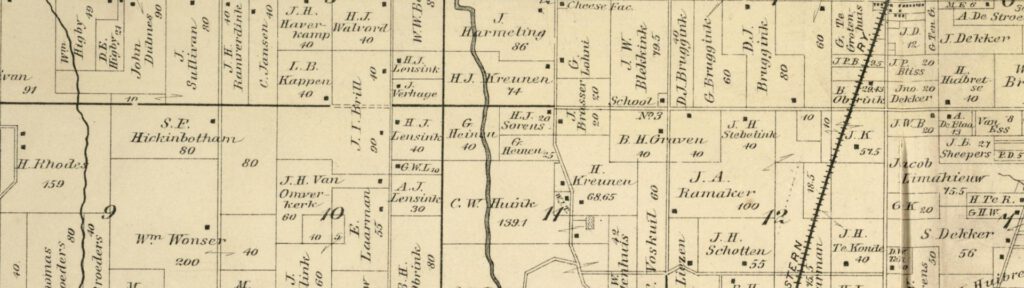
Gradus owned land in the 11th section of Holland Township, Sheboygan County — an estimated 50–60 acres, bisected by the Onion River. This land and the buildings on it passed on to subsequent generations of the Heinen family. A house on this land, which may have been built by Gradus himself, was still along Highway 32 in 2021, although it was clearly in need of a facelift.
Death and cemetery
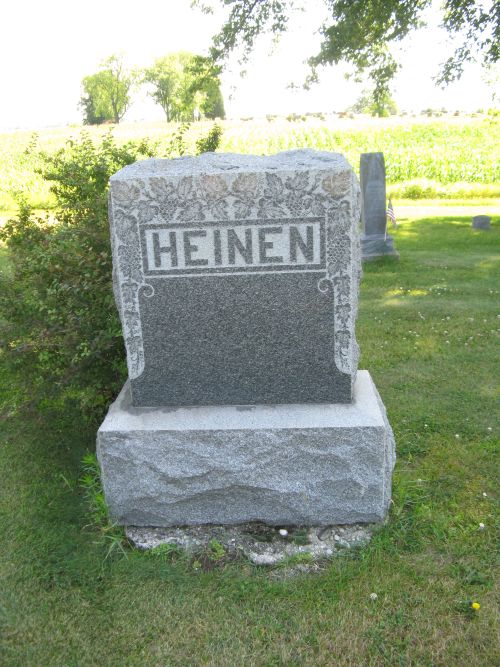
Willemina died on 12 March 1879 and Gradus on 24 October 1908. Both died in Holland Township and were buried at Union Cemetery in Oostburg, Sheboygan.
After Gradus’ death, the local newspaper reported:
G.J. Heinen, who lived with his son Gerret Heinen, died last Saturday morning, after suffering a stroke a few weeks ago. The deceased was a Civil War veteran. He left behind two children, Gerret and Mrs. A. te Stroete, several grandchildren and four great-grandchildren. The funeral took place on Monday from the Reformed Church. Reverend Beckering led the service.”