

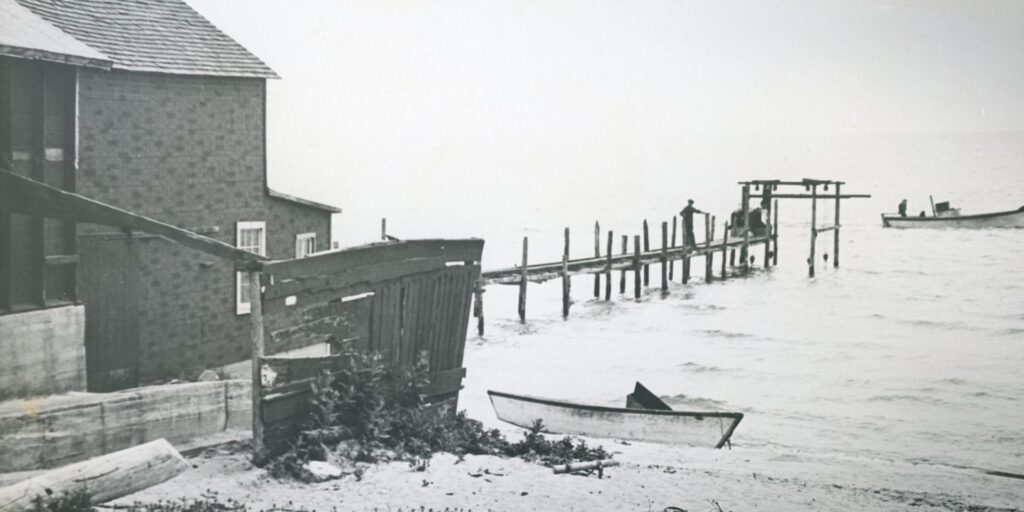
Fishing pier near Amsterdam, Sheboygan, circa 1930 (Photo Sheboygan County Historical Research Center)
The Amsterdam pier in Sheboygan County, Wisconsin, was built around 1851 and was once an important transshipment point for lumber, agricultural products, and fish. With a length of about 300 meters, it provided access to the deep water of Lake Michigan. A lively community of Dutch immigrants, fishermen and traders arose around the pier. After the arrival of the railway in 1872, the pier fell into disrepair. Nowadays only a park remains on the water.
The construction of the pier
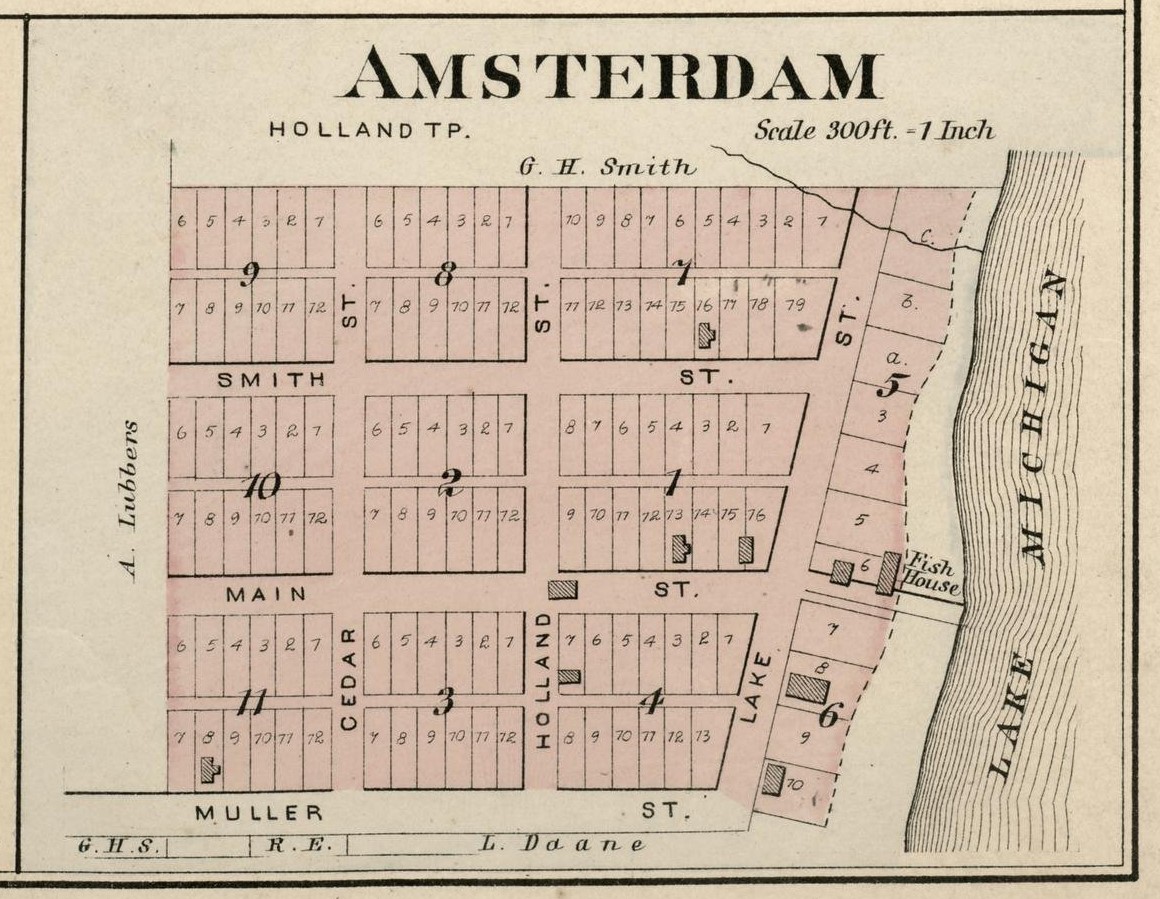
Who exactly built the pier of Amsterdam in 1851 is uncertain; some sources mention the Walvoords, others Gilbert Smith. The pier extended 300 meters into Lake Michigan from what is now called Amsterdam Road, and at the end had a depth of more than 6.5 meters — enough for the ships of the time. Initially, the pier was used for the export of wood, but soon also for agricultural products and fish. The village had many fishermen who derived their livelihood from the lake.
Dutch immigrant Hendrik Walvoord, one of the company’s administrators, and his son Garrit Jan Walvoord came to the area in 1849 with other family members. The Walvoord family opened a grocery store, where they offered food and general merchandise in exchange for local products such as firewood, barrel wood and fish.
Tragedy and setbacks
On July 11, 1856, a tragedy occurred. According to various sources, Garrit Jan Walvoord was either on his way to a dredger that had been hired to deepen the pier that morning, or he was measuring firewood. During this work, he fell off the pier, possibly because the wood started to move while he was scrambling over it. He was buried under water when some tree trunks fell on top of him and died. His wife Anna Maria Engel Nolton and his father continued the shop for a while.
But fate was not long in coming: in January 1857, the Walvoord shop was completely destroyed by fire and was not rebuilt. At the beginning of June 1858, the steam sawmill of Thompson, Tinsler and Watser also went up in flames.
Growth and decline
Despite these setbacks, Amsterdam seems to have flourished for decades. At its peak, there were at least two shops, a blacksmith, an inn, a cooperage and a school. In 1872, everything changed: the Milwaukee, Lake Shore & Western Railway was built, but it ran inland via Cedar Grove. As a result, Amsterdam lost its transport function. Due to the disappearance of the wood supplies and the arrival of the railway, many residents moved to Cedar Grove. Some stayed, especially the fishermen.
In addition to the Smith family, other families also started fishing businesses. Names associated with this activity include: De Witt, De Zoute, Grotenhuis, Huibregtse, Ingelse, Kobes, Kolste, Moennig, Nath, Roerdink, Smies, Stokdijk, Van der Jagt, Van Drieste, Weiskamp, Westerbeke and Zuurmond.
Rescue on the water
On March 18, 1906, Captain Delos Smith and his crew rescued more than 60 people from the burning steamer Atlanta on the fishing boat Tessler. They managed to pull the ship ashore just north of Amsterdam. Only sailor Michael Hickey did not survive: he jumped between the two ships and drowned.
The demise of the fishing industry
As timber stocks dwindled, fishing became the most important economic activity. In the beginning, fishing was done close to the coast with sailing boats and trawls. Later, they switched to pound-nets in deeper water, first with steam and later with gasoline engines. White fish and sturgeon were initially abundant, but later mainly herring, smelt and trout were caught. However, fish stocks declined sharply after the arrival of the sea lamprey in the 1930s. As a result, the once flourishing fishery slowly collapsed.
The Amsterdam of today
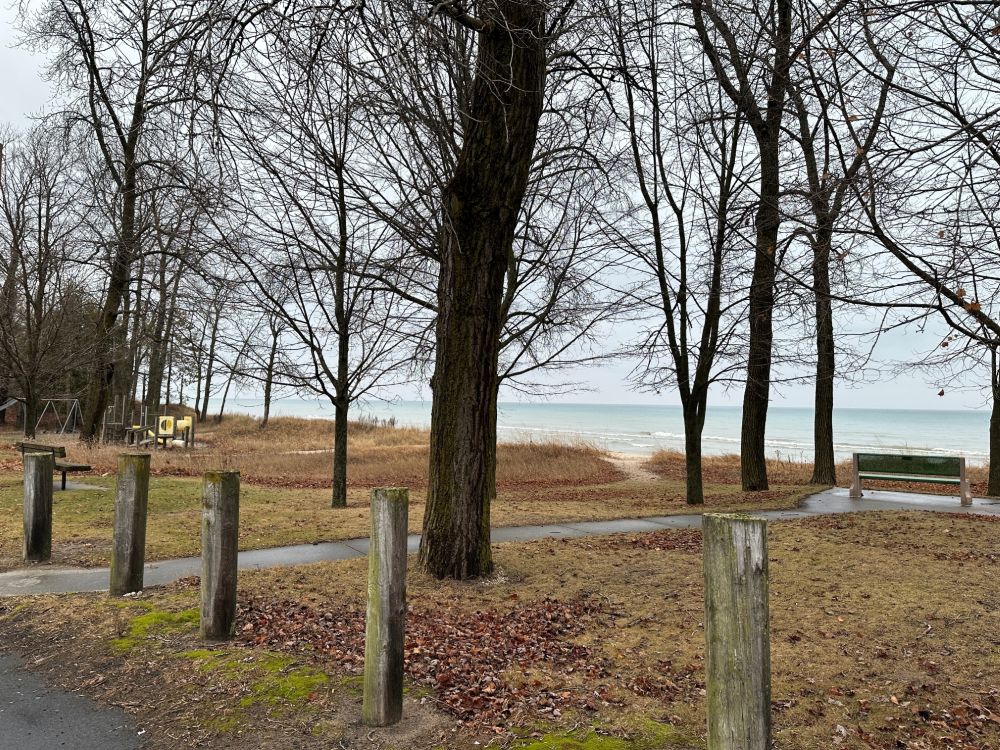
Little is left of the former village of Amsterdam today. The former site now houses a small park with a playground, picnic area and a boat ramp. What was once a bustling trading and fishing village is now a silent reminder of Wisconsin’s Dutch pioneering history.