

Daily newspaper Tubantia, 23 May 1953
“I will be very pleased if you try to speak to me in Dutch,” Wilhelmina te Slaa from Lyndhurst – a city in the United States – said to us four years ago when we were talking to her in the living room of the Somsen family, Hogestraat Aalten. That was Friday, August 5, 1949. A few days earlier, Ms. Wilhelmina te Slaa arrived in the Netherlands and because it was precisely in the period in which the question of Indonesia was in the center of attention in the Netherlands, but also abroad, we wanted to receive from Ms. in Slaa we would like to know what people in America thought about the Netherlands and the relations with Indonesia.
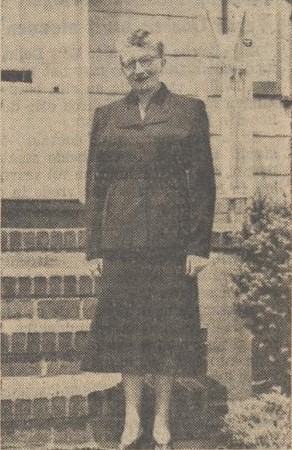
What Ms. te Slaa at the time, is irrelevant here. We have almost forgotten about it and the image of Miss te Slaa has also faded in our minds. Only occasionally, when we leaf through our photo album, did we suddenly remember this hefty lady with dark glasses, sparkling eyes, this lady who could talk so pleasantly and could speak English and Dutch so nicely.
Major relief operation for disaster area
In 1911 Wilhelmina te Slaa, together with her parents and her sisters Grada, Hanna, Betje and Drika and her brother Dirk went to America. In 1949 she was in the Netherlands for a few weeks and then she went back to her school in Lyndhurst, where she teaches American youth.
However, that she has not forgotten the Netherlands is proven by several important events in her life and that has also recently become apparent. Miss Wilhelmina te Slaa has, immediately after the news of the disaster that has struck the Netherlands on February 1, organized a relief action for the affected in the Netherlands. In the Washington School at Lyndhurst she gave a speech to the youth. She told of the suffering that has affected many in the Netherlands and she gave an enthusiastic speech about the small country by the sea, her native country.
“We have to bring clothes together for the people in the Netherlands,” said Ms. in Slaa and she didn’t have to say that twice. All students of the school were in favor of the plan and they went to work. A collection of clothes began in Lyndhurst. Miss te Slaa personally took the lead. Anyone who wanted to miss clothes could give it to one of the pupils, and there were many in Lyndhurst who responded to the call of Miss Slaa. “Operation Holland” called Ms. in Slaa the action. The local press in Lyndhurst cooperated every possible way to stimulate “Operation Holland” and even went so far in its zeal that it wrote that the popular miss in Slaa had been born in the region that had been flooded by the disaster… The latter was a bit exaggerated, because Aalten is still high and dry on the quietly rippling Slinge.
Crates full of goods to the Netherlands
The result of the action was that one crate after another could be packed with goods. This work was done by the pupils of Miss te Slaa in one of the annexes of the Washington School and when all the crates were packed – Yes, to whom was it to be sent then? Miss te Slaa didn’t know. She still knows a lot about the conditions in the Netherlands, but after all, it has been 42 years since she left the Netherlands as a girl of barely eleven years old. However, Miss te Slaa knew that the flooded areas were in the vicinity of Rotterdam and therefore she sent the coffins to the deaconies of various denominations in the Maasstad.
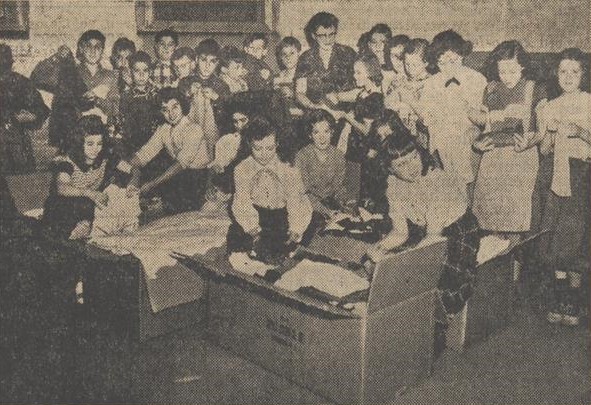
Miss te Slaa has shown that, although she is American in her entire life, she has always kept a great place for the Netherlands in her heart. It is not the first time in the past forty-two years that Miss te Slaa has organized an aid campaign for the Netherlands. She also knows how to get things done and in that respect she shows that she has as much entrepreneurial spirit as her father, Berend te Slaa, the carpenter from Hoogestraat from Aalten who in 1911 became the topic of conversation in many families in Aalten because he had taken it into his head to go to the United States with his wife and offspring.
“I didn’t like that at all at the time,” Miss te Slaa told us four years ago and neither did my brother and sisters. “I had just completed six classes of primary school in the Netherlands and in America, because I didn’t know a word of English – except for yes and no – I had to start again in the first grade. However, after two years I had gone through the entire school and I spoke English like the best. I trained as a teacher, graduated and worked successively in different schools. I like it quite a bit. In my spare time, I go to a university, because I want to try to get a doctorate.”
As said, miss te Slaa has a warm heart for the Netherlands. This became apparent on 10 May 1940, the day on which the Netherlands was overwhelmed by the Germans. No sooner had Miss te Slaa in the U.S. heard the news of the raid on the radio than she called the Dutch embassy. “The Netherlands has been raided,” she said to the ambassador, “what do you have to do for me?”
Organizing on a large scale
“You are the first to call about this,” the ambassador replied. Miss te Slaa did not wait long for an organized relief campaign. She immediately began to organize. Friends and acquaintances were made enthusiastic about her plan and started under her leadership with the manufacture of garments for the merchant navy. Miss te Slaa constantly expanded the campaign. More and more women’s clubs and organizations from all over America were called in, so that the relief effort took on a tremendous size. The merchant navy did not need everything that was made for a long time. However, Miss te Slaa did not slow down the enthusiasm, she rather encouraged it. And so it was possible that, shortly after the liberation of the Netherlands, crates full of garments could be sent to the Netherlands, which were gratefully accepted here.
The work of Miss te Slaa not only attracted the attention of numerous women’s organizations in the U.S., the Dutch government also knew about her work and it was a great satisfaction for “this Dutch American” when H.M. Queen Wilhelmina sent her the “Badge for Social Work” from London. However, it did not stop with this badge. During the war years, Princess Juliana came to speak personally with Miss te Slaa about her work. This meeting took place in New York. Afterwards, Miss te Slaa also had a meeting with Queen Wilhelmina, during which the relief work and its organization were discussed. Miss te Slaa is entirely the type of an American woman; a woman who goes through life purposefully, but after having lived in America for 42 years, her heart beats as strongly for the Netherlands as it used to, when Willemientje te Slaa sang at a school in Aalten: “Do you know the land, the sea snatched…”
Wilhelmina te Slaa was born on November 12, 1899 at the Hogestraat 24 in Aalten, daughter of carpenter Berend te Slaa and Berendina Gezina Somsen. On November 24, 1911, the Te Slaa family left Aalten and emigrated to the United States.
Wilhelmina te Slaa died on September 25, 1981 in Ridgewood, New Jersey. The local newspaper wrote after her death:
MIDLAND PARK – Wilhelmina te Slaa, 81, died Friday at the Valley Hospital, Ridgewood. Born in the Netherlands, she came to the United States at age 11, living for many years in Prospect Park before moving to Midland Park five years ago. She was a retired teacher of the Eastern Christian system for 23 years. She was a member of the Midland Park Christian Reformed Church and was a graduate of Calvin College, Michigan, and had attended Columbia and Rutgers universities. She also taught the blind at the North Jersey Training School, Totowa. She is survived by several nieces and nephews. Arrangements are by J.H. Olthuis Funeral Home, 159 Godwin Ave. John Goodrich Sr.