

In 1811, the Civil Registry was introduced in the Netherlands. Before that, important life events were recorded by church authorities in baptism, marriage and burial books (DTB books). In Aalten and Bredevoort, these registers were mainly kept by the Dutch Reformed Church (later the Dutch Reformed Church). In addition, Catholic baptismal records are available of the Cross Chapel in Hemden from 1706 onwards. These DTB registers are an indispensable source for genealogical research in the period before 1811.
Unfortunately, DTB books are not always complete; Some books have been lost and the registration was not equally systematic everywhere. Moreover, in different places, these registers were started at different times.
Available DTB books
- Aalten (NDG): Baptism and marriage from 1665, death/burial from 1762.
- Bredevoort (NDG): Baptisms and marriages from 1638/1639.
- Shirts (RK): Baptisms from 1706 onwards.
Baptismal books
Contain the name of the person baptized, date of baptism and often the names of the parents and sometimes the witnesses. In older books, the name of the mother is often not mentioned. The date of baptism is not the same as the date of birth. Children were baptized as soon as possible after birth, often on the following Sunday. From 1772 onwards, the date of birth is also mentioned in Aalten.
Wedding books
Contain the names of the bride and groom, wedding date and sometimes additional details such as names of parents, witnesses and in case of remarriage the previous husband(s). Sometimes the date of the marriage announcement was noted instead of the actual wedding date.
Burial books
Contain, in addition to the burial date, the name of the deceased or only the relationship to the head of the family or farm, for example ‘Hendrik te Slaa zijn vrou’, ‘de vrou aan de Smoege’ or ‘een kint van Derk Neerhof’. In the burial book of Aalten for the period 1762-1811 the date of death is also noted, but this is not the case in all burial books.
Symbols
On Oud Aalten, symbols are sometimes used to indicate important facts of life. Here is an overview of these symbols and their meanings:
| * ~ ⚭ ✝︎ ± < > | Birth Baptism Marriage Death About (approximately) Before (date) After (date) |
DTB Book Transcriptions
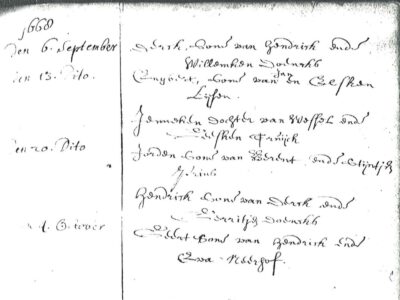
Various transcriptions of DTB registries are available for researchers, which facilitate the research. Transcriptions of DTB books in the Achterhoek are available on Genealogiedomein.nl.
Direct links:
Tips for searching DTB registries
- WhoWasWho: DTB data can also be found on WieWasWie.nl (events, names and dates). This can greatly facilitate the search, but also refer to the accompanying transcript for more information and context. WhoWasWho also offers links to the scan of the original register, on the website of the Gelderland Archives. Although this is very interesting to watch, the original handwritten texts are often difficult to read.
- Variable spelling: Names were not always written consistently. Try variations in your search.
- Surname changes: Before 1811, surnames of people were not always fixed. Especially in the countryside, it was not unusual for someone’s surname to change when moving to another farm.
- Check dates carefully: The date of baptism is usually not the date of birth and the burial date is not the date of death.
Additional resources
In addition to DTB registers, other archives can provide useful information, such as member registers, tax registers, notarial deeds, military and judicial archives. The Achterhoek and Liemers Heritage Centre (ECAL), the Gelderland Archives and the website Genealogiedomein.nl are valuable sources for such research.
Sources
- MEB – Centre for Family History (Basic Knowledge DTB)
- Heritage Centre Achterhoek and Liemers
- Gelderland Archives
- Genealogiedomein.nl
- WieWasWie.nl