De Graafschapper, 29 April 1948
The Exodus of Dutch emigrants to Canada does not seem to be coming to an end for the time being. All these people are here squeezed out of their narrow boundaries and swallowed up by the great country on the other side of the ocean, with its enormous surface area, for whom this population growth is no more than a drop in a bucket.
It is a strong belief in a good future and an indestructible enthusiasm for Canada with its enormous opportunities that stimulates the departure of these Dutch farmers. But it is also the spirit of their forefathers, the pioneers of the East and the West, that lives on in these tough workers of polder land and field and in which the true tractor’s blood of the Dutchman does not deny itself.
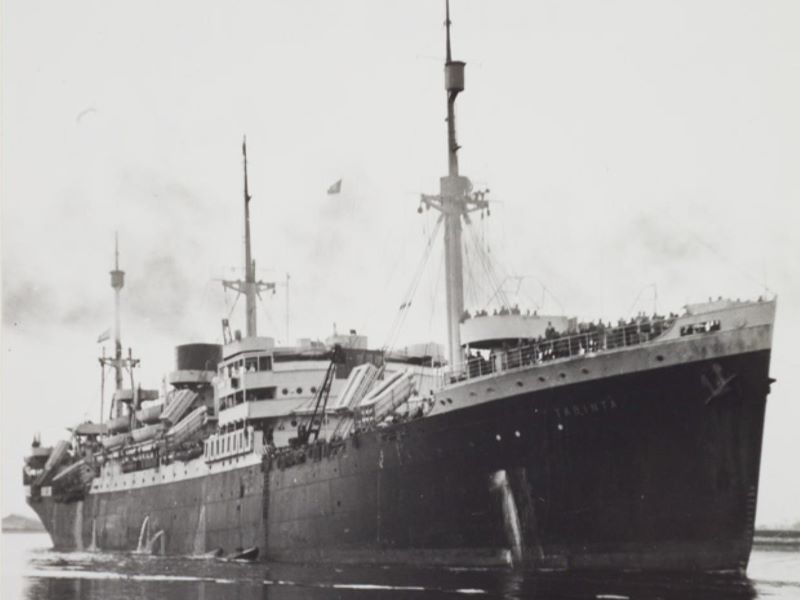
Saying goodbye
Every time a ship with emigrants leaves and we witness this departure, we are reminded of the well-known saying: “To say goodbye is to die a little.” Because for most of these emigrants, this departure means a forever farewell to the country where they once stood. And since it is not the worst part of our people that emirates, the departure is felt as a loss.
A lot of heart-touching scenes often take place here. Weeping mothers who can only tear themselves away from their sons with difficulty when they have to embark, but also fathers who say goodbye to their children with tears in their eyes, while the other family members usually have difficulty controlling themselves. This is not an exaggerated sentimentality. Rather, it is a demonstration of affection that leaves nothing to be desired in terms of authenticity.
This time it is the “Tabinta” of the Mij. The Netherlands, which will bring a large contingent of emigrants to Canada. It is the second departure in a month to Canada, proof that progress is starting to be made in the implementation of the emigration plans. This year they hope to bring 10,000 people to Canada with the “Kota Inten” and the “Tabinta” and next year they even want to double this number.
Today is a particularly beautiful day for sailing. The emigrants have come to Rotterdam from all parts of the country and the Achterhoek is also represented.
People
Hendrik Winkelhorst from Aalten wants to take the big step and look for a livelihood in Canada. His wife Grada goes with him, of course, as do the three children: Willemien, Arie and Wim. Their destination is Ontario and they arrive at a mixed farm of 50 hectares. Hendrik has abandoned his brother, where he has been working as a driver lately, and he hopes to exchange his car for a tractor there. Here in Holland it became too scary for him. Too much bureaucracy. Things will get better in Canada, he believes. He will write to his family members when things are going well for him, but also when things are going badly for him. However, he is in good spirits. What others succeed in, he will also succeed.
The 22-year-old Albert te Winkel from Barlo meets us with a cheerful smile. He is not the least impressed by this departure. The Oosterink farm in Barlo will now have to do without him. He worked there for no less than 41/2 years. So he knows how to get things done, by the way he is one of ten at home and then you learn that early on, he says. He does not yet know at which farmer he will be put to work there. He does know the destination and that is West Meath, in Ontario. He also tells us that he will look for a wife in Canada. He thinks there are enough of them there. We wish him every success with this.
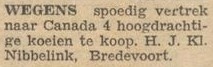
Blacksmith Klein Nibbelink from Bredevoort abandoned his forge today – to escort his son Hendrik out. Hendrik is already on the ship, but his father tells us that Hendrik is 24 years old and had his own company in Bredevoort. Henry saw little future here, but hopes to find it in Duchess in Alberta. Hendrik is not married yet, so he only has to take care of himself. Father Nibbelink believes that he will succeed.
Jan Hendrik Geurkink of the Krosenbrink in Miste, is the Benjamin of the Achterhoekers. He is only 18 years old, has worked at home on the farm and attended agricultural school. It is getting too stuffy for him here and although he is still very young, he wants to try it in Canada. His sister is not so sure that this will work, but in this case he can always come back, she says. Moreover, Jan Geurkink comes to the same farm as Hendrik Klein Nibbelink. There is plenty of work for both of them, because it is a mixed farm of 285 hectares.
There is also a person in hiding from Aalten on the boat. It is Maarten Schinkelshoek from Rotterdam, who had been in hiding in Aalten for a long time on the farm of the Wed. Luiten, “‘t Olde Mulder“. He learned a lot there and wants to put that into practice in Canada. He has already made friends with the other boys from Aalten. The three of them get along quite well.
Farewell!!
Around 5 o’clock the “Tabinta” blows its steam whistle for the third time. This is the signal to leave. When the ship detaches itself from the quay, the Wilhelmus is played. As always, a solemn and moving moment, which the emigrants will not easily forget. Slowly the distance between the ship and the people left behind increases, until it disappears from sight forever. There they go, into the distances unknown to them. Our best wishes accompany them in this.
Our region has once again paid its toll on emigration. Several other Achterhoekers left for Canada with the Tabinta, but it was not possible for us to have a personal interview with all of them, nor did we have the names of all the Achterhoek emigrants at our disposal.
Do you have interesting stories about family members who emigrated from Aalten to Canada? Send us a message!